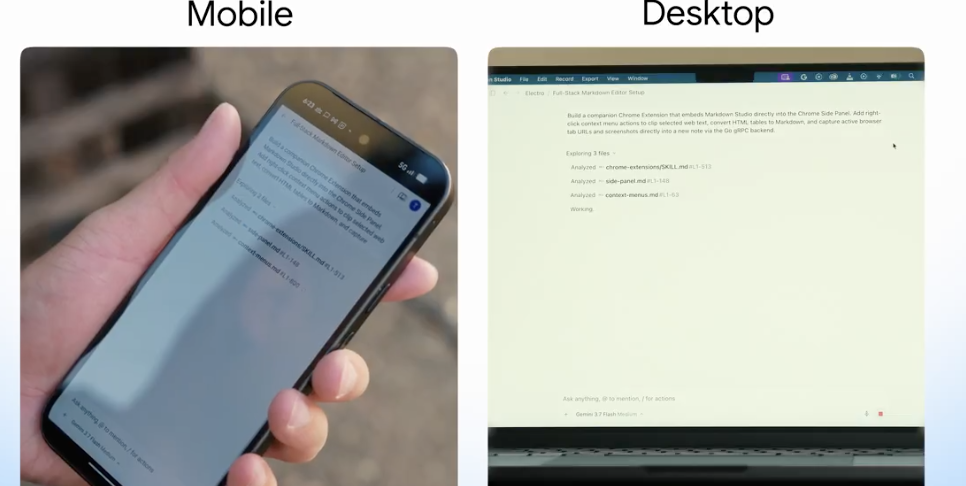
On August 21, Google launched the Remote Control feature for Antigravity . Users can now access running AI programming sessions via modern browsers as well as iOS and Android mobile devices. This feature has begun rolling out in batches, giving Google AI Ultra users priority access.
AI programming sessions are starting to drift away from the computer
Remote Control is not simply a remote desktop. According to official documentation, users can view active conversations, initiate new Agent tasks, review implementation plans, check generated results, and continue giving instructions when the agent requires human intervention.
This addresses the increasingly practical problem of Agent programming: a major refactor, test, or dependency migration can take a long time, so developers don't have to stay at their workstations all the time. The phone is more like a portable controller, while the computer continues to handle the local development environment and task execution.
The phone becomes the AI Agent console
The most valuable mobile scenario is not "writing code on the phone," but handling key nodes in the agent workflow. When a task is completed or input is needed, the mobile device can receive a notification, allowing developers to confirm, add requests, or proceed to the next task.
This design also reflects that AI programming products are changing the logic of interaction. In the past, the core of IDEs was the editor, which developers had to operate continuously; After entering Agent mode, people are more responsible for setting goals, checking plans, authorizing operations, and accepting results.
Remote Control competes for developer time
Previously, various Antigravity mobile control solutions had emerged in the community, indicating that remote management of AI Agents is not a need for the edge. As single task times lengthen, tools like Claude Code, Codex, and Gemini CLI face similar challenges: Agents can work on their own, but at critical moments, human decisions are still needed.
After Antigravity made Remote Control an official capability, the focus of competition shifted from "who can generate more code" to "who can make the agent run autonomously for longer." In the future, AI IDEs may no longer be limited to desktops; browsers and mobile phones will gradually become agent orchestration and approval terminals.
For AI programming tools, what truly changes on mobile is not the coding location, but the online way developers and agents interact. When Agents can execute continuously and humans only intervene at critical moments, "sitting in front of the computer programming" is turning into "managing a group of AI Agents working at any time."