caagent open source: Use YAML to orchestrate multiple agents with one click, MCP tools and Docker workflows plug and play
This AI tool takes intelligence and automation in its simplest form: a single YAML can define multi-agent collaboration, model routing, and tool permissions. The cagent natively supports OpenAI, Anthropic, Gemini, and DMR, and uses MCP to connect tools and use Docker for push and pull, which is suitable for orchestrating ChatGPT and Claude into enterprise-level large model pipelines.
1. What problems does it solve?
1. Turn Agent into configuration instead of code
AI, ChatGPT, Claude and Gemini's characters, memories, tools, and hyperparameters are all written into YAML, allowing developers to get auditable, reusable automated workflows without having to pile scripts.
2. Multi-agent collaboration and free model switching
Artificial intelligence multi-agent can divide labor for dialogue, retrieval and execution; Switch between OpenAI, Anthropic, Gemini, and DMR according to tasks, take into account quality and cost, and build a robust large model orchestration.
(1) The "last mile" of tools and delivery
rely on MCP to mount tools such as retrieval, database, browsing, and functions; Docker is used to push and pull images, making it easier to implement CI/CD and grayscale releases.
2. How to get started
quickly 1. Three-step closed-loop
AI tools are intuitive to use:
a. Write a YAML definition agent and tool
b. Run the validation and log observation locally
c. Push to the environment through Docker and pull the deployment
2. Typical workflow template
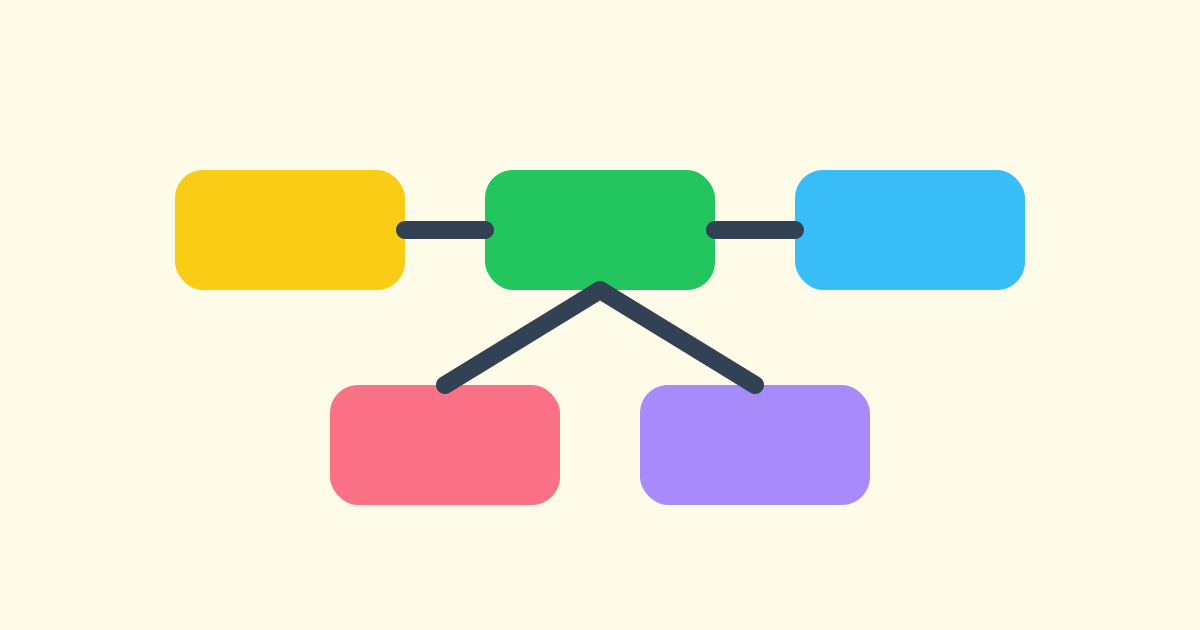
ChatGPT is responsible for planning tasks and decomposition steps, Claude is responsible for security and style review, Gemini or DMR performs high-throughput calls, and cagent unified orchestration and retry falloff to achieve end-to-end intelligence.
(1) Practical points
(1) Add system prompts and glossaries to key agents
(2) Set whitelists and timeouts for tools
(3) Enable distributed queues and concurrency limits
3. Applicable scenarios and comparisons
1. Suitable services
Multiple rounds of customer service, content production, data pipelines, automated operation and maintenance, research assistants, etc., can assemble large models and MCP tools into observable assembly lines.
2. Difference from code-based frameworks
YAML-first caagents focus on configuration governance and auditability; Code frameworks focus on flexibility. The two can complement each other, first use caagent orchestration, and then use SDK for in-depth customization.
4. Project address
https://github.com/docker/cagent
frequently asked questions (Q&A)
Q: How to choose OpenAI in YAML? , Anthropic, Gemini or DMR?
A: Write the provider and model name in the model segment, and switch according to the task according to the routing policy. ChatGPT and Claude can take on the role of planning and review, respectively.
Q: How do I connect the MCP tool to the cagent?
A: In YAML declares MCP endpoints and permission scopes, the agent automatically discovers the tool and injects it into the agent, which can be used to automate retrieval, database, and function execution.
Q: What are the benefits of Docker push and pull?
A: Package the configurations and dependencies of AI, ChatGPT, and Claude collaboration into an image, and push it to the repository to pull and reuse it in various environments, which is convenient for grayscale and rollback.
Q: What are the advantages compared to writing Python orchestration directly?
A: Configuration is a document, and changes can be audited; multi-model switching and fallback standardization; It is more conducive to collaboration and reuse for AI tools and large model teams.