1. Abstract
MiniMax M2.1 is an open source rights model released by MiniMax, focusing on the "real software development + agent" scenario, focusing on strengthening coding robustness, tool calling, instruction compliance, and long-link planning, and providing local deployment and tool call guidelines. Model weights are publicly available on Hugging Face under the Modified-MIT license.
2. Core features
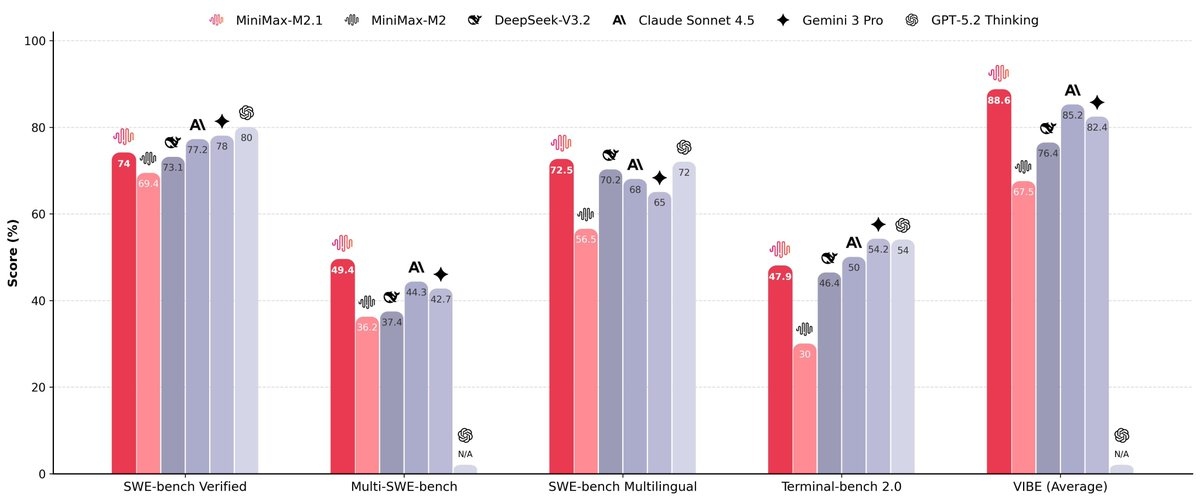
- Evaluation orientation for real development: Official results such as SWE-bench Verified 74.0, Multi-SWE-bench 49.4, SWE-bench Multilingual 72.5, and VIBE average of 88.6 are used to describe multi-file engineering repair and "zero-to-one" application development capabilities.
- Usability designed for Agents: Provides OpenAI-compatible service forms (such as vLLM serve) and comes with a Tool Calling Guide to facilitate access to browser/terminal/retrieval tool chains.
- Multilingual and application development coverage: Emphasize multilingual scenarios such as Rust/Java/Go/C++/Kotlin/Objective-C/TypeScript/JavaScript, as well as the execution capabilities of Web/Android/iOS and office workflows.
3. Installation
- Environment and resources: The official deployment documents are mainly Linux, Python 3.9–3.12; Model weights are large, and on-premises deployments usually require multi-card high video memory (the documentation example mentions that about 220GB of memory/video memory equivalent resources are required for weights alone, and long contexts can significantly increase memory overhead).
2. vLLM (recommended service): Install the nightly version of vLLM according to the official vLLM deployment guide and start it with vllm serve MiniMaxAI/MiniMax-M2.1 --trust-remote-code. If you need automatic tool selection and analysis, add the corresponding parameters according to the document.
3. Transformers (easy to integrate scripts): Fix the version according to the official Transformers deployment guide (example Transformers 4.57.1) and enable trust_remote_code=True for loading and dialog template calls.
4. Typical use cases
- Code agent: warehouse-level problem location, multi-file modification, running testing and repair closed-loop (CI/terminal driver).
- Multilingual migration and refactoring: cross-language module transformation, interface alignment, performance and maintainability optimization suggestions.
- Full-stack/mobile prototype: Web/App generation and iteration from requirements to running demos (emphasis on executability and interactive effects).
- Office automation: Combine "rule/constraint documents + tool calls" to complete multi-step table, document, and information retrieval and organization tasks.
5. Ecology and competing products
- Ecosystem: MiniMax Agent and Open Platform API are provided at the same time. On the open source side, there is a Mini-Agent sample project, and the VIBE benchmark is also published in the form of a dataset, which is easy to reproduce experiments or regression tests.
- Competing products: Claude Sonnet/Opus, Gemini, DeepSeek, Kimi, etc. have their own strengths in different lists; MiniMax M2.1 is positioned more "self-hosted + agent toolchain + multilingual development", and the results under the same scaffolding/same budget/same context settings should prevail when comparing.
6. Limitations and precautions
- High threshold for on-premises deployment: The weight and contextual cost determine that "local" is closer to its own server/multi-card workstation than an ordinary single-card notebook.
2. trust_remote_code needs to be enabled: It is recommended to audit the repository code and dependent versions before deployment to ensure compliance and security.
- The running score is not equal to production: the evaluation is greatly affected by scaffolding, prompts, tool descriptions and superparameters, and targeted regression sets and safety assessments should be done before going online.
- Licensing and compliance: The original terms and distribution requirements of Modified-MIT shall prevail, with special attention to the declaration obligations of redistribution and derivative models.
7. Project address
https://huggingface.co/MiniMaxAI/MiniMax-M2.1
8. Frequently asked questions
Q: Is MiniMax M2.1 "open source weighted" and can it be commercially available?
A: The official weights are released on Hugging Face and marked with Modified-MIT; Whether it is commercially available and what notices need to be retained are subject to the original license.
Q: What is the minimum hardware required for MiniMax M2.1 on-premises deployment?
A: The official deployment document gives a reference to multi-card high video memory (only weights about 220GB, and long contexts will increase overhead); It actually depends on the parallel strategy, precision/quantization, and target context length.
Q: How does MiniMax M2.1 run "Tool Calling" with vLLM?
A: Refer to the vLLM Deployment Guide and Tool Calling Guide, enable automatic tool selection and corresponding parsers in the startup parameters, and organize the tool schema and message format according to the documentation.
Q: What are the official recommended inference parameters for MiniMax M2.1?
A: The document gives common suggestions: temperature=1.0, top_p=0.95, top_k=40; you should still do grid adjustment parameters according to the task (repair/build/plan).
Q: What teams is MiniMax M2.1 suitable for priority trial?
A: Teams that need self-hosted control, are multilingual codebases, and want to turn "coding + toolchain + long tasks" into a reusable agent pipeline are more likely to reap the benefits.