
1. Abstract
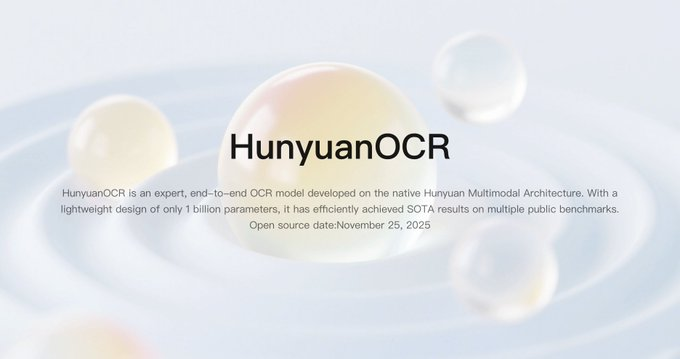
HunyuanOCR is an end-to-end OCR expert model open-sourced by Tencent's Hunyuan team, based on Hunyuan's native multimodal architecture and training strategy, and achieves leading performance in OCRBench (<3B scale) and OmniDocBench with only about 1 billion parameters. The model covers complete links such as text detection, recognition, layout understanding and translation, taking into account accuracy and inference costs, and is suitable for large-scale implementation in actual business.
2. Core Features
1. Lightweight but high-precision: about 1B parameters, with a score of 860 in OCRBench and 94.1 in OmniDocBench, while significantly reducing deployment costs.
2. Multi-scene text capability: Support text detection and recognition such as street view, handwriting, and wordArt, taking into account natural scenes and regular documents.
3. Complex document parsing: It can output structured results such as tables and formulas (such as HTML/LaTeX), which is suitable for complex layouts such as bills and reports.
4. Video and subtitle processing: Support video subtitle extraction, which is convenient for content retrieval, secondary creation and cross-platform distribution.
5. End-to-end photo translation: Support about 14 languages, and one instruction and one inference can complete the detection, recognition and translation link.
3. Installation
- Clone the repository from GitHub and install Python dependencies, you can create a virtual environment and run sample scripts based on the repository example.
- Download the HunyuanOCR weights and configuration files from Hugging Face and load the inference locally or on the server.
- Choose the deployment method according to the scenario: local GPU service, containerized service, or integration into the existing multimodal/agent system.
4. Typical use cases
1. Bill and certificate processing: Identify the text of bills and certificates and convert them into structured fields to facilitate business review and archiving.
2. Digitization of complex office documents: Parse reports, papers, tables and formulas, and output HTML/LaTeX for easy secondary editing.
3. Street view and store sign recognition: collect street view pictures, and identify and retrieve text such as store names, street signs, and notices.
4. Video subtitle extraction and translation: Extract subtitles from long videos in batches and perform multilingual translation to accelerate secondary creation.
5. Cross-border e-commerce/game localization: End-to-end photo translation of product images, game screenshots, etc.
5. Ecology and Competing Products
1. Ecological Location: HunyuanOCR is based on the Hunyuan multimodal system, which can be combined with other vision/multimodal models of Hunyuan for more complex document understanding and intelligent assistants.
2. Comparison with traditional OCR solutions: Compared with the "detection + recognition + layout analysis" cascade scheme, HunyuanOCR emphasizes end-to-end reasoning of a single model, reducing module stacking and engineering complexity.
3. Comparison with other open-source OCR tools: Traditional OCR tools have advantageous character recognition capabilities, but often require additional components for complex document structures, video subtitles, and integrated translation, while HunyuanOCR has advantages in single-model coverage and ease of use.
6. Limitations and precautions
- Although the number of parameters is relatively small, it still needs to have a certain amount of computing power when processing high-resolution, multi-page documents or batch videos.
- End-to-end design brings high integration, but some strong customization processes (such as specific typography rules) may require additional post-processing.
- Identification or translation errors may still occur in multilingual and complex scenarios, and it is recommended to add manual review in key business scenarios.
- The model is updated quickly, so you need to pay attention to the latest version, weight, and sample code changes of the repository before deployment.
7. Project Address
https://github.com/Tencent-Hunyuan/HunyuanOCR
8. FAQs
Q: Does HunyuanOCR support multilingual photo translation?
A: Yes. The official provides end-to-end photo translation capabilities, currently supporting about 14 languages, and can complete detection, recognition and translation in a single inference.
Q: What is the difference between HunyuanOCR and traditional cascading OCR solutions?
A: HunyuanOCR emphasizes the end-to-end paradigm of "single instruction + single inference", using a multimodal model to cover detection, recognition, structuring, and translation, which is easier to deploy and maintain than multi-model cascade solutions, but requires more task modeling within the model.
Q: What are the basic requirements for deploying HunyuanOCR on-premises?
A: GPU environments with modern deep learning frameworks are generally recommended, and small-scale inference can be completed on a single card; If you need to process long documents and video subtitles in batches, you can increase video memory and concurrency optimization according to the scale of your business.
Q: Which businesses are HunyuanOCR suitable for priority trying?
A: Priority is suitable for scenarios with complex text styles, diverse languages, and structured output or translation, such as document digitization, intelligent customer service knowledge storage, video content understanding, and cross-border scenarios.