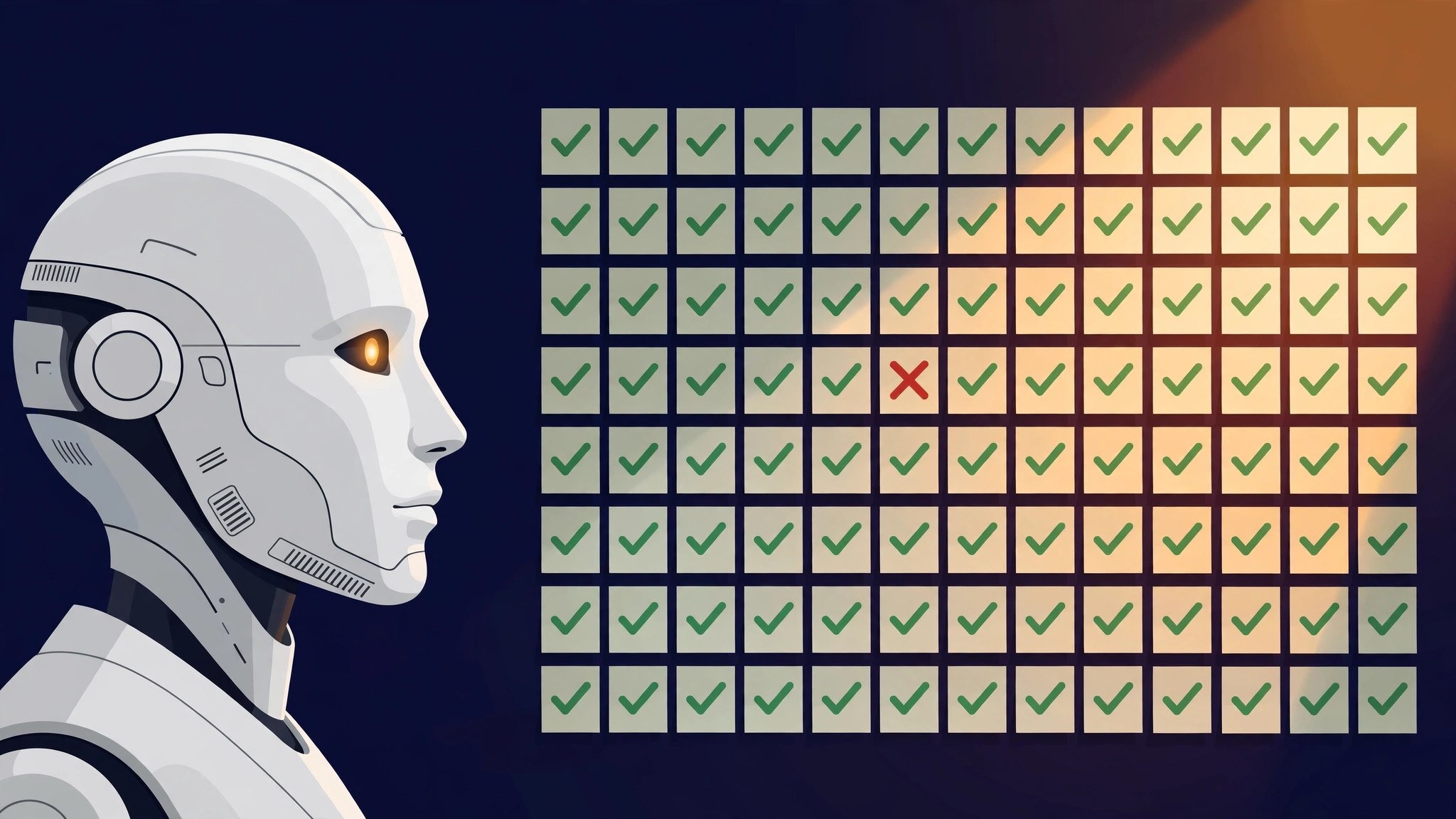
Humanity's First Exam (HFE) is a new benchmark Google DeepMind launched on November 24, 2026: instead of asking whether models can solve hard problems, it asks whether they can get simple questions right every single time. Its 544 elementary text and image prompts cover 20 foundational capabilities. Top models come close to a perfect score on a single attempt — but once they have to answer correctly again and again, the gaps open up immediately. That is what makes it worth watching: for the first time, the industry is scoring 'reliability' on its own.
Why a perfect score once still means failing repeatedly
HFE groups the 544 prompts into 136 families of four closely related variants, each sampled four times; a family only counts as passed when all 16 attempts are correct. Under this strictest measure in the technical report, OpenAI's GPT-6.2 Astra scores 92.4%, GPT-6.2 Sol 86.9%, and Google's own Gemini 4 Neon 85.8% — while on a single attempt, the top five models all land between 96% and 98%. The sharpest contrast comes from Anthropic's Claude Opus 5.5: 91.2% on a single try, but only 63.0% under the strict measure. The technical report also notes that about 73% of errors come from visual perception, including 31% from misjudging position, direction, or paths and 23% from miscounting objects.
Only 112 prompts in 28 families are public, under a CC-BY-4.0 license; the other 432 prompts in 108 families stay private to prevent benchmark gaming and overfitting. The leaderboard lives on Kaggle, where 16 models compete head to head. DeepMind has also opened a three-week question-writing competition, closing December 15, inviting the public to submit everyday questions that models still get wrong.
Can you pick a model straight from this leaderboard?
Not yet, at face value. HFE's questions were deliberately chosen to expose weak spots, so the scores measure 'how steady a model is where it is most likely to slip' — not how often it fails in everyday use. The grading also relies on Gemini's own models, and although a Claude-based audit found only about 3% of the marked-wrong answers plausibly defensible, the setup of writing the test and grading it in-house still deserves a note. Its real value is adding a new dimension to model selection: if you are putting a model into customer service, document review, or form-filling — workflows where a single mistake causes real trouble — a high single-attempt accuracy is not enough. Check how it holds up under repeated testing like HFE first. ShellBench, launched around the same day, November 24, tests whether agents can finish everyday tasks; HFE tests something more fundamental.
Three things to watch next: whether new models join the Kaggle leaderboard, how the question bank gets updated after the submission window closes on December 15, and whether vendors start optimizing specifically for HFE. If optimization only targets the 112 public prompts, the leaderboard will quickly lose its signal — the genuinely valuable signal sits in the 432 prompts that stay private.