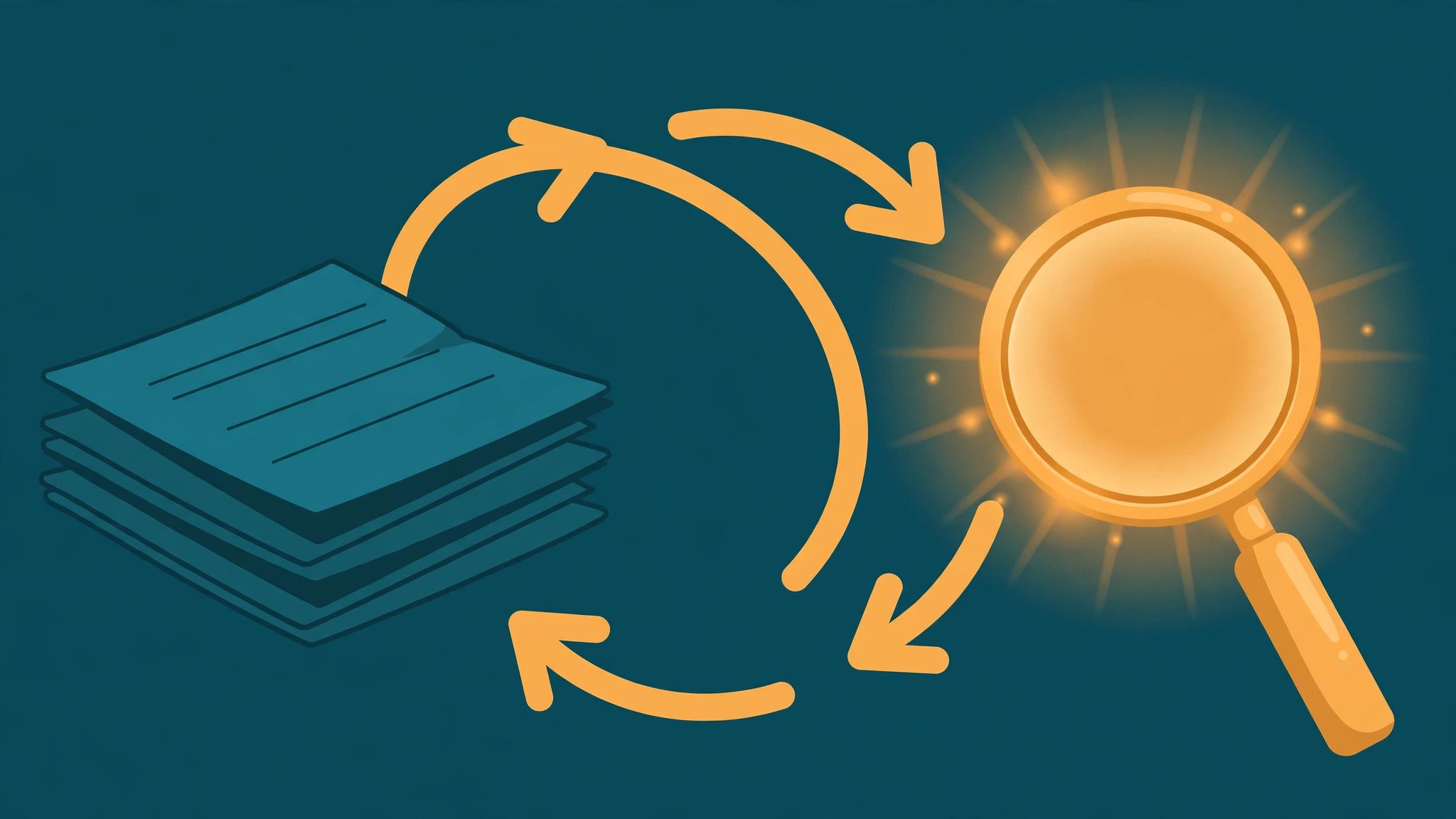
Agentic RAG is a retrieval-augmented generation architecture in which an AI agent controls the retrieval process itself. Traditional RAG is a fixed pipeline: a question comes in, the system retrieves once, and the model generates an answer from the results. Agentic RAG turns that straight line into a loop — the agent first breaks the question down, decides what to look up and where, checks whether the results are enough, and if not, rephrases the query and searches again until it has the evidence it needs. The difference is not a stronger model; it is that retrieval changes from a hard-coded step into a step that makes decisions.
Why Traditional RAG Fails on Complex Questions
Traditional RAG gets only one shot at retrieval. The question is turned into a vector, the most similar passages are fetched, and the model must answer from that material alone — if retrieval misses, there is no recovery. That is fine for simple questions such as "what is the refund period in this document?" But when an answer must be pieced together across documents — for example, confirming when a product first supported MCP and in which version it later changed its pricing — a single retrieval pass can almost never hit both facts at once, and the model is left to improvise. Traditional RAG also never judges the quality of its results: irrelevant passages get stuffed into the prompt as-is, and the answer comes out wrong with great confidence.
| Traditional RAG | Agentic RAG | |
|---|---|---|
| Retrieval passes | Fixed at one | As many as needed, in a loop |
| Who decides what to search | Fixed by developers | Decided by the agent at runtime |
| What if results are poor | No recovery | Rephrase and switch sources |
| Multi-step questions | Hard, needs manual splitting | Native support: split, then search |
| Cost | Cheap, low latency | More expensive, slower |
What the Agent Actually Does Extra in the Loop
The agentic loop usually has four moves. First, decompose the question: break a complex question into sub-questions that can each be answered on their own, retrieve for each, then combine the pieces. Second, pick the data source: factual questions go to the knowledge base, real-time ones to web search, numeric ones to a database — no longer every question through the same vector store. Third, self-check: judge whether the retrieved material can support an answer, and discard and re-search if it cannot. Fourth, retry with a rephrased query: when a search comes up empty, rewrite the query terms or swap in synonyms instead of asking the same question three times. None of these four moves needs a new model; what changes is the control flow: a retrieval process that used to be fixed at development time is now decided step by step by the model at runtime. To understand the idea, start with how a Transformer reads a whole paragraph — the attention mechanism is exactly the underlying ability an agent uses to judge where to look.
Three Common Misconceptions
The first misconception is equating it with a bigger vector store. No matter how large the store, retrieval is still one-shot; the point is that the retrieval process can correct itself. The second is that more loops are always better. Every loop is a model call, and ten rounds can cost several times more than one — production systems need a cap, such as three rounds at most. The third is that it fits every question. For single-fact lookups and standard customer-service answers, traditional RAG is faster and cheaper; bringing in Agentic RAG there is overkill. It earns its cost on research-style questions: piecing answers across documents, verifying numbers, searching before judging. The dividing line is simple: if you would need to search more than once to answer a question yourself, it is worth handing to Agentic RAG.