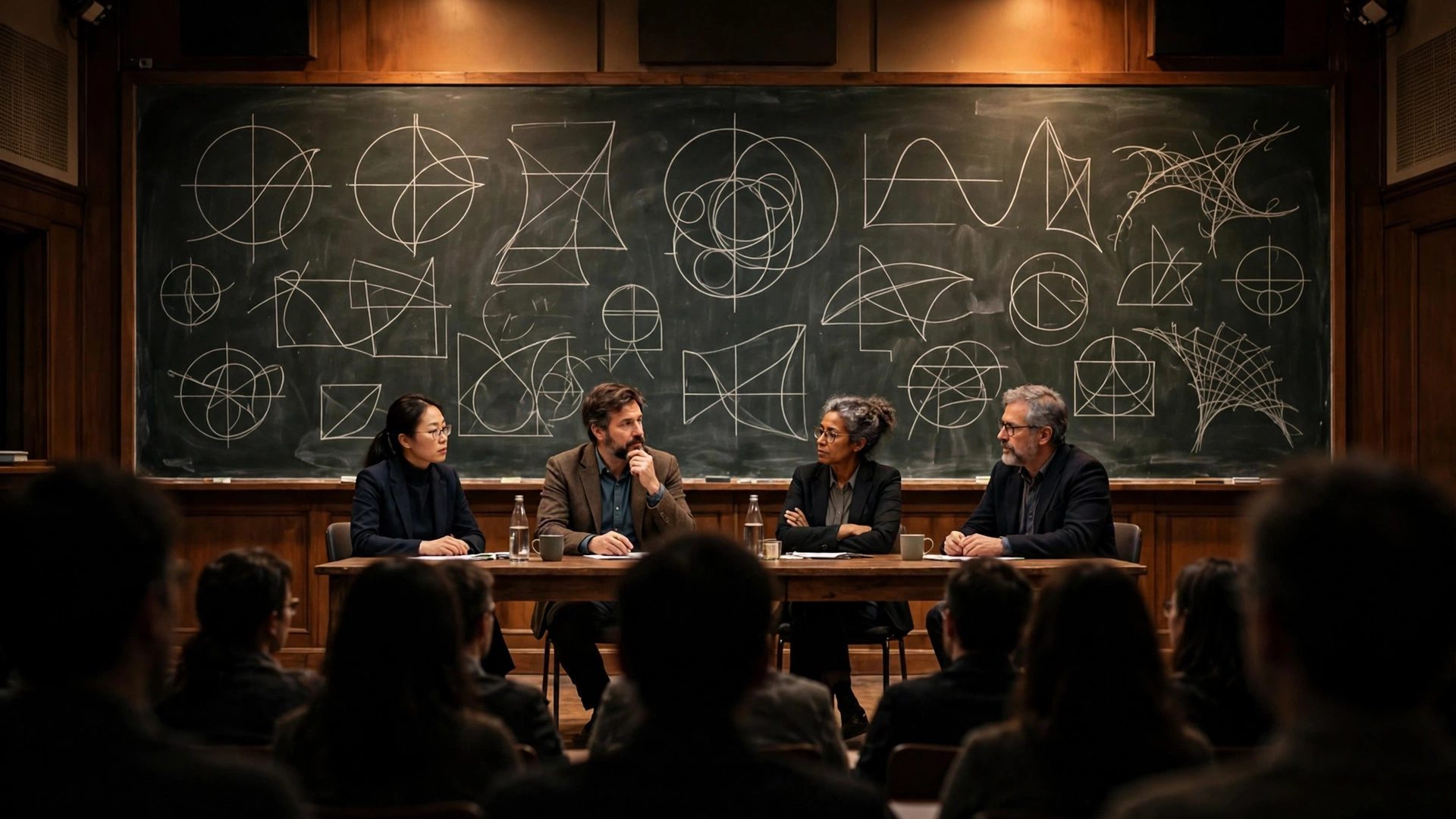
On November 20, MIT News published an account of a mathematics panel held this week. Mathematicians from MIT, Harvard, Northwestern University and New York University sat down together to discuss how AI is rewriting mathematical research. A remark by Northwestern professor Bryna Kra captured the mood: "Math has changed more in the last two months than in the last 100 years." The backdrop is a string of long-open mathematical problems that AI agents have cracked within months.
What happened in math's "two months"
In the summer of 2025, Google DeepMind's models won gold-medal status at the International Mathematical Olympiad. In September 2026, OpenAI focused thousands of agents on a single challenge and produced a proof related to the Navier-Stokes equation in 88 hours. A month later, the company released 722 manuscripts claiming AI had solved major unsolved problems across many areas of mathematics — a wave that has been dubbed the "mathocalypse". The panel, titled "AI and Society: The Future of Math" and held on November 16, was moderated by science writer Kevin Hartnett, with panelists Jacopo Borga of MIT, Michael Hopkins of Harvard, Bryna Kra of Northwestern and Tristan Buckmaster of New York University.
The proofs exist — but where is the understanding?
The disagreement centered on what counts as understanding. Hopkins was blunt: AI-generated proofs are "nonsense" full of "strange ideas", and "for math to be important, it has to have human understanding". Kra argued that being first should no longer be the priority, and neither should speed: the way mathematicians are assessed has to change. Interviews are becoming more important than papers, journals are being flooded with AI-assisted submissions — one journal has had to hire an additional editor — and clear exposition of a proof is becoming more valuable, with new journals appearing that publish only explanatory videos, such as Mathematical Discourse. Hopkins also noted that among students there are both "AI vegans" who refuse to use AI and a new kind of mathematician who, like a "horse whisperer of AI", is skilled at steering models.
The discussion offered no final verdict. Borga said, "The castle is collapsing. There's open ground to explore." Buckmaster urged students to stay the course and find "new ways to be creative and communicate your ideas". A more concrete test still lies ahead: the Riemann Hypothesis has been claimed proved, and the Lean code delivered by Claude is only just beginning to be checked by the mathematical community — whether the proof holds, and whether humans can understand it, are two different questions.