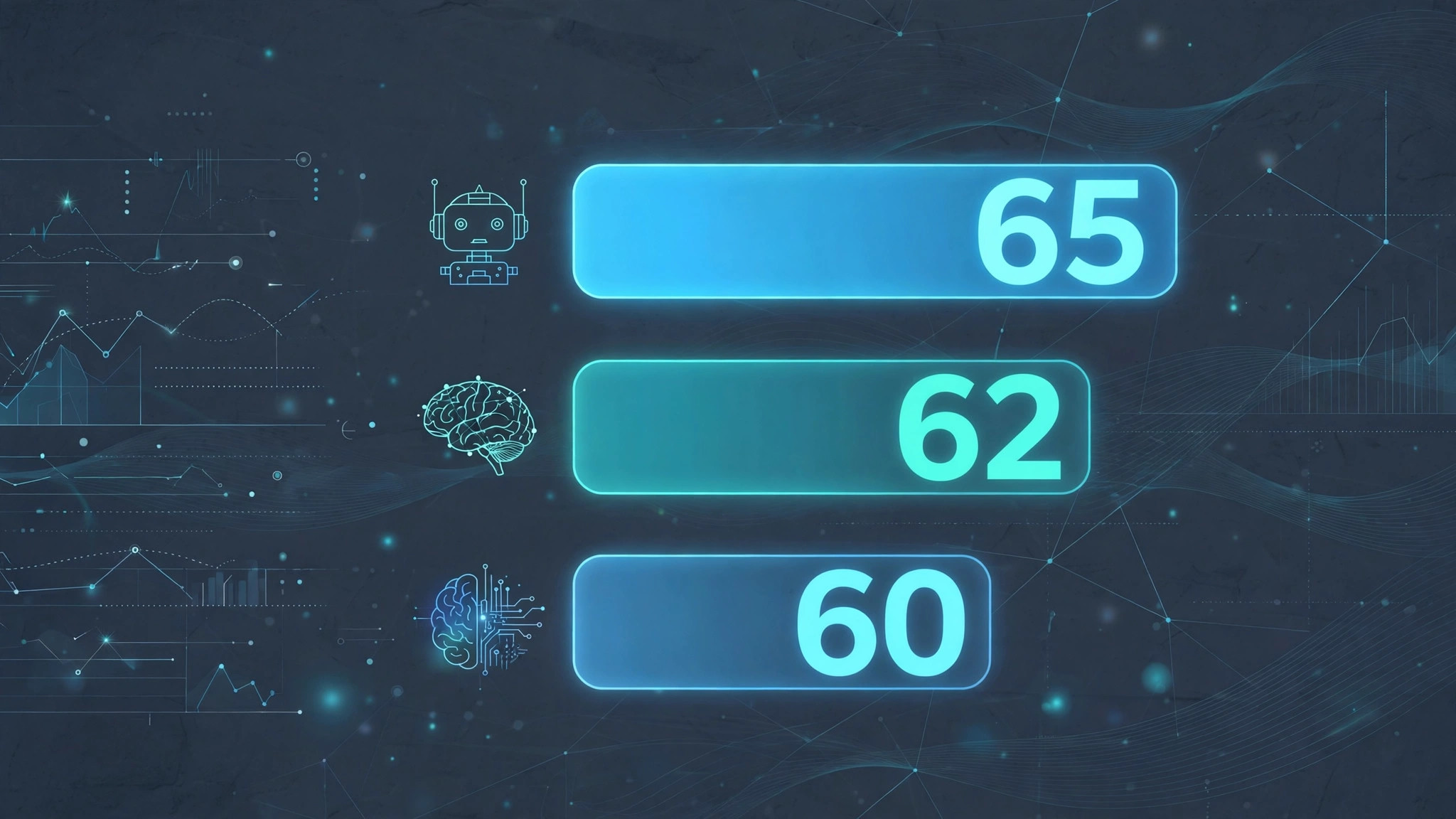
The Intelligence Index is the composite model score published by Artificial Analysis. Its full name is the Artificial Analysis Intelligence Index, and it compresses the overall capability of each large language model into a single score from 0 to 100, so the models can be ranked at a glance. On the leaderboard of November 17, 2026, Claude Fable 5.2 led with 65, OpenAI's GPT-6.2 Astra, released the same day, came second with 62, Google's Gemini 4 Carbon scored 60, and the lighter Gemini 4 Hydrogen scored 54. It is not the result of any single test, but a weighted synthesis of a whole evaluation suite.
How is a score of 65 calculated?
The current version, v5.0.1, contains 9 evaluations, split across four categories — Knowledge Work, Coding, Science, and General — each worth 25%. Knowledge Work measures how well models complete real office tasks, with AA-Briefcase v1.1 accounting for 15%; Coding tests code changes and terminal work, with FrontierCode-AA 2.0 and Terminal-Bench 4.0 together worth 25%; Science covers terminal-based research tasks and physics reasoning; General covers breadth of knowledge and hallucination rate, with AA-Omniscience v1.1 worth 15%, split into 10% accuracy and 5% for not hallucinating. Most evaluations use pass@1 scoring — a first attempt must be correct to count — while open-ended tasks such as AA-Briefcase are graded by a judging panel and converted to Elo. A score of 65 is simply the weighted composite across these 9 evaluations, out of 100.
What does a gap of two or three points actually mean?
The leaders are separated by only two or three points. Artificial Analysis estimates the 95% confidence interval of the total score at under ±1%, but that is only statistical error — a gap of two or three points does not mean a real difference in capability. What matters more is the same model's score at different reasoning effort levels: GPT-6.2 Astra scores 62 at max effort and about 60 at high effort — lower the effort, and the ranking moves with it. Its sibling, GPT-6.2 Sol, scores 57 at max effort. Cost is another easily overlooked dimension: running the full index costs about $26.50 for Claude Fable 5.2 and about $4 for GPT-6.2 Astra, a gap of 3 points against a cost difference of more than sixfold. Choosing a model by score alone is the same as assuming price does not matter.
What the index cannot measure
The Intelligence Index is primarily an English-language, text-based suite. Multimodal ability, voice input, and multilingual performance are tested separately and do not count toward the score. It also does not answer the question "is this model right for my work": its knowledge-work tasks lean toward general office scenarios, and vertical domains such as customer service, law, and medicine are not covered. Versions change, too: in November 2026 the index moved from v4.3.2 to v5.0.1, changing the weights from 30/20/20/30 to 25% for each of the four categories, so scores cannot be compared directly across versions. Use it as a starting point for screening models: look at the sub-scores for your own task type — Coding for programmers, Science for researchers — then consider reasoning effort and cost. Scores can quickly rule out models that lag behind, but among the top five, what separates them is price and performance in your specific scenario, not a gap of two or three points.