BioBasicsBench is a new benchmark OpenAI released on November 6, 2026: instead of textbook biology questions, it hands models 100 real wet-lab tasks — reading gel images, counting colonies, interpreting microscope photos — and asks whether the experimental conclusion holds. Developed with enzyme-design company Ligo, the benchmark puts OpenAI's newest model, GPT-6 Astra, at a 66.7% mean score, 22.9 points above the previous generation's GPT-5.6 Sol. But OpenAI cautions that a higher score does not mean the model can stand in for a scientist.
What it tests: raw evidence from real experiments
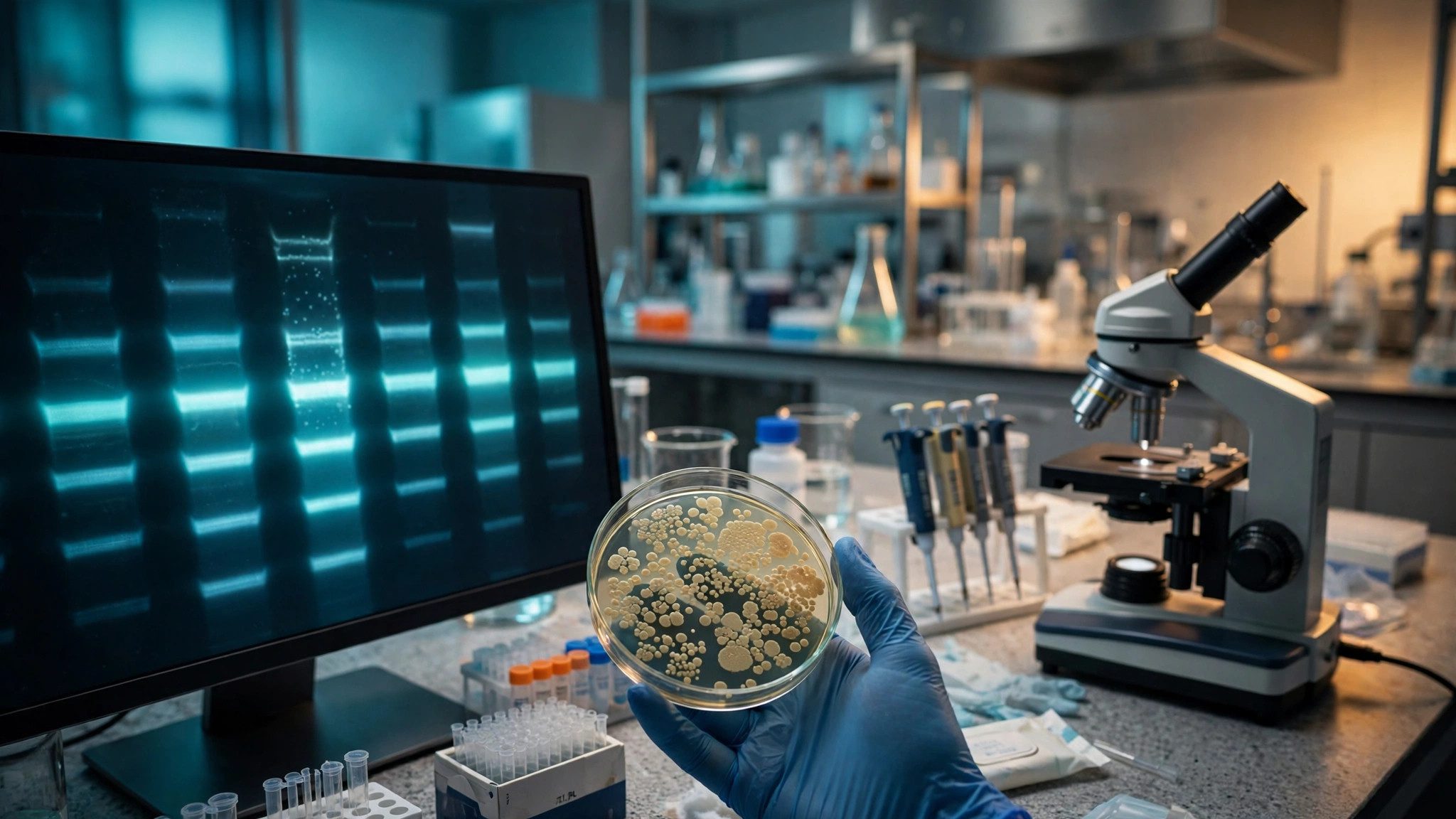
The 100 tasks span five everyday areas — protein methods, imaging and cytometry, quantification and assays, nucleic acid methods, and molecular cloning — and all the evidence comes from Ligo scientists' own experiments: gel and blot images, colony-plate photos, microscopy images, sequencing files, instrument-exported tables, and bench-work videos. Every task carries an expert-written scoring rubric and passed three rounds of review. OpenAI tested 7 models across 37 model-and-reasoning-effort combinations, running each task five times, for 18,500 scored attempts. At the highest reasoning effort, GPT-6 Astra averaged 66.7% (95% confidence interval 60.3%–73.1%), GPT-6.1 Sol 62.0%, and GPT-5.6 Sol just 43.8%. GPT-6 Cyber previously found 948 privilege-escalation flaws in a Linux kernel evaluation — but one test hunts for bugs, the other reads experiments.
What 66.7% means — and what it doesn't
What matters is not another leaderboard but a different way of setting questions: earlier science benchmarks mostly used clean charts picked from papers, and a model that aces them may still fail on the mess of real experiments — failed runs, blurry images, contradictory observations. BioBasicsBench tests exactly that: models must spot insufficient evidence and catch broken controls. In the published examples, Astra noticed that two fluorescent dyes' detection windows overlap, so brightness can't be compared directly, and that a negative-control plate was labeled with the wrong antibiotic. The same company recently disclosed two cases of its research models going astray in evaluations and doesn't hide its shortcomings. The limits are equally clear: all seven models tested are OpenAI's own, with no human baseline and no rival models involved; 66.7% is a mean score computed from the rubrics, not "two-thirds of the questions solved," and certainly not a pass rate.
Two things to watch next: whether OpenAI publishes the dataset, rubrics, and scoring code so other labs can reproduce the scores and test their own models, and whether Astra's weaknesses shrink in the next round — in individual tasks it still lets a prior assumption steer it, picks the wrong colonies, or keeps only the observations that suit it. For life-science researchers, the benchmark is best read today as a capability map: it marks where models can already help at the bench and where a human still has to check — not a license to work in the lab.