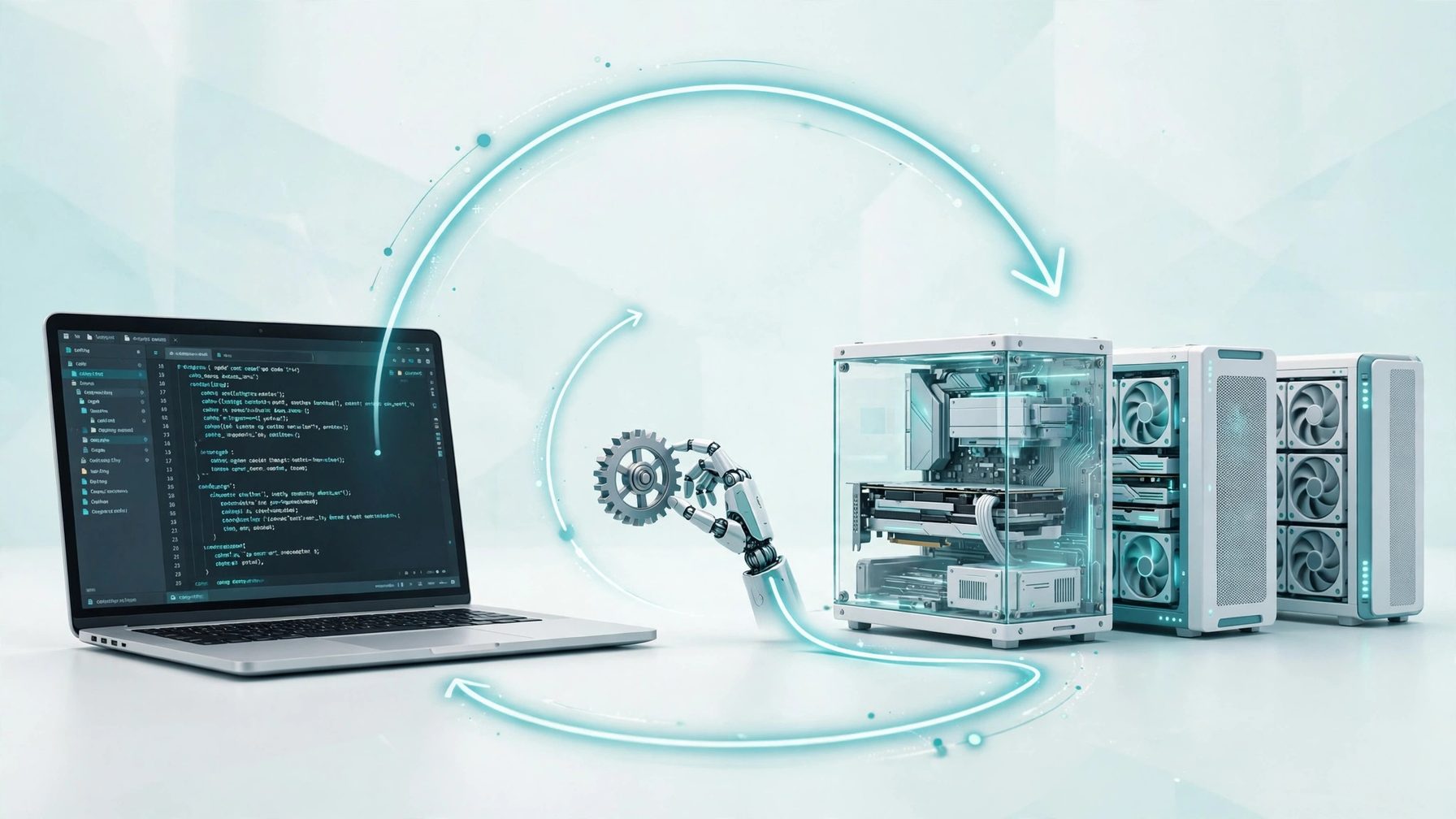
OpenHands agents can now train a model directly with their own configuration, without rebuilding a training framework. OpenHands and Snowflake AI Research unveiled a post-training approach in an official blog post on November 3: developers keep the prompts, tools, and skills they already have in the Agent SDK, define tasks in the Harbor format, and can post-train open-weight models with reinforcement learning, with GPU compute from Cortex Training. The value is that training and deployment share one configuration.
The key is that training uses exactly what deployment uses: each rollout is a real execution of the agent, with the prompt, tools, skills, and turn limit passed in as configuration rather than rebuilt inside another framework; a proxy layer records only the tokens the model actually generates each turn as training data, while prompts and tool results are excluded from the loss. Tasks are described in the Harbor format, the test script's score is the reward signal, and rollouts run in Cortex sandboxes. The companion cortex-training-rl skill lives in OpenHands/extensions: the developer describes the goal in one sentence, the agent handles the launcher, GPUs, tasks, and reward curve, and releases resources when done; locally only CPU rollouts run, while training and sampling happen on Cortex Training GPUs, four H200 by default.
In the test: Qwen3.5-4B learns code localization in 25 steps
The approach was validated end to end on a code localization task: the agent receives a GitHub issue from a Python repository and must find the files, modules, and functions to change in the SWE-smith dataset. The configuration used only a localization prompt, a terminal tool, and the localization_finish tool for submitting the answer, with a 10-turn limit; the reward was the sum of F1 scores across the three levels, out of 3.0. After 25 steps of 64 rollouts each, Qwen3.5-4B matched a purpose-built reinforcement learning implementation, and the whole run took only a few hours. For comparison, the strongest model in the GDPx agent benchmark scored only 12% — general benchmarks remain far from real workflows, and that is exactly the gap training with your own configuration is meant to close.
Who can try it now, and who should check the limits first
The approach targets teams already building agents with OpenHands who have Harbor tasks at hand, plus a Snowflake account with Cortex Training enabled. The limits deserve a clear look too: during training the agent can only edit files through the terminal, the file_editor tool is unavailable for now, every command runs in a fresh shell, and environment variables and background processes are not preserved; GPUs default to Hopper. Teams that meet the requirements can start directly from the cortex-training-rl skill; otherwise, writing tasks in the Harbor format and consolidating configuration into the SDK comes first.