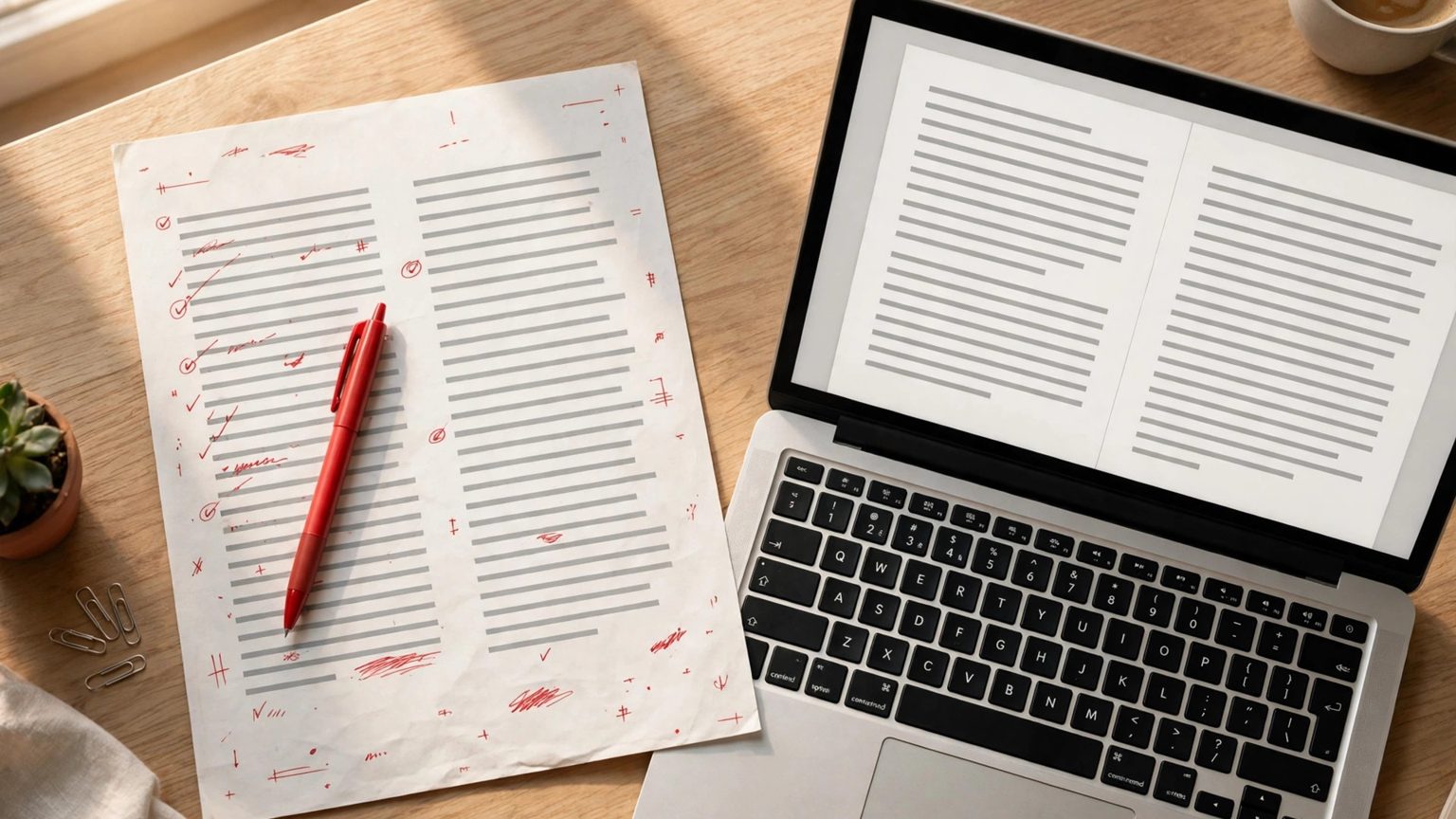
A translation proofreading prompt is for the moment when you already have a draft translation but are not ready to send it. Asking only "check whether this translation is correct" usually gets back a vague "it looks fine", while the sentences that actually drift from the source slip through. Paste the source text and the translation together, and spell out what to check, which terms are fixed, and where the text will be used, and the AI will compare them sentence by sentence: which sentence lost meaning, which term changed halfway through, and where a number or the tone is wrong, listed first, with a fix for each.
Copy this prompt first
You are now a senior bilingual editor, fluent in [source language] and [target language], experienced in proofreading [intended use] texts.
Compare the source text and the translation I paste at the end, sentence by sentence. Check only what is pasted; do not guess information that is not there.
Check in this order: 1) Fidelity: anything omitted, added, or distorted in meaning; 2) Terminology: whether the same word is translated the same way throughout, following the [glossary]; 3) Details: whether numbers, dates, personal names, and place names are correct; 4) Tone: whether the tone fits [intended use], flagging anything too casual or too stiff.
First output a comparison table, one row per problem, with the source sentence, the translated sentence, the problem, and the suggested fix; sentences with no problem do not need a row. Then give the full revised translation, changing only the sentences with problems and keeping the rest unchanged. Mark anything uncertain as "uncertain", and say what information would settle it.
Source text:
[paste source text]
Translation:
[paste translation]
How to fill in the square brackets
- [source language] and [target language]: name the actual languages, such as "English" and "Chinese", not just "source" and "target".
- [intended use]: pick one, a business email, product instructions, or a blog post; the tone standard follows the use.
- [glossary]: list words with fixed translations first, such as product names, personal names, and place names; if there is no glossary, write "none, keep terms consistent throughout".
- [paste source text] and [paste translation]: paste them paragraph by paragraph, aligned; if the paragraphs are out of order, the sentence-by-sentence comparison will not line up.
- Length per run: if the text is over 800 words, split it into sections first, proofread each section, then check the combined text for consistent terminology.
A filled-in opening looks like this
You are now a senior bilingual editor, fluent in English and Chinese, experienced in proofreading business emails.
Glossary: SmartFlow is always rendered as "智流", and Zhang Wei is always rendered as "张伟".
When the output looks wrong, adjust it like this
- If the AI only says "no problem": add "every sentence must be marked as checked or given a problem in the table, do not skip any", and send it again.
- If the revision is freer than the source: add "change only the sentences that drift, and keep the sentence order and structure as close to the source as possible", then proofread again.
- If terms are still inconsistent: paste every rendering used in the text, ask it to settle on one first, then replace it throughout.
- If a number was changed wrongly: do not let it calculate on its own; write "numbers are to be checked only, not converted", and check any conversion separately.
Fix the sentences flagged in the table first, then read the revised translation through once: once the tone reads smoothly and the terms are consistent, the draft is ready to send.