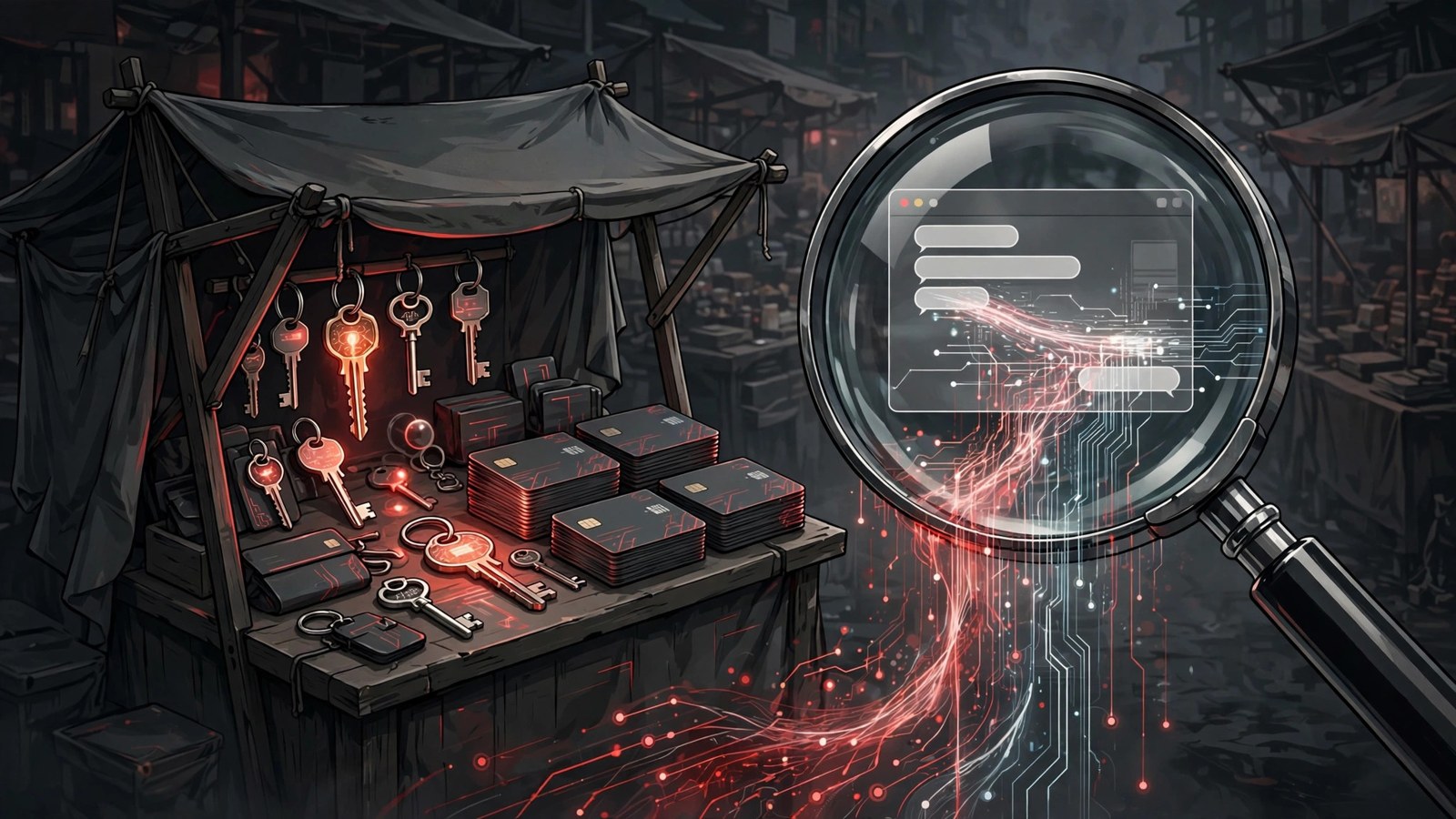
“Cracked AI” is being sold openly on second-hand marketplaces, according to an investigation aired on October 21, 2026 by China National Radio's Voice of China service: paid tiers of popular models including Doubao, DeepSeek and Kimi are being sliced into goods priced from a few yuan to a few dozen — some sellers offer "cracking tutorials", others rent out premium accounts by the minute, and still others resell strings of API keys. The price looks trivial; the real cost sits elsewhere, because every prompt you type and every file you upload may pass through the seller's server first.
Three ways of selling, each tested by reporters
The first is tutorials. One seller claimed that a 1.2-yuan tutorial plus a so-called "internal command" would let buyers claim Doubao membership trial perks repeatedly — "unlimited free membership". Reporters who tried obtained nothing, and the seller suggested switching devices. The tutorial's actual content teaches buyers to rotate through family members' and friends' phone numbers and multiple devices, up to four claims per device: the "crack" is multi-account arbitrage. The second is account rental. A Kimi premium membership rents by duration, 4.7 yuan for 10 minutes up to 21.7 yuan for an hour; after payment, buyers land not on Kimi's official site but on a relay page called a "Kimi timed workspace" with a countdown, and chat records persist for 24 hours after expiry so a top-up can resume them — which also means the renter can read them. The third is API key packages, from 1.99 yuan to 99.99 yuan for between 220 and 14,000 calls. Sellers claim bulk purchases, but security experts say the supply is mixed: some keys are scraped from publicly leaked credentials on open-source sites, others are stolen by breaking into systems, and once the real holder revokes a key, the buyer's balance can vanish overnight.
The platforms answer in one voice: unofficial, unauthorized, will be cracked down on
Doubao responded that subscriptions are issued only through official channels, that no "crack" exists and "unlimited free membership" is impossible, and warned users against low-price offers from unofficial channels. The Kimi team said renting and selling its accounts on second-hand platforms is unofficial and unauthorized, breaches its user agreement and will be firmly cracked down on, adding that conversations and information in such accounts are fully visible to the renter, with risks of data leakage and fraud. Security expert Li Tiejun warned that relay stations can record entire interactions, and that prompts, files and code submitted by users may be kept or even resold; as we reported when Meta Muse share links turned up in search results, the exposure surface of AI conversations does not come only from official products — grey relays add a deliberate layer of retention on top.
Cheap is not free: separate the legal bill from the security bill
Wu Shenkuo, a law professor at Beijing Normal University, noted that parts of the sellers' conduct already cross legal lines: obtaining interfaces through reverse engineering or scraping may infringe providers' technical measures and intellectual property; reselling interfaces at scale without a licence may constitute unlicensed business operation; and intercepting or reselling user information in the process may directly violate personal information protection law. For buyers, the risk is more immediate: an account banned or a balance zeroed out is the small part — feeding work documents, unpublished code and personal material into a relay of unknown origin is the irreversible loss. Experts recommend that marketplaces proactively monitor and delist such goods, that providers strengthen detection of anomalies such as many accounts on one device, and that regulators follow up on scaled arbitrage and the data black market. For ordinary users the conclusion is a single line: save money through official promotions if you like, but do not pay the seller with your own data.