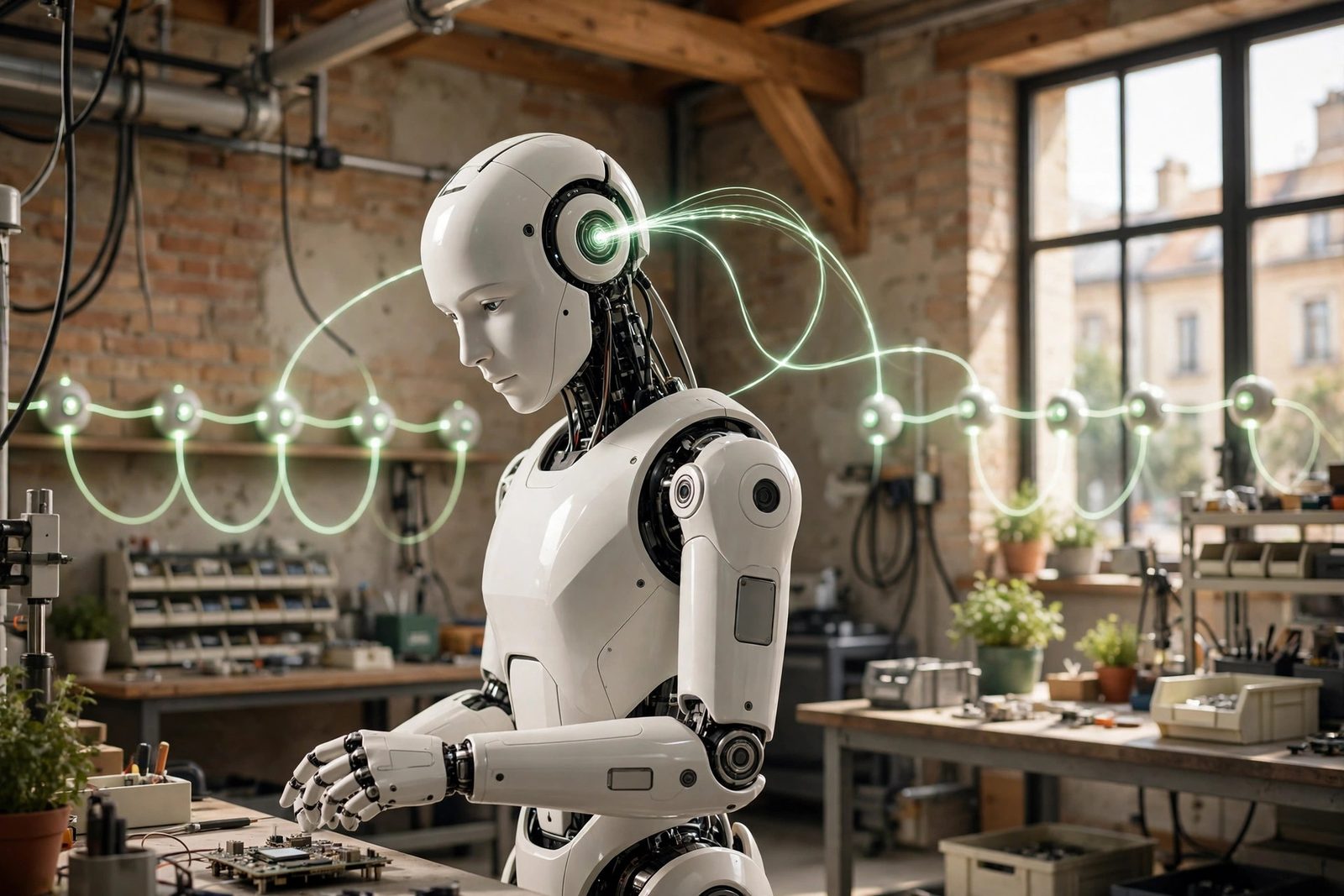
The robot memory partnership between NEURA Robotics and NXAI was announced in Metzingen, Germany, on October 20, 2026: the two companies will jointly develop a memory component for cognitive robots, connecting NEURA's Physical AI stack with NXAI's xLSTM recurrent architecture, so that robots can track tasks across many steps and act on accumulated experience instead of treating every situation as if it were the first.
A partnership in two halves: research, and platform
The first half is joint development. Neuron AI, which NEURA released on October 14, already combines 3D vision, touch, audio, robot state and language with a memory function in one multimodal foundation model; the partnership now aims to weave xLSTM's ability to hold and update state efficiently across long sequences into that stack. The second half is platform openness: NXAI plans to make its own xLSTM-based model available on the Neuraverse platform alongside Neuron AI. Companies will be able to fine-tune that model for their own tasks with the Neuraverse toolchain, test it in the NEURA Gyms and deploy it on suitable robots, while deciding for themselves whether to share their process knowledge and data. Neuron AI itself remains NEURA's own model and continues to be developed independently.
Why memory is precisely what robots lack
NEURA's announcement states the problem plainly: a chatbot processes one request at a time, but a robot operates in a continuous loop of perceiving, deciding and acting — many times per second, potentially for an entire shift. That demands memory on two levels. Working memory handles the immediate: has the component already been inserted, is the door open or closed, has the start button been pressed? Episodic memory goes further: a robot that has performed a process many times should draw on that experience when the same situation returns. Without both layers, a robot re-reads the world at every step, and reliability on long tasks stalls.
Why xLSTM is the piece aimed at this gap
xLSTM comes from NXAI, founded by LSTM co-inventor Sepp Hochreiter, and is built exactly for this gap: fast, memory-efficient, and able to hold state across long sequences. It contrasts with the Dream-1 robot foundation model covered here yesterday: Dream-1 rents robots a brain from the cloud by the hour, while NEURA is betting on robots that grow more capable on the job, through experience.
Do not mistake the announcement for a delivery
The progress needs a cooler reading. What was published is a partnership and a roadmap: the memory component has no launch date, and the NXAI model's arrival on Neuraverse is stated as a plan, not a release. NEURA brings its own robot hardware, sensors, real-world training data from the NEURA Gyms and an industrial deployment platform; NXAI brings decades of research into recurrent networks. Whether the two can convert xLSTM's state-keeping advantage into measurable success rates on factory floors will only be known once the component ships and is tested. For European Physical AI, though, the signal is clear: while U.S. rivals compete on cloud brains and funding scale, European players are competing on robots that improve locally, over long processes, the more they work — a slower road, but one that, if it works, makes industrial customers far harder to win away than an hourly API ever could.