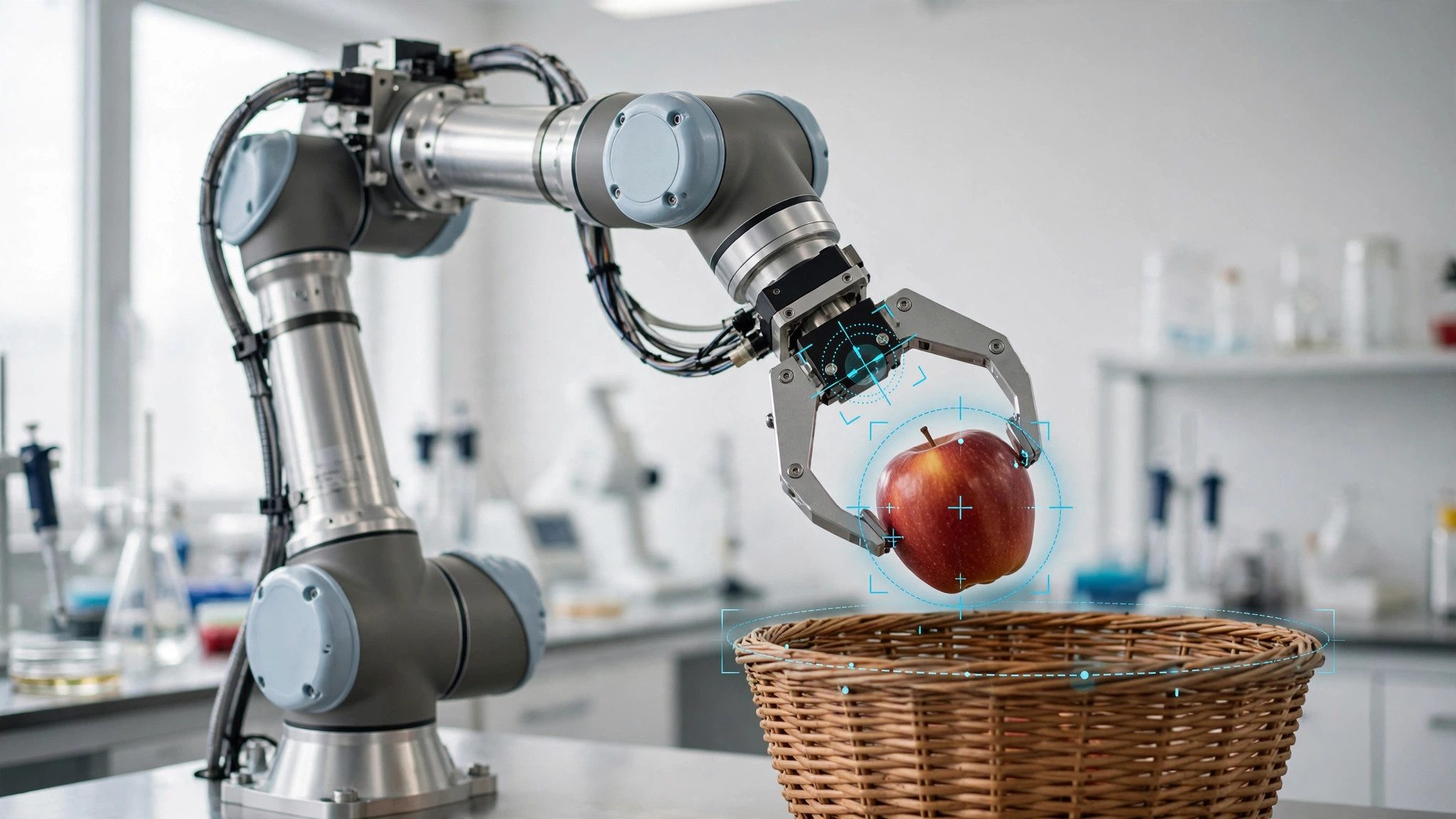
ACE-Brain-0.6 was officially released by Daxiao Robotics on October 19, 2026. The 9B-parameter embodied foundation model competes on one thing only: helping a robot see exactly where a target is, where to grasp it, and where it can be placed. In the eight visual grounding benchmarks published by Daxiao, it beat OpenAI's GPT-6 Astra on six, and edged it out on the average of seven public benchmarks, 74.53 to 73.68. The results come from materials published by Daxiao, and the Shanghai Observer report explicitly noted they still await third-party verification — that caveat belongs up front.
It does not compete on chat, but on pointing at the right spot
Visual grounding means mapping a language instruction onto a physical location: when a user says "put the fruit in the basket," the model must identify the fruit and the basket, and judge the basket's rim, the bearing surface, the grasp point and the direction of movement. Daxiao's analysis holds that general multimodal models such as GPT-6 Astra already reason strongly, but still err on fine-grained geometric localization and complex spatial relations; in text Q&A a small deviation hardly matters, while for a robot a few centimeters off means a failed grasp. ACE-Brain-0.6 integrates object recognition, multi-instance localization, spatial-relation understanding, functional-region recognition, interaction-point prediction and "target does not exist" judgments into one spatial perception system built to fill exactly that gap. It is built on Qwen3.5-9B, with the vision encoder frozen and only the language model parameters fine-tuned.
Broken down, the win is uneven
| Benchmark | ACE-Brain-0.6 | GPT-6 Astra |
|---|---|---|
| Where2Place | 76.55 | 71.10 |
| PixMo-Count | 89.41 | 88.10 |
| RoboSpatial | 74.82 | 69.55 |
| RoboAfford | 88.51 | 84.94 |
| ShareRobot | 49.70 | 46.60 |
| RobotGrounding (Daxiao's own) | 94.13 | 91.10 |
The largest gaps are in spatial-relation and functional-region tasks, while the counting lead is small; the seven-benchmark public average differs by only 0.85 points — a specialized win within the same tier, not a generational leap. RobotGrounding is Daxiao's own benchmark, with 2,591 questions across 14 task types, so a lead there should be discounted accordingly. The "target does not exist" judgment is the more noteworthy item in this result set: when the scene does not contain what the user asked for, the model must say so plainly instead of inventing a location — a safety baseline for robots entering real environments. A similar small-model route appeared recently in the REKI robot model, which also relied on public data and specialized optimization.
A million verifiable samples are the real point of this release
ACE-Brain-0.6 was trained on roughly one million samples covering about 940,000 images and 2.7 million question-answer pairs. The team integrated more than 30 open robotics data families with private first-person data, selected key frames from robot manipulation videos using gripper state and motion amplitude, and used vision tools such as Grounding DINO and SAM 3 for localization, region recognition and semantic correction, converting heterogeneous data into supervision signals with explicit visual evidence. Controlled experiments show that, with architecture and training method unchanged, scaling data from 260,000 to one million samples raised the seven-benchmark public average from 69.3 to 74.5, about 2.4 points per doubling; but adding only more samples of existing types gained less than 1 point — new scenes, new spatial relations and new supervision forms did the work. That conclusion is the more useful takeaway for peers: the bottleneck for embodied data is diversity and verifiability, not raw volume.
It is still a distance from robots doing real work
The cold water: grounding benchmarks measure localization judgments on static images, not a robot's success rate at continuously grasping and placing objects in a real scene. Lighting changes, occlusion, object deformation and gripper execution error all eat into scores outside the benchmark. Daxiao has not published real-robot task success rates this time, nor said whether the model weights will be opened. Until that information arrives, ACE-Brain-0.6 is best read as a convincing directional proof: a 9B-class model, fed high-quality specialized data, can match or beat a top general model on one key capability — whether it makes robots work more reliably awaits real-machine data.