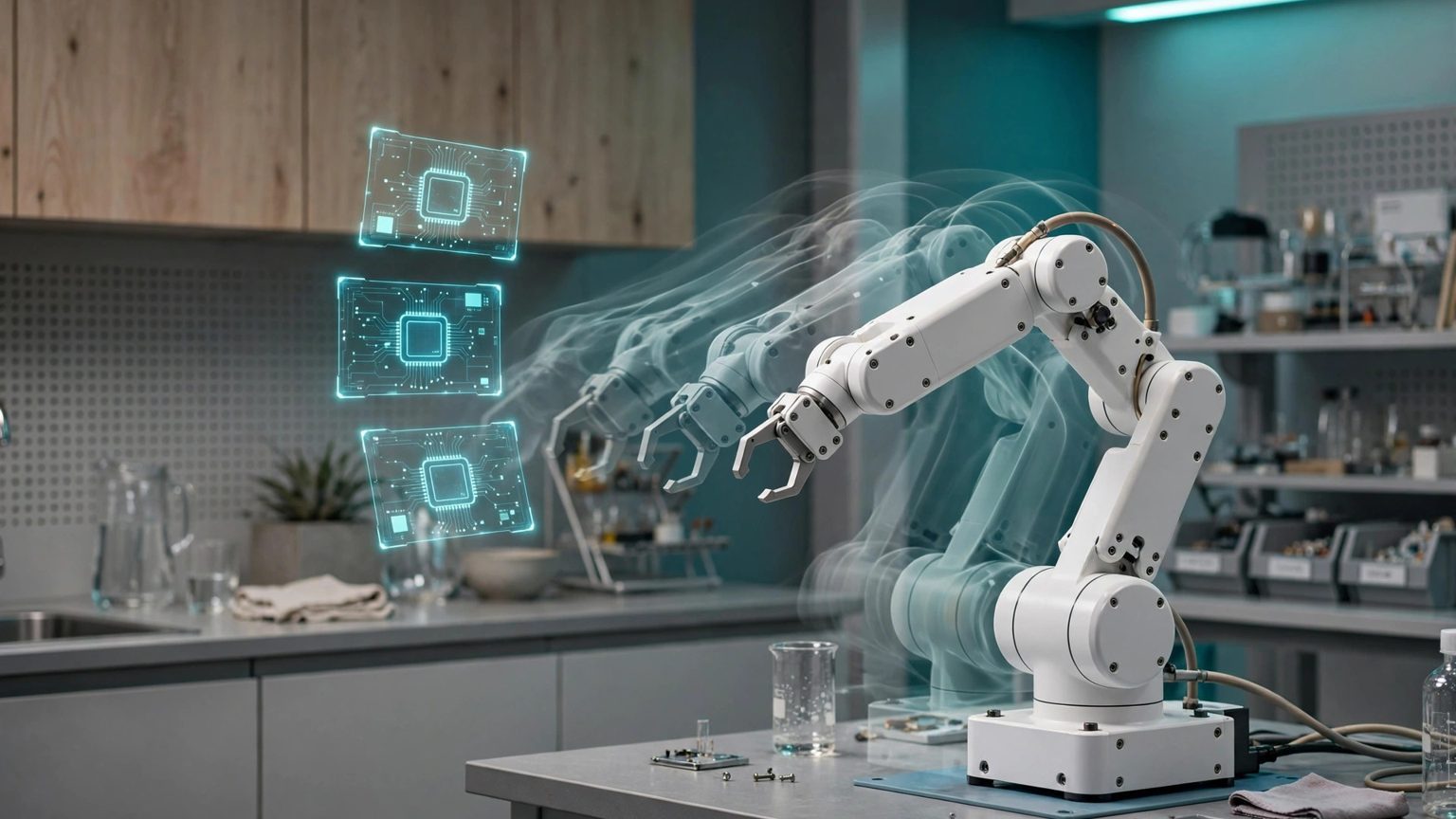
The REKI robot model was released on October 17, 2026 by Kyutai, the French open-science lab, together with Inria and École des Ponts. The official project page, the full code and all weights on Hugging Face went public in the same round. REKI is a 2.4B-parameter vision-language-action model (VLA) with a concrete job: watch camera views, read an instruction, and output a robot arm's actions directly. The part worth attention is not another leaderboard entry, but how it gives the robot a memory — at almost no cost — and fixes a common failure mode in the process.
Why robot arms swing back and forth between two poses
Many VLAs decide from the current frame alone. The problem is that some poses look nearly identical in a single frame: in the demonstration data, the step after pose A goes to B, and the step after B goes back to A. A memoryless model cannot tell where it just came from, so it oscillates between the two poses and burns the whole task. Kyutai calls this perceptual aliasing and measured it on RoboTwin: without memory, 18.6% of episodes oscillate; with memory, that drops to 4.1%, with the biggest gains on two-arm tasks.
Memory lives in the action expert, not the big model
REKI pairs a Qwen3.5-2B vision-language backbone with a 200M-parameter flow-matching action expert. Its memory works like this: each frame gets 32 register tokens inside the action expert that summarize that frame's views and instruction, and those registers are cached for the next two frames to read. Because the registers never attend to the actions themselves, they are computed only once per frame and reused across denoising steps and later frames. The cost is small enough to live behind a decimal point: reading the cache adds 0.1 ms to one action chunk, and each remembered frame costs about 2 MiB of GPU memory. REKI predicts an action chunk in 21.8 ms on one H100, the fastest among the compared models.
Trained only on public data: who beats it, and who does not
REKI was pretrained exclusively on public data — real-robot teleoperation, simulation and egocentric human video totaling roughly 1.0B frames, plus a smaller vision-language mix — for 200,000 steps on 32 H100 GPUs. It scores 90.4% on LIBERO-Plus, the top score in Kyutai's comparison; 65.8% on RoboTwin Clean2Rand, behind only Qwen-RobotManip at roughly twice its size; and 38.4% on RoboCasa365, well behind Xiaomi's robotics model. Its strength is generalization when the environment changes, not winning every benchmark. On a real UR5 arm, the team finetuned it with 50 demonstrations per task for one hour to teach it new tasks.
The weights ship under CC BY-NC-SA 4.0, so research and reproduction are fine, but commercial use is off the table. Most scores also come from simulation benchmarks; how far REKI gets in real kitchens and factories is for other teams to verify. For people working on embodied AI, the signal is clear: giving a robot a memory does not necessarily take a bigger model — putting the last few frames in the right place can beat adding parameters.