ASPIRE v1.0 was officially open-sourced on October 16, 2026: Linxi "Jim" Fan, who leads NVIDIA's GEAR lab, announced that day that the code for the robotics agent framework had landed in the NVlabs repository of NVIDIA's labs on GitHub, under an Apache 2.0 license. ASPIRE takes a very different route from mainstream robot learning — instead of training a new policy network, it has a large language model write the robot's control code directly, then read the logs, fix the code and try again until the task works.
Skills are stored as code, not baked into weights
Traditional robot systems have an old habit: whatever fix they work out during one task is thrown away when the task ends, and the next task starts from zero. ASPIRE keeps the fix. It maintains a continually growing skill library that distills validated repairs — localization tricks, perception prompts, debugging workflows — into reusable entries that a later task can call up directly.
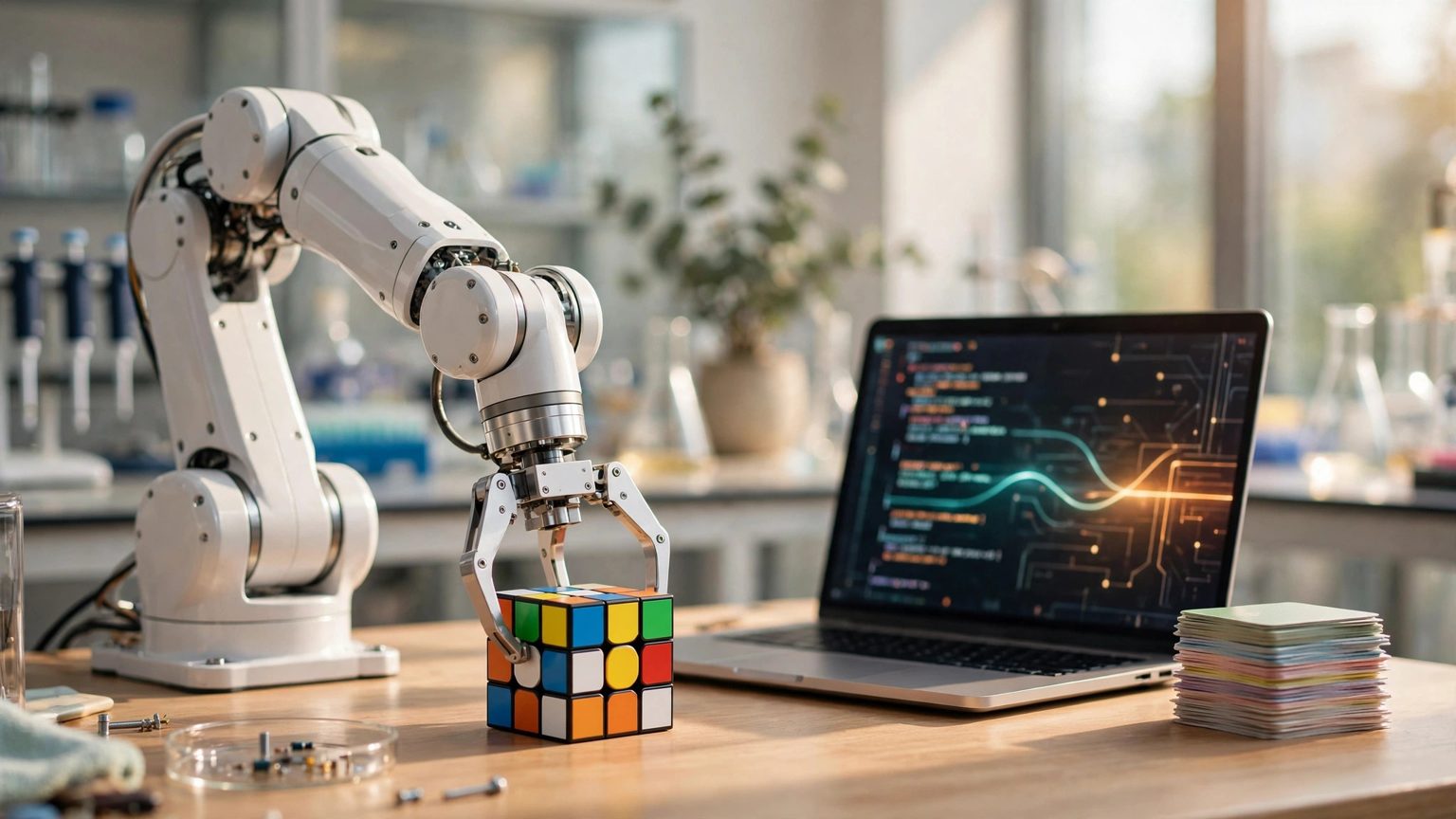
The real-robot demos on the project page show how far this route has come: one robot arm, driven by GPT-6 Astra, learns online to solve a Rubik's Cube, repeatedly revising its own control program; in another demo, skills learned in simulation transfer to a physical robot tidying a table. In this October update, the project team reports that ASPIRE reached a 99% success rate across 80 manipulation tasks in LIBERO-Pro. That figure deserves a caveat: it is the project's own score on its own benchmark, not yet independently reproduced — good for judging direction, not as an industry yardstick.
Three parts: an execution engine, a skill library, evolutionary search
ASPIRE can repair its own code because three components work together. First, a closed-loop execution engine: every perception, planning, grasping and control call the robot makes leaves a multimodal trace with visual evidence, so the agent can track down exactly which step failed instead of receiving a bare "failed." Second, the skill library, which stores validated fixes for later tasks to retrieve. Third, evolutionary search: the system generates several candidate programs in parallel and cross-references their failure records, instead of circling one wrong direction.
The combination already showed gains in the paper version's tests: the project paper reports that on LIBERO-Pro's perturbation tests it beat the strongest baseline by up to 77 points, with clear advantages as well on Robosuite's bimanual handover task and BEHAVIOR-1K's long-horizon household tasks. Skills also transfer across embodiments — experience accumulated in simulation served as programming guidance for a different physical robot, sharply cutting the reasoning tokens needed for debugging. This is the same current that is turning robot foundation models into hosted services (see Pi API enters public testing): the model's job is shifting from directly controlling the machine to programming it and accumulating its experience.
The limitations are printed on the project page
The ASPIRE team does not hide the caveats; the project page lists them in their own section. First, it is not yet a fully autonomous real-world learner: real deployment still needs reliable success detection, safe resets, safety monitoring and calibration. Second, it depends on a frozen frontier large model, and whether smaller models can sustain the same debugging loop is unverified — in other words, a large part of the score belongs to the big model behind it. Third, it can only act within a predefined set of perception and control primitives, which is safe but limits what behaviors it can express. Fourth, long-term management of the skill library is unsolved: as entries pile up, some will go stale, become redundant or even mislead new tasks; and the repeated debugging and evolutionary search are themselves compute-hungry.
So the value of ASPIRE v1.0 is not that robots can now learn everything by themselves. It is that a complete engineering paradigm has been open-sourced: let an agent write code that controls the robot, and store experience as code that can be kept and passed on. For robotics teams, that is worth more time than any single demo video — a paradigm can be reused; a demo cannot.