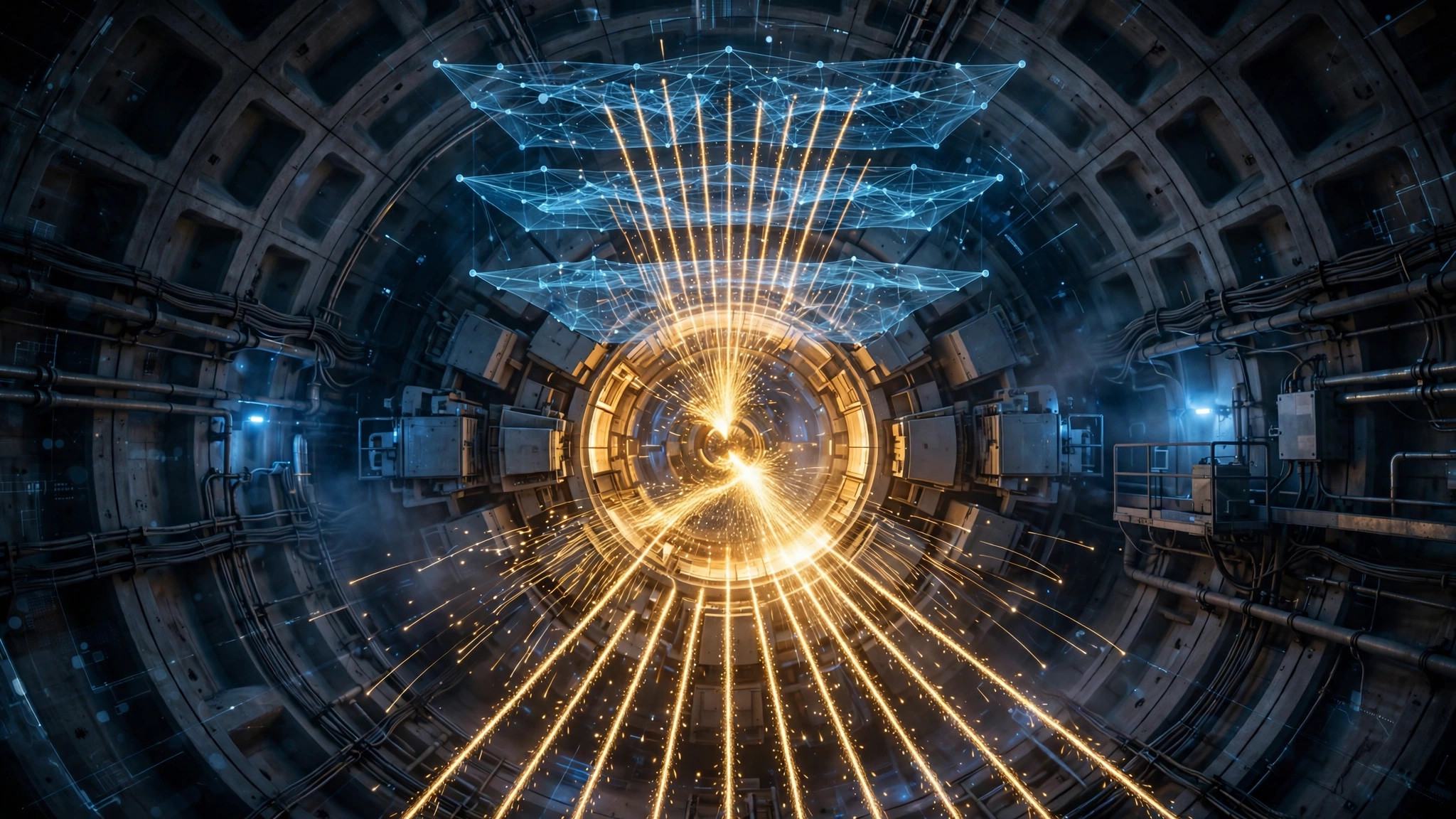
CERN announced on October 15, 2026 that the European Laboratory for Particle Physics has signed a statement of intent with France's Mistral to build a long-term strategic partnership. Its centerpiece is a single pretrained foundation model for collider physics, the Large Physics Model, trained on billions of simulated proton-proton collisions at the Large Hadron Collider (LHC). One model is meant to handle collision reconstruction, particle identification, anomaly flagging and evaluation of future detector designs. Reuters reported the same day that neither a timeline nor a budget was disclosed: this is a direction-setting agreement, not a product launch.
Today a chain of algorithms, tomorrow perhaps one model
Reconstructing a collision today means passing detector signals through a chain of specialised algorithms that progressively turn raw signals into the particles and objects physicists analyse. Machine learning already sits inside many of those steps, but each model owns one narrow task. A foundation model changes the division of labour: after seeing billions of simulated events, a single model could reconstruct, identify and single out the events that do not match known physics. For CERN, decades of simulation archives become training assets. For Mistral, it is a chance to take large-scale training into a field where data volume and rigour are both extreme. The timing is notable: just this week, Mistral brought a product design team in-house through an acquisition, and it is now signing a long-term deal with Europe's flagship physics laboratory.
The data is the asset, and also the pressure
CERN puts the stored LHC experimental data at around one exabyte, a million terabytes. The High-Luminosity LHC, expected around 2030, will raise collision rates roughly tenfold, and today's analysis pipelines were not designed for that volume. CERN's Chief Information Officer Enrica Porcari argued in the announcement that high-energy physics offers an unusually rigorous environment for developing and testing AI, and that the results should serve the whole physics community and be shared. The partnership also fills a gap on both sides: CERN holds the data and computing heritage, Mistral holds the engineering experience of training very large models.
No product yet, but a template is being set
Some caution is warranted: the statement of intent carries no timeline, no budget and no model size, and nobody has promised when a first version might join real physics analysis. Its significance lies elsewhere. It is a clear early example of a scientific foundation model built the other way round — not a general chat model fine-tuned for a discipline, but a model pretrained from the start on one field's accumulated simulation data. If that works in particle physics, other data-rich sciences will copy the pattern. With a European laboratory and a European model company, the sovereignty storyline writes itself; the harder test will be evaluation, because a physics model will be judged on reconstruction accuracy and anomaly discovery, not on chat leaderboards.