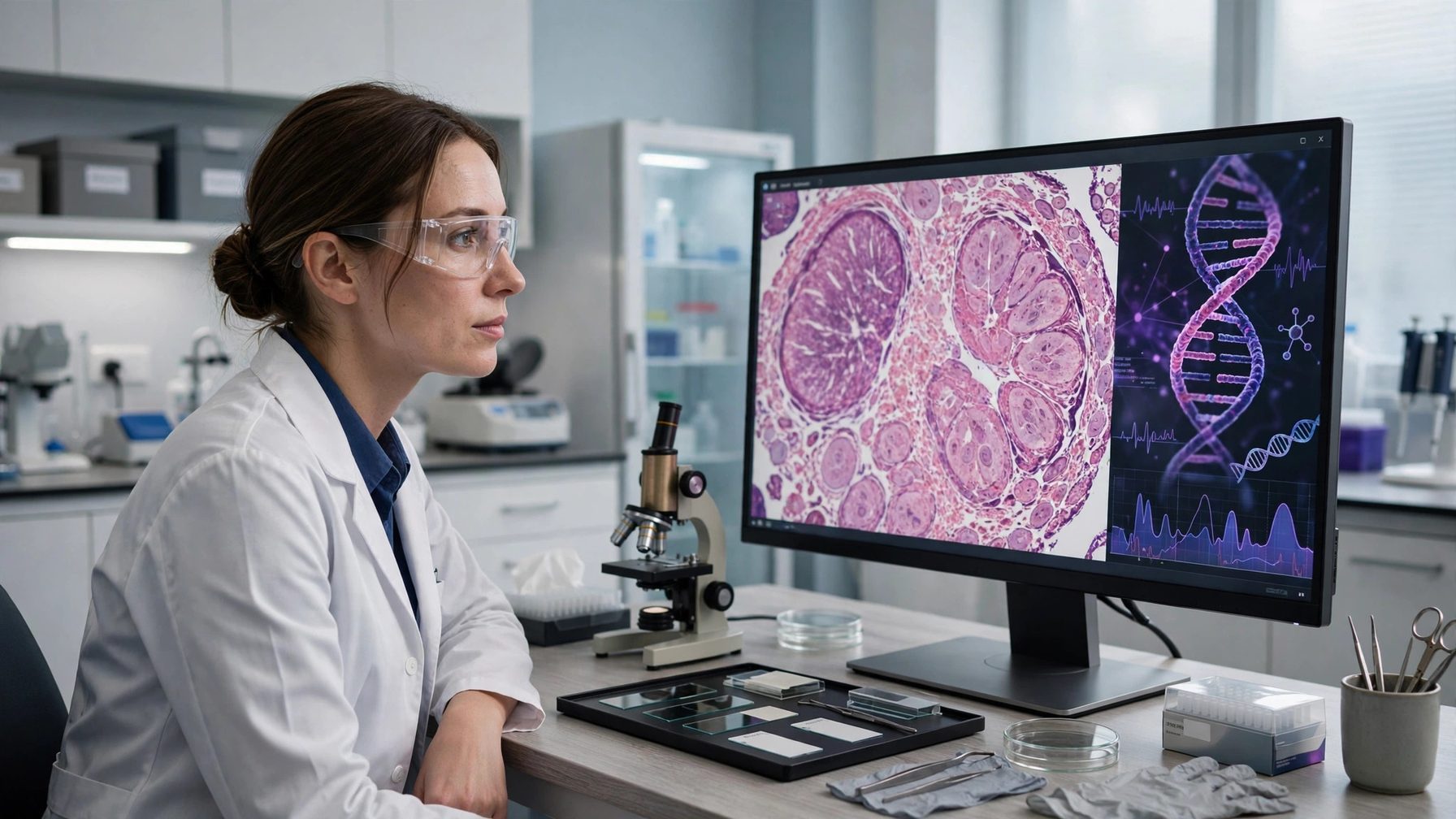
DeepGEM 2.0 was released on October 10, 2026, in Guangzhou: the National Center for Respiratory Medicine at the First Affiliated Hospital of Guangzhou Medical University, working with KingMed Diagnostics, launched this multimodal large model for lung cancer pathology and gene prediction, developed with the team of academician Zhong Nanshan. It does not try to replace diagnosis. It tackles an earlier bottleneck: genetic testing for lung cancer patients is expensive and slow, and many grassroots hospitals cannot run it at all. The model takes the digital image of a routine pathology slide as input and, in as little as one minute, returns mutation-risk predictions for 12 gene targets, telling doctors which direction is worth investigating first.
Which step it removes
Targeted therapy for lung cancer starts with knowing which driver mutation a tumor carries. The two existing routes are both painful. Stepwise single-gene testing checks EGFR first and works down the list, and some cases wait a month. Large next-generation sequencing panels scan hundreds or thousands of genes at once, costing from a few thousand to about 20,000 yuan, even though most patients carry only one or two driver mutations. DeepGEM 2.0 sits in front of both as a prescreen. Slide images already exist as a routine pathology product, so no extra sampling is needed. Patients flagged as high probability go straight to targeted PCR or immunohistochemistry confirmation nearby; low-probability patients can move to a large panel or non-targeted options. It replaces "test everything first" with "compute first, then test precisely."
From six targets to twelve
The previous generation predicted six genes — EGFR, KRAS, ALK, ROS1, TP53 and LRP1B — after the team distilled patterns linking images to genes from more than 8,000 pathology samples. Version 2.0 adds BRAF, ERBB2, FGFR, MET, NTRK and RET, bringing the total to 12 and covering every gene target of lung cancer targeted drugs currently approved in China. The reported prediction precision reaches up to 90%. By pairing the AI prescreen with targeted confirmation, the developers expect the overall cost of genetic testing to fall into the range of a few hundred yuan — not because sequencing itself gets cheaper, but because so many blind full-panel scans are filtered out.
Why the grassroots level is the real story
The point of impact is not the top-tier hospital but county and prefecture-level facilities, where sequencing capacity is missing and patients either travel upward and wait for typing results or start chemotherapy and miss the targeted-therapy window. A prescreen needs only digitized slides and compute, so triage can happen locally. This matches where medical AI is heading: Google's AMIE has moved differential diagnosis into real clinic workflows in a Lancet study, and the contest is shifting from whether a model answers correctly to whether it fits into an actual care pathway and saves patients time and money.
A prescreen is not a diagnosis
The 90% figure is a best case, not an average every target and every hospital will reach; sample sizes differ sharply by target, and rare-target predictions still need more real-world data. A prescreen also cannot replace confirmatory testing: high-probability results still need targeted verification, and a low-probability result must never be treated as proof that no mutation exists, because the patient pays for a miss. The developers themselves frame the next step plainly — turn the result from a sample into a product and push it into grassroots care. Three things are worth watching: when per-target accuracy data is published, how the model validates in outside hospitals, and how far the prescreen-plus-confirmation combination actually pushes total cost down in real billing. Until those answers arrive, DeepGEM 2.0 is best read as a prescreening upgrade with a clear clinical pathway, not as a substitute for genetic testing.