
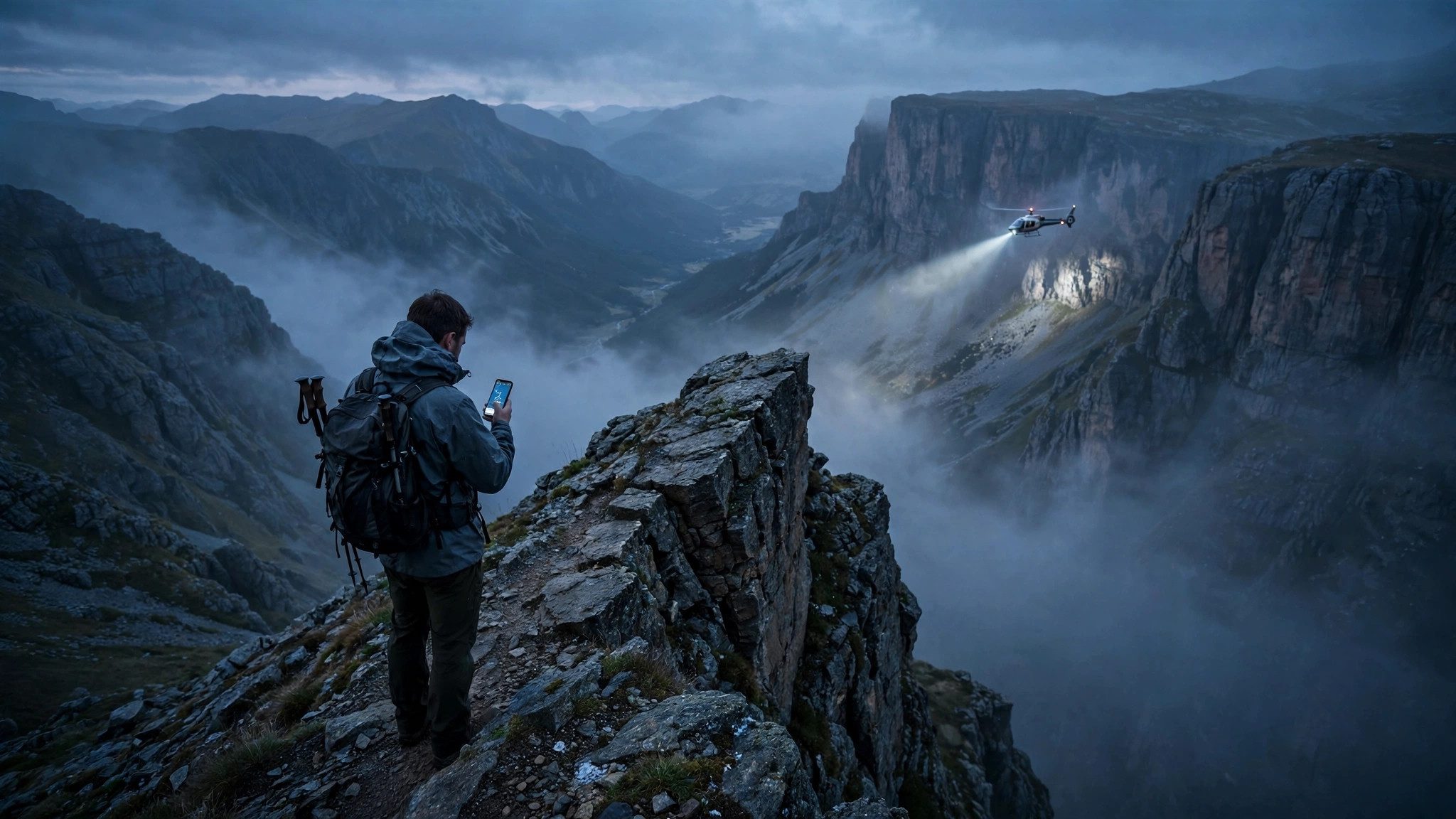
A hiking route generated by Claude led a 16-year-old onto a cliff face that requires climbing gear to pass. On October 3–4, 2026, the teen became stranded on Crown Mountain in British Columbia, Canada, and was lifted out by helicopter by North Shore Rescue. Outdoor outlet Backpacker published a detailed, rescue-team-verified account on October 7, followed by several other outlets. The story is not really about one model being right or wrong — it is about why route information from a chatbot cannot be used directly as outdoor navigation.
What happened
According to the rescue team and media reports, the teen rode a gondola up Grouse Mountain and asked Claude to plan a new route to Crown Mountain. Crown Mountain has a standard non-technical hiking route, but the model's route directed him toward Crown Gully and left him on a narrow ledge at the base of the Widowmaker Arete — a technical climbing route where a fall could mean serious injury or death. After he called for help, rescuers received the call at about 3:30 p.m.; because he was too close to the cliff wall for safe rotor clearance, two rescue technicians were inserted above him, built an anchor, rappelled down to him and moved him to an extraction point, hoisting him into the helicopter at about 6:30 p.m. and flying him back to the rescue base.
The rescue team's warning was blunt
North Shore Rescue search manager Paul Markey told multiple outlets the same thing in substance: Claude has never been to that mountain, has never walked that route and has no outdoor experience, so its routes are no substitute for a hiker's own research, training and navigation skills. Reports also noted that the teen did not blame Claude and said he had also consulted maps and other tools while planning; once stranded, he stayed in place and was reasonably well equipped — things he did right. In September 2026, a similar AI-route-related rescue occurred on California's Mt. Shasta, prompting rescue organizations to repeat their warning against planning trips with AI.
What chatbots can and cannot do outdoors
The root problem is that a language model produces a route description that reads plausibly, not a field-verified track: it does not know which section is a cliff, which gully holds water or ice this season, or whether the route exceeds the asker's ability. Outdoors, the sensible approach is to treat AI answers only as a starting point for gathering information: verify the route segment by segment against official trail descriptions, proper maps and recent first-hand reports; confirm difficulty ratings, gear requirements and bail-out points before setting out; carry offline maps and tell someone the plan. A chatbot can help organize a packing list or explain terminology — but using its route as navigation means outsourcing judgment to a tool that has never been there.