
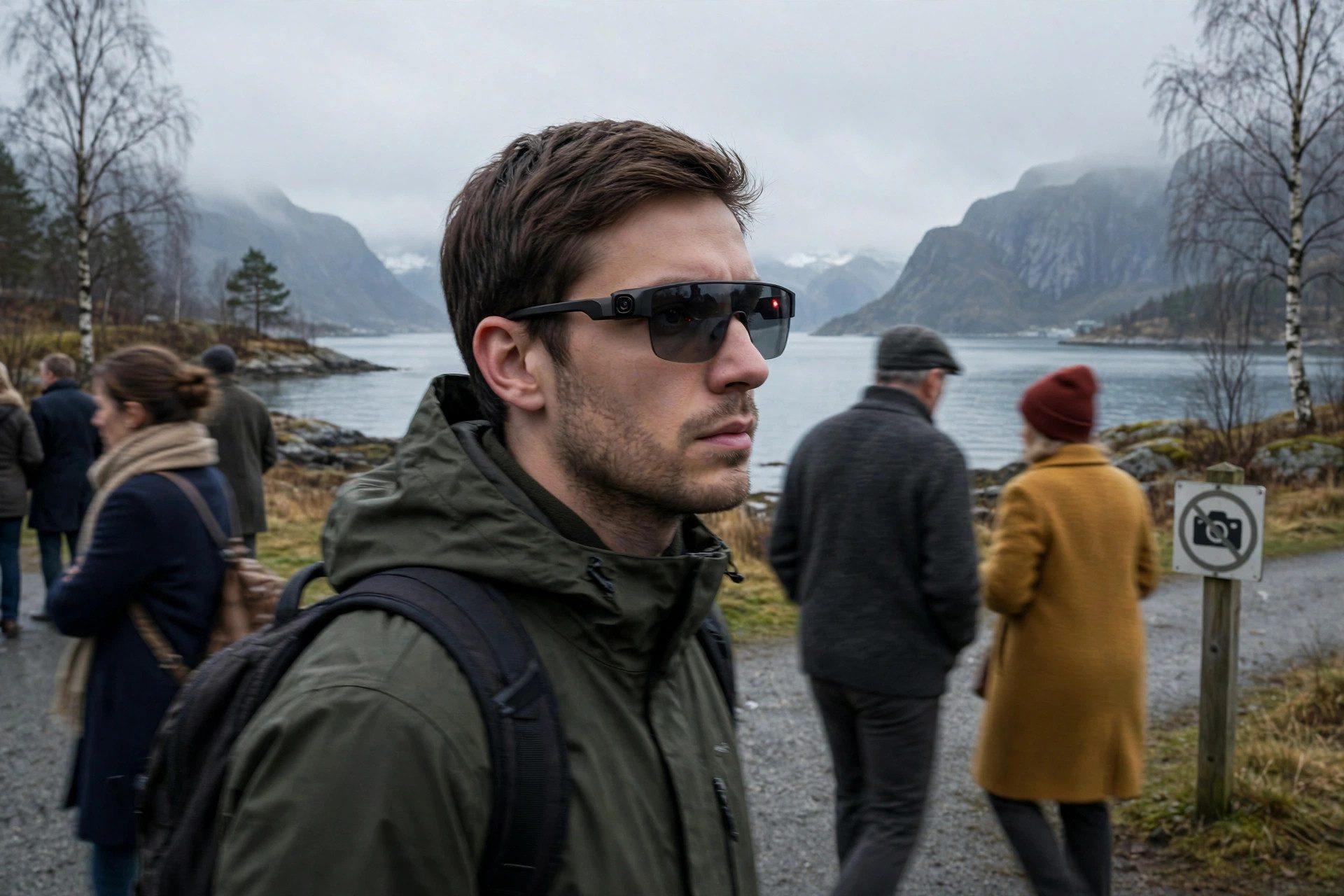
AI glasses may soon have to come off in some public places in Norway. The Ministry of Digitalisation and Public Governance announced on October 5, 2026 that the government will propose a temporary ban on using AI glasses in selected places, out of concern that people could be photographed, filmed or audio-recorded without knowing it. Digitalisation and Public Governance Minister Torgeir Micaelsen said he is worried that powerful new technology is entering settings where people are used to being unmonitored — yet could be recorded at any moment.
Three categories of places could be covered
According to the ministry, the candidate scope of the temporary ban falls into three groups:
- Crowded public places: parks, bathing beaches, museums, shopping centers and public events, including playgrounds and sports, music and cultural events.
- Places for children and young people: schools, kindergartens, playgrounds and youth clubs; whether higher-education institutions are included is still under consideration.
- Privacy-sensitive places: doctors' offices and other health institutions, swimming pools, and gyms with changing rooms and shower facilities.
The government stresses this is not a total ban: use would remain allowed where others are not at risk of being filmed without consent, and in purely private use. Exemptions will let vulnerable groups and socially beneficial uses in delimited cases continue. Which technology the ban covers is still being examined, with three options on the table: glasses with a camera and audio recording, glasses with a camera and AI functions, or a broader scope covering other body-worn technology with a camera, audio recording and/or AI.
Next steps: a bill soon, and an expert group for permanent rules
Norway's minority government says it will present a bill to the Storting, the national parliament, as soon as possible, and will appoint an expert group to assess the challenges of body-worn technology and advise on permanent national regulation. The point of a temporary ban is precisely to buy time for that assessment and for an informed public debate.
This is not Norway's first move to tighten the rules on smart glasses. On August 25, 2026, then-minister Karianne Tung proposed regulating smart glasses and similar devices more strictly than under current rules — for example, considering a ban on facial recognition of other people in public spaces. That direction had input from Datatilsynet, the data protection authority, and the Consumer Council, and the education minister had already urged schools to regulate smart-glasses use in their conduct rules. This site has covered small models that run locally on glasses; the stronger on-device AI becomes, the less recording depends on the cloud — and the harder it is for bystanders to notice anything at all.
A place-based ban leaves enforcement with a definition problem
The deepest social friction with AI glasses is that they erase the visible signal of recording: raising a phone is a gesture, while wearing glasses signals nothing. By banning by place rather than by product, Norway protects the most sensitive spaces first and leaves permanent rules for later. The real difficulty will be enforcement: as glasses come to look like ordinary eyewear, how widely the covered-device definition is drawn, and how a violation is established on the spot, will decide whether this temporary measure is a working buffer or mostly a statement of intent.