RobCo's valuation topped $1 billion on October 5, 2026: the Munich-based industrial robotics company announced that day that, through a transaction involving new investment and a sale of existing shares by employees, its valuation had reached 892.4 million euros (about $1 billion), doubling in nine months and making it Europe's newest robotics unicorn. According to Reuters reporting on the same day, the valuation came from a sale of existing shares following a funding round in January this year, and The Wall Street Journal said about $40 million worth of shares were sold mainly by employees to new and existing investors.
Doubling in Nine Months: First, Where the Money Came From
The nature of the deal needs to be made clear first: this is not a new round of large-scale financing, but a price set by a transfer of existing shares. In January, RobCo had just completed a $100 million Series C round led by Lightspeed and Lingotto, at a valuation of about $500 million at the time. In this transaction, existing shareholders including Sequoia, Lightspeed, Greenfield, Kindred, Lingotto and Promus Ventures continued to participate, while new participants included Cherry Ventures and the European Tech Collective, a group formed by a number of European tech founders; the company did not disclose the total size of the transaction or how much was new money versus existing shares. Co-founder and chief executive Roman Hölzl described the transaction as allowing the employees who helped build the company to realize part of its value early, while using strong investor demand to strengthen the company's foundations.
The Anchor for the Valuation Is Alfie: A Robot That Has to Learn to Work on Its Own
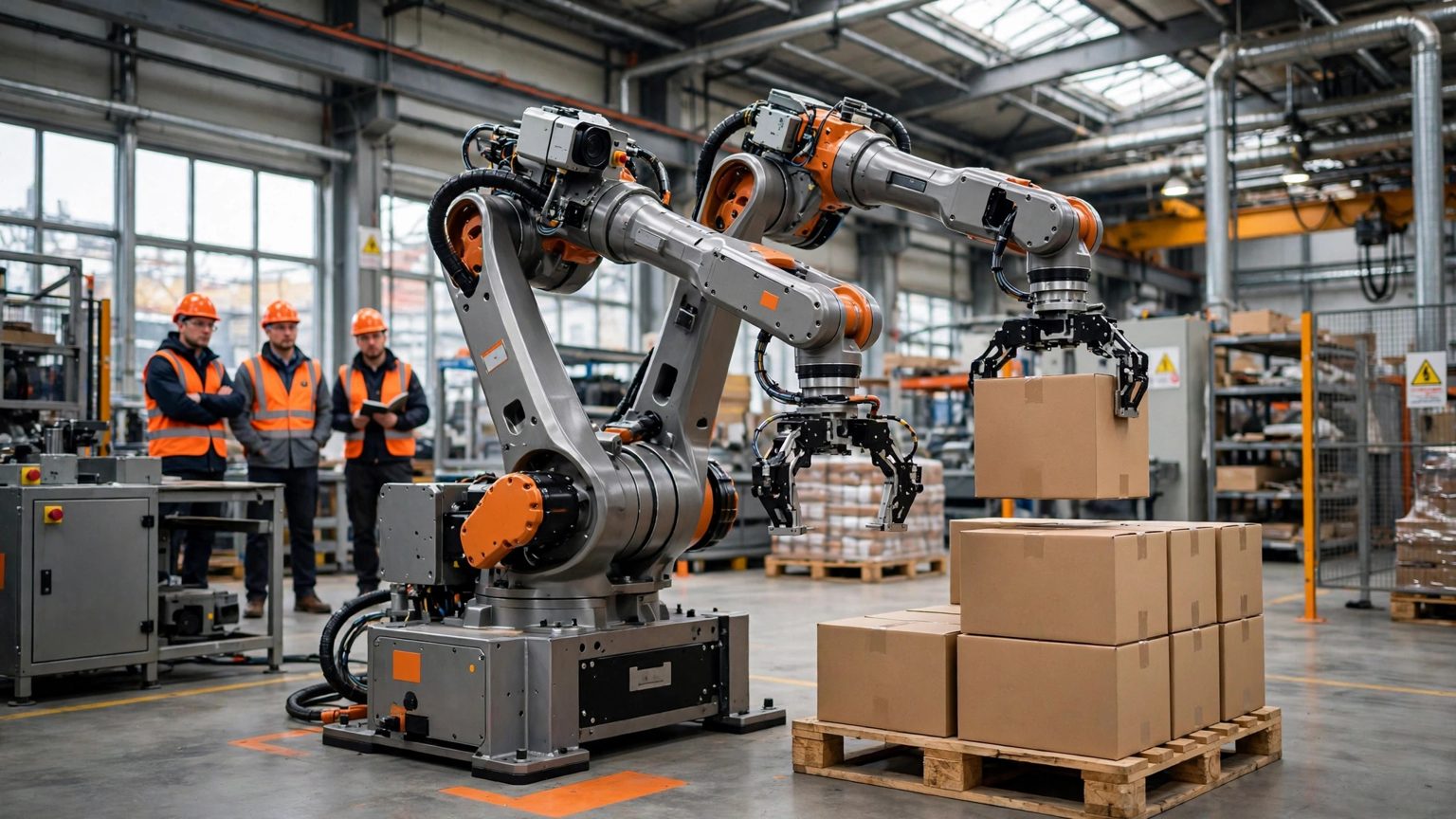
RobCo was spun out of the Technical University of Munich in 2020 and builds industrial robots driven by physical AI, combining perception, motion planning and self-learning methods so that robots can take on work that traditional automation has failed to handle for decades: factory-floor tasks involving mixed product categories, unstructured environments and high safety requirements. The company's flagship product is the dual-arm robot Alfie, which integrates perception, reasoning and execution, and is planned to be formally released for commercial use on March 4, 2027, at RobCoN, the company's first summit, to be held in Munich.
On the business model side, RobCo leases its capabilities through a robot-as-a-service approach, with zero upfront investment for companies, gradually automating existing processes such as loading, palletizing, dispensing and welding to reduce the risk of retrofitting. According to The Wall Street Journal, the company has sold more than 1,000 robots, and its customers include German automaker BMW. The industrial automation sector has seen a flurry of activity recently, with Schneider Electric just acquiring industrial software maker PTC for $22.6 billion, as software giants buy up the design side while robotics companies compete for the execution side, and the two lines converge on the same factory landscape.
Shifting Its Center of Gravity to the United States: Europe Supplies the Technology, America Supplies the Orders
RobCo entered the U.S. market in 2025, and the United States is now its fastest-growing market, with customer operations covering more than a dozen states, manufacturing and assembly operations in Austin, Texas, and a laboratory in San Francisco, while the chief executive himself has relocated to the United States to personally lead the expansion. Sequoia partner Luciana Lixandru's view is that AI should not stop at reasoning and generation, but should also be able to do hands-on work in the physical world.
RobCo is not an isolated case: Germany's NEURA Robotics and Agile Robots and the United Kingdom's Humanoid have all crossed the $1 billion valuation line. PitchBook data cited by The Wall Street Journal shows that robotics and physical AI startups raised a combined $33.4 billion in the first half of this year, exceeding the total for all of 2025. The enthusiasm is real, but a note of caution is also warranted: the $1 billion valuation was priced by a transfer of existing shares and has not been validated by a new large funding round, and RobCo's real test will come after Alfie goes commercial in 2027 — whether factory customers renew their leases, and whether the cost per robot per hour can beat human labor and traditional robotic arms, will be the answer to whether this valuation can hold up.