Muse Spark took center stage in a collaborative research effort that Meta announced on October 2, 2026: a team of Meta mathematicians worked with the model to produce six research papers, five of which answer previously unsolved open problems. The team used the Thinking Mode of Muse Spark 1.1 and 1.2, working entirely through the regular chat interface on meta.ai, with no custom research scaffolding.
From Competition Gold to Questions With No Answers
Earlier in 2026, Meta's models reached gold-medal level in five high-school Olympiads across mathematics, physics, and chemistry. But competition problems have known answers, while open research problems have no ready-made answer, and no one can guarantee that a given approach will work. The six papers span probability, differential equations, group theory, optimization, arithmetic physics, and non-associative algebra — placing the model squarely in front of exactly this kind of question.
Three Representative Results
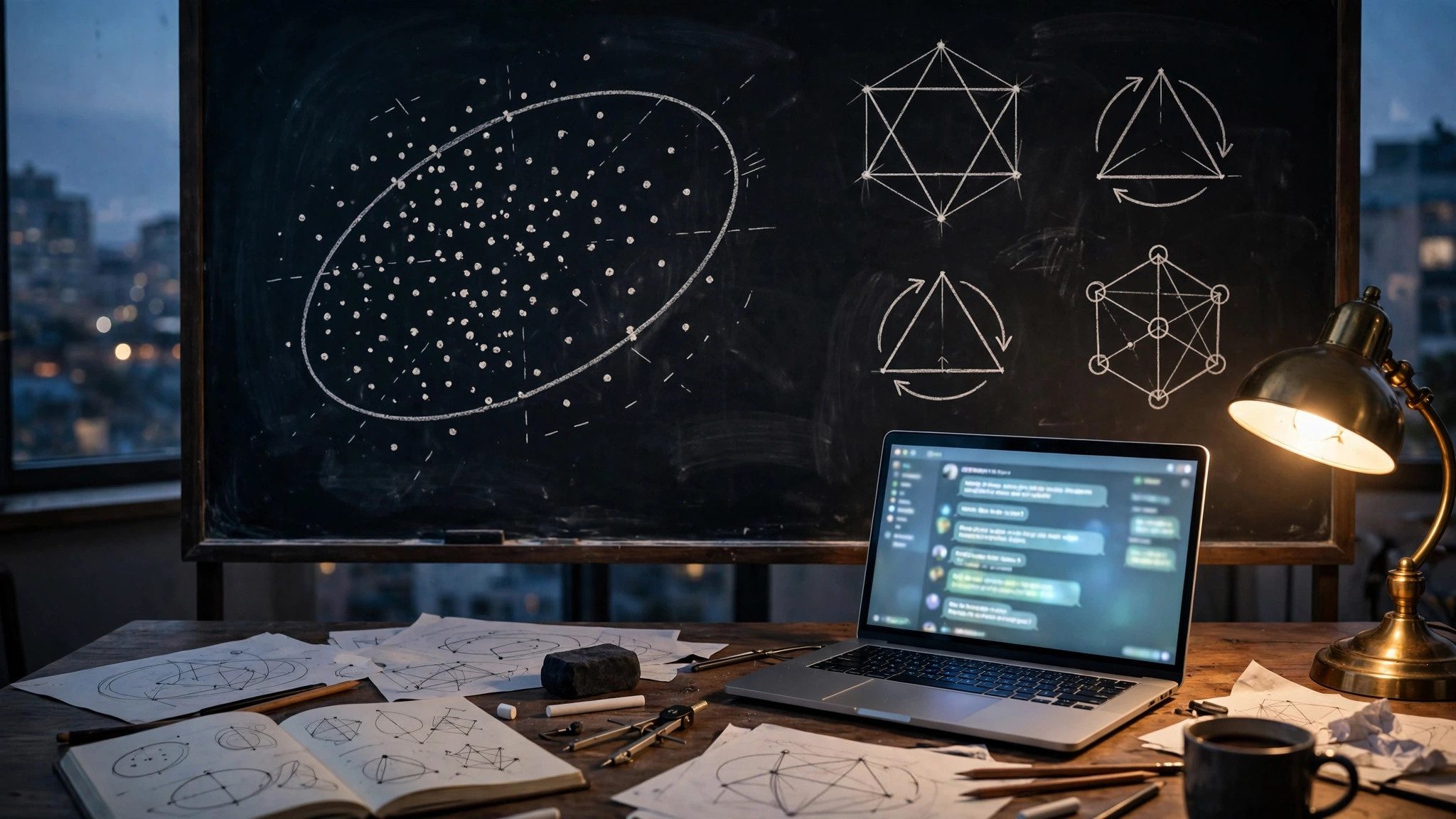
The probability work, led by Aykut Arslan, studies a rigorous threshold for Gaussian ellipsoid fitting and gives a sharp threshold for the number of points that can be fitted exactly; behavior exactly at the threshold remains unresolved, and Meta notes three independent concurrent works from August 2026. In differential equations, Leonard Dinh proved, for the mass-critical biharmonic nonlinear Schrödinger equation, that radial negative-energy solutions must collapse in finite time. This settles a problem left over from 2015 and confirms a prediction made by numerical simulations in 2002. In group theory, Brennan and Golich disproved a conjecture proposed by Kida in 2024: Muse Spark generated a GAP search program and found a group of order 384 as a counterexample. Meta also thanks another AI agent, Nilradical, which reported a different counterexample on September 16, 2026.
The remaining three papers advance their respective fields: the optimization paper discusses the tightness of cycle relaxations, the arithmetic physics paper proves an equality between two-point functions in string theory and height functions, an idea originating with Manin in the 1980s, and the non-associative algebra paper gives a three-dimensional counterexample for evolution algebras together with an alternative characterization.
Collaboration, Review, and Verifiability
The mathematicians led the research throughout, exploring jointly with the model, and a second group of mathematicians reviewed the work. Each paper clearly marks which passages were written mainly by the researchers and which by the AI, and notes the prior research it builds on; after completing the work, the team learned that other teams had independently published solutions to some of the same problems, and the papers acknowledge them. This practice of labeling authorship paragraph by paragraph and accounting for citations and concurrent work is at the heart of verifiability in research writing, and it connects with what AstaBrief Goes Open Source: Ai2 Uses a Small 8B Model to Write Research Reports With Citations focuses on: conclusions should be traceable, and contributions should be distinguishable.
The significance of these papers is not that a model scored more points, but that the standard of judgment has changed: from chasing competition scores to verifiable collaboration on questions with no answers. Public authorship labels and a clear review process let outsiders check, item by item and by the rules of the research community itself, what AI actually contributed to the work.