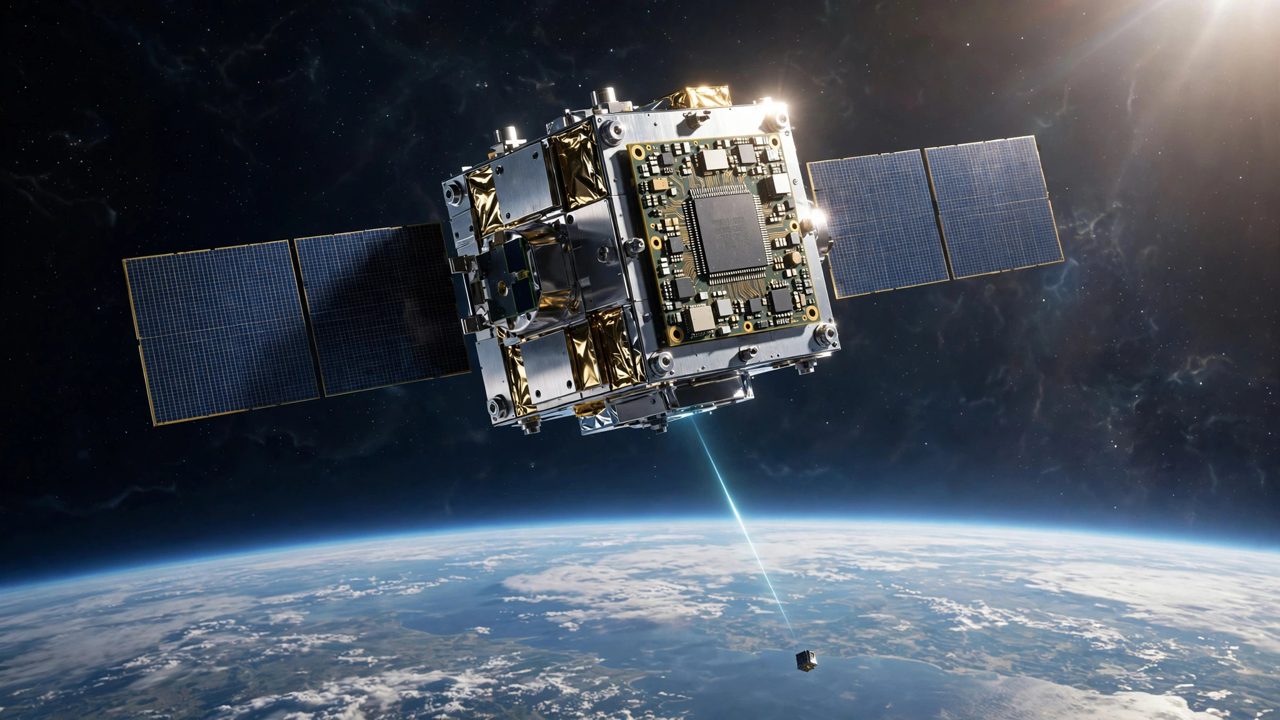
Project Suncatcher is Google's long-term research program exploring whether machine learning infrastructure could one day be hosted in space. On October 2, 2026, Google announced that its first prototype satellite is in orbit: the team has established contact with it and confirmed it is operating as expected. The satellite was built by Google in partnership with Planet and launched aboard SpaceX's Transporter-18 rideshare mission. Its job is deliberately narrow: put a TPU into the real space environment and see whether it survives.
The first satellite tests one thing: whether a TPU can live in space
Over the coming weeks, the team will gather in-orbit data, focusing on how TPUs handle the physical stress of spaceflight, radiation, and extreme temperatures. Considerable groundwork was done on Earth first: according to Google's official background post of September 24, the launch phase involves roughly ten minutes of acceleration, with TPUs and other components potentially enduring 50 to 100 g, and triaxial vibration testing has been completed. Trillium TPUs were radiation-tested at the proton beam facility of UC Davis's Crocker Nuclear Laboratory and withstood more than the total ionizing dose of a five-year space mission. Cooling relies on heat pipes plus radiators, validated in a thermal vacuum chamber. The peer-reviewed paper behind the mission has been published in the journal Joule.
Why Google wants to send compute into orbit
The math starts with energy. Near-Earth orbit offers near-constant sunlight, and solar generation there can reach up to eight times what is achievable on the ground — that is the starting premise of the space data center concept. In Google's longer-term vision, each future satellite would carry dozens of TPU chips running as a cluster, satellites would talk to each other over high-bandwidth, short-distance laser links, and multiple constellations would connect into scalable machine learning infrastructure. But the first prototype carries no real compute workload; it validates the question at the front of this road: can the hardware live?
The next milestone is in 2027
The plan calls for two satellites to launch in 2027 to test interconnection — the first step from "one satellite carrying chips" toward "a group of orbital compute nodes working together." Ground data centers are now paying for grid capacity, siting, and cooling; the space route faces radiation, the absence of maintenance, and launch costs instead — an entirely different engineering ledger. The first satellite's significance is that space-based compute moves from concept discussion to having actual in-orbit data. But interconnection, operations, and cost per unit of compute remain unverified, and drawing conclusions now would be premature.