
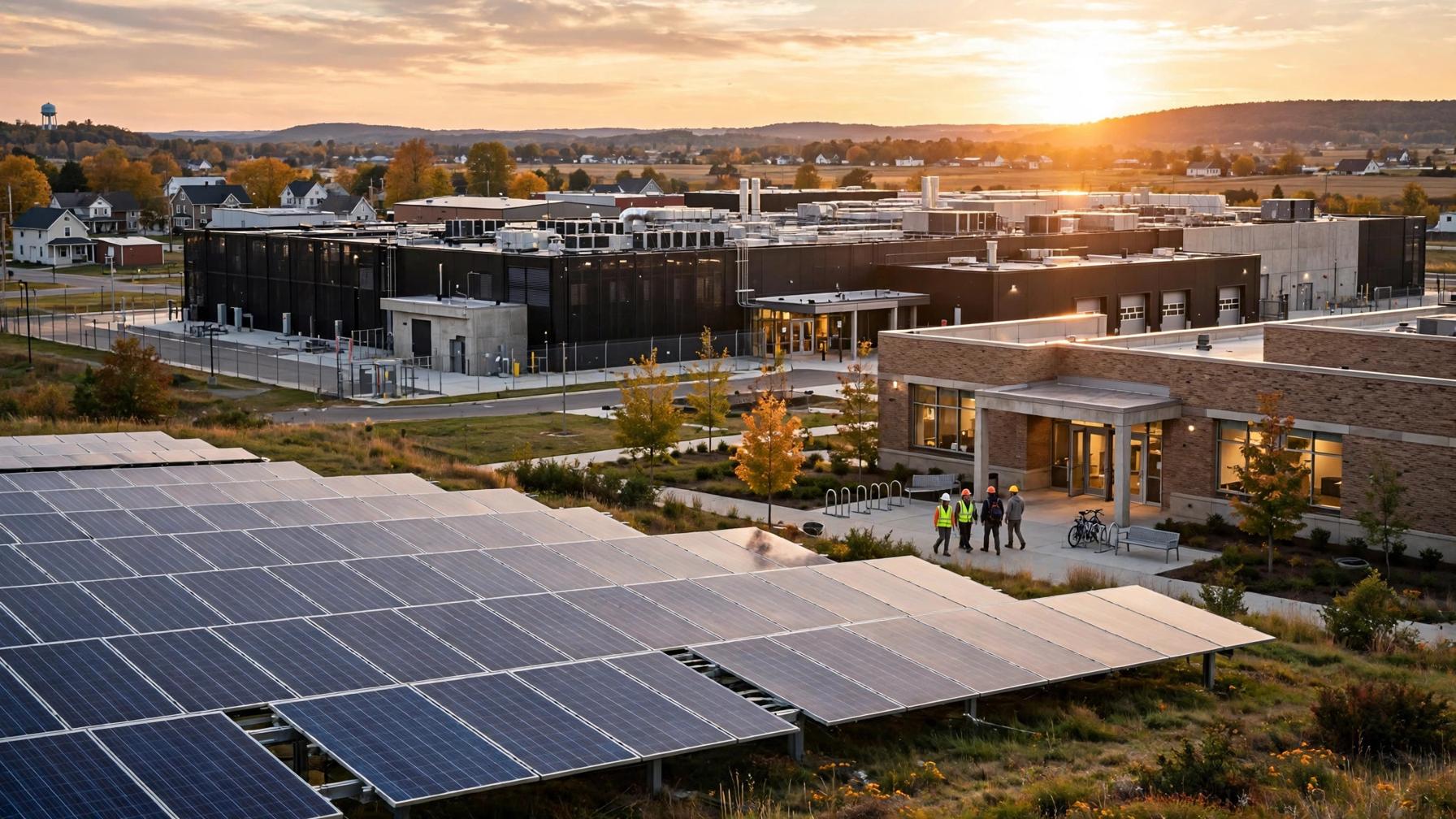
Amazon is starting to spend money outside the data center itself, on the tightest bottleneck in its expansion. On October 2, 2026, AWS Chief Executive Officer Matt Garman published an official article on About Amazon announcing the Built Together program, which will invest more than $1 billion over the next five years in U.S. communities that host its data centers, a plan cross-checked by Reuters reporting the same day. The money is additional investment: over the past three years, Amazon has already invested more than $1 billion in communities of this kind. The program rests on three pillars: education and employment pathways, energy affordability and water solutions, and flexible funding allocated according to each community's priorities.
First, the education and jobs pathway
The education component has the widest reach. Amazon will cover community college out-of-pocket costs for about 300,000 students, agreements with 26 colleges are already moving forward, and it has made an initial investment of more than $100 million to set up a community college fund. Job training is scaling up in parallel: the company will build 16 more training centers near data centers, on top of 3 existing centers and another 6 under construction, with expansion investment of about $100 million and a goal of training up to 100,000 workers per year by 2028. For local residents, these arrangements turn a data center from a facility that only takes land and electricity into a neighbor that offers tuition support and job training, and acceptance often starts to shift from there. The training is geared toward roles in operations, electrical work and construction, so graduates can move directly into jobs hiring locally.
Then, the bill for power and water
The most immediate community concerns about data centers focus on electricity prices and water use. Amazon plans energy-efficiency upgrades for more than 300 schools and community buildings and more than 30,000 homes, and officially estimates that each household could save about $700 a year on electricity bills. On water, replenishment projects are expected to return more than 8 billion gallons per year. The company also reaffirmed its goal of becoming water positive by 2030, replenishing more than it uses, and said the goal is officially 75% complete. Released alongside the investment is the Amazon Data Center Commitment: it will no longer sign confidentiality agreements with government agencies, will publish energy and water data every year, will use lower-emission backup generators at new sites, and will bear electricity costs so as not to push up local residents' power bills.
What it is buying is not equipment, but permission to keep building
The backdrop to this announcement is not an easy one. More than 100 data center moratoriums are under review across the United States, and local resistance has become a scheduling risk. Measured against capital spending, community investment is only a small part: in comparable compute deals, Broadcom's $42 billion loan tying it to Anthropic's compute business also shows how the giants are using long-term capital to lock in building capacity. Amazon says it invested $276 billion in data centers between 2011 and 2025. Garman compared this round of construction to the interstate highway system begun in 1956, stressed that it is private investment rather than taxpayers' money, and attributed part of the opposition to misinformation — that attribution is his own wording.
From an industry perspective, the bottleneck for AI infrastructure is shifting from chips and power to land and community consent. The $1 billion is not buying equipment; it is buying the social foundation that lets later sites break ground and expand. The caveat deserves to be stated just as clearly: Amazon has not published a full breakdown of the $1 billion, and how much each pillar receives and which communities the money flows to are not yet transparent. Whether the commitments are kept will depend on the energy and water data published year by year and on actual disbursement progress — which is precisely the point of its pledge of annual disclosure. For new projects still at the site-selection stage, being able to settle these terms in advance is becoming a precondition as important as grid access.