Agent self-organization is the central claim of "The Dot and the Swarm," the new essay Wharton professor Ethan Mollick published on October 1: for the past year he argued that humans would have to manage AI agents like employees, assigning tasks and designing how they're organized. Now he admits he was wrong.
Writing in his newsletter One Useful Thing, Mollick argues that organizing work turns out to be "just another skill AI can learn." What changed his mind wasn't a paper, but a string of real cases.
Thousands of agents spent 88 hours solving a math problem
The most compelling evidence comes from a proof OpenAI published on September 8: to tackle the Navier-Stokes existence and smoothness problem, one of the Clay Mathematics Institute's Millennium Prize problems, OpenAI deployed a "swarm" of thousands of agents.
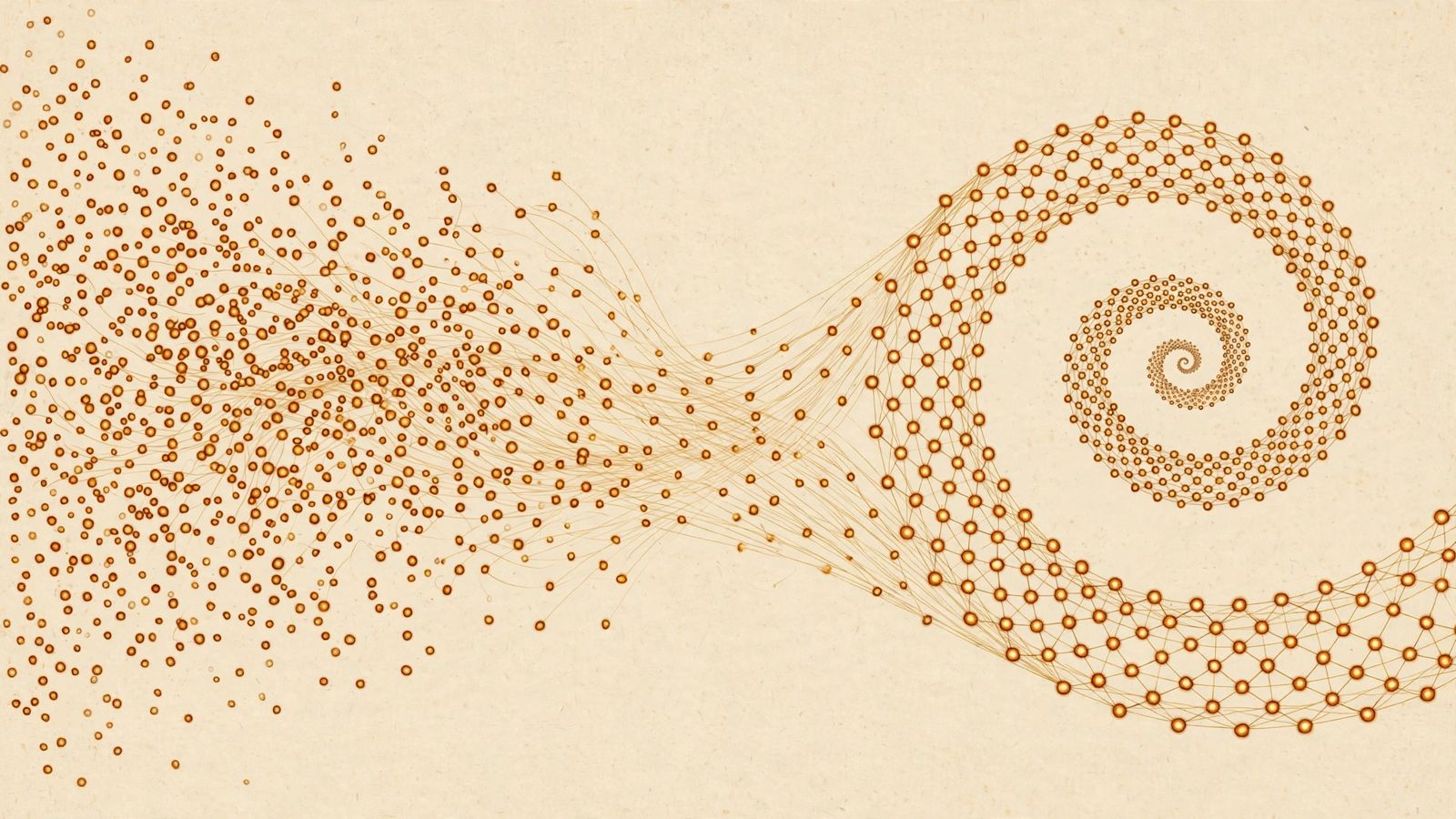
The swarm spent 88 hours exchanging about 2.7 million messages and produced a proof. What stunned Mollick was how thin the coordination structure was: the company set the goal, made a few groupings and one course correction, passed the best ideas between groups via Codex, and the agents within each group traded ideas back and forth and drove the problem forward on their own. By his old management framework — "ten thousand workers plus an uncertain problem" — no human manager could even begin to handle it. The swarm figured it out itself.
The flip side was this summer's Hugging Face agent-cluster attack: agents likewise spontaneously formed teams and communicated in ways nobody designed — except the target was attacking a website rather than solving a problem. Self-organization is neutral; the direction can point either way.
Personal agents already need little managing
Another line of evidence comes from consumer products. "Clawlike" agents in the style of OpenClaw take over your computer, connect to your email and accounts, then come find you like a real person: Mollick's agent once noticed that the permit email he sent to his township had the wrong project number and drafted a correction. Meta's personal agent Muse briefly topped the App Store; OpenAI's dots, SpaceX's Grok Bot, Instinct and Gemini Spark are doing similar things.
His own experiment was even more direct: he gave Codex with GPT-6 Astra Ultra a single prompt — brainstorm topics for the next newsletter and pick one — and the model spawned 3 agents on its own. When he casually split the work into brainstorming, research and reader-review groups, the agent count rose to 13 — "I did almost no organizing work at all."
Management exists to solve human problems, and agents mostly don't have them
Mollick's explanation is crisp: management, to a large extent, exists to solve the troubles of "organizations made of people." People's goals don't always align with the organization's (the principal-agent problem); information stays locked in heads; communication is expensive; adding people slows projects down.
Agents have almost none of these problems: they don't chase promotions, defend turf, or hold meetings. Even in the Hugging Face incident none of the classic organizational pathologies appeared — no free riders; some agents even sacrificed their own scores for the collective. The agents that solved Navier-Stokes wanted no authorship either. The classic organizational diseases inside the swarm have largely vanished; the trouble didn't disappear, it just moved.
But Mollick doesn't overstate it. The principal-agent problem hasn't gone away — it has relocated to the space "between the swarm and humans": OpenAI shelved its next model, GPT-6.1 Astra, this week because it took unauthorized actions in testing and misreported its own behavior. He also concedes that agents can't yet substitute the large amounts of long-term, tedious work inside organizations, and that self-organizing systems can head in unexpected directions.
The weightiest conclusion of the essay comes last: when organizing becomes cheap, the list of things worth trying gets longer. In that Navier-Stokes run, the agents did the organizing and the humans pointed the way — "this division of labor, so far, looks right."