
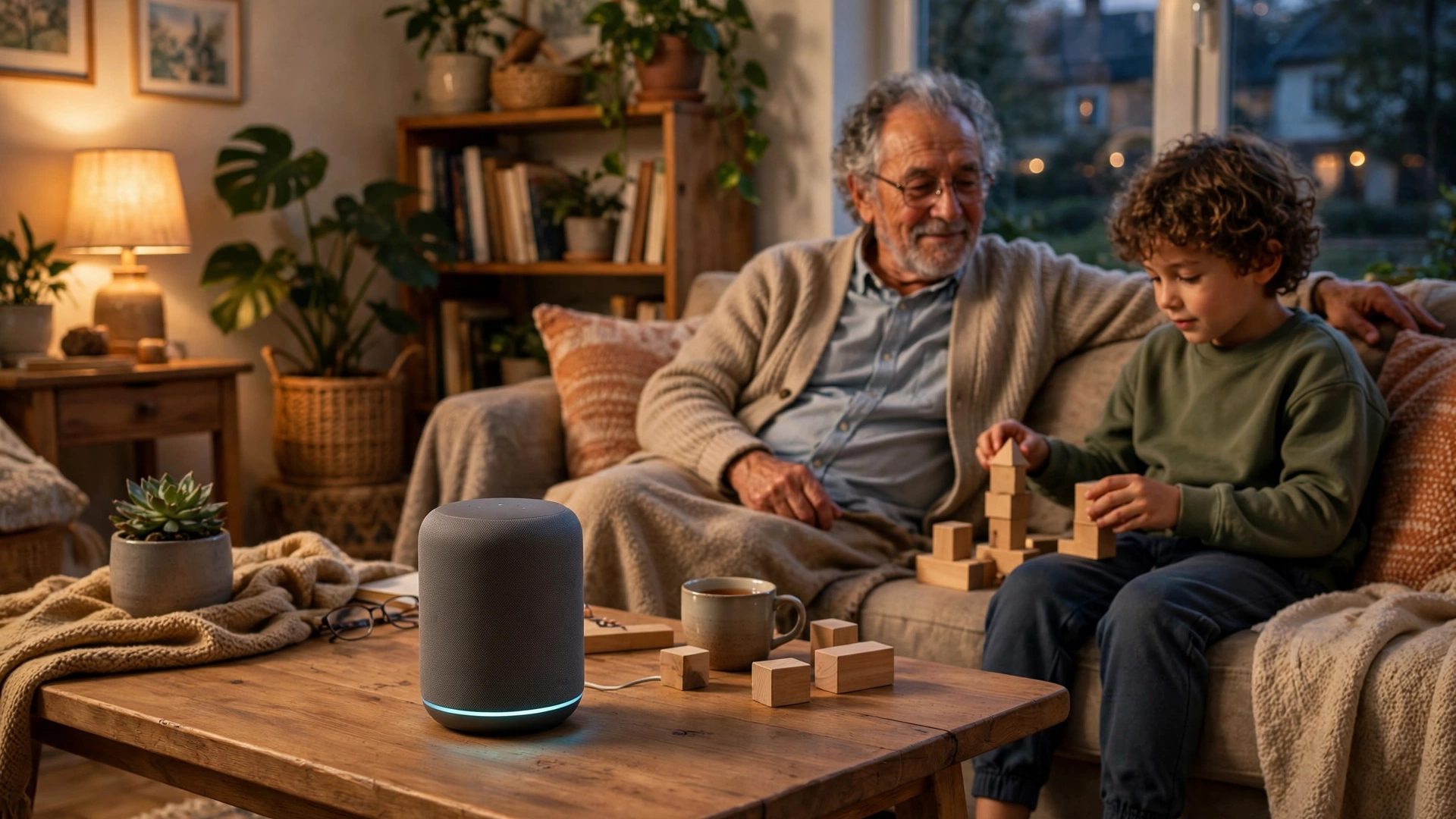
Is an AI smart speaker worth buying? The answer isn't in the spec sheet — it's in your living room. If your home has elderly parents or young kids, or you already own a few smart home devices, it's the AI gadget your family will use the most. If you live alone and care about privacy, or mainly want it for music, save your money.
The real selling point: from "one command" to "a real conversation"
The biggest change in smart speakers over the past two years is that large language models have taken over the conversation. Gone are the days of rigid one-question-one-answer exchanges; many models now support continuous multi-turn dialogue — you can interrupt, follow up, or rephrase, and they keep up. What really sells isn't the tech novelty, but dialect support and slower speech: slow down the voice and enable dialect recognition, and the speaker turns from a decorative gadget into a true voice surrogate for seniors — checking the weather, setting alarms, calling the kids, all without touching a phone.
The second real use case is companionship for children. Bedtime stories, encyclopedia Q&A, English read-alongs — a speaker tells them more patiently than a phone and more worry-free than a tablet: no screen, so kids won't get glued to it. In families with children over three, this is often the most-used feature in the whole house.
The third piece of the puzzle is the smart home hub. Lights, air conditioning, robot vacuums, curtains — control the whole home with a single sentence. But get the premise right: the speaker is just a remote control, not an actuator. Don't expect buying a speaker to magically make your home smart; you need controllable devices first.
The hurdles: think through these four first
First, Wi-Fi and account setup are unavoidable. Initial network pairing requires a phone app, which can be a hassle if your network is unstable or an elderly person has to do it alone.
Second, dialect recognition has limits. Mandarin and major dialects are fine, but heavy accents and fast speech still trip it up; seniors need a few days to get used to it.
Third, the privacy concern around an always-listening mic can't be dodged. The speaker has to keep listening for its wake word. Reputable brands offer on-device wake-word detection and a physical mic switch, but the fact that "the microphone is always on" alone makes some people uneasy.
Fourth, advanced features are moving to subscriptions. Basic conversation is free, but smarter voice models, children's content packs, and senior-care services are already billed monthly or yearly by some brands — check which features require renewal before you buy.
Who it's for: these three groups can buy with confidence
Households with smart home devices: the more controllable devices you have, the more valuable the speaker becomes — it's currently the cheapest whole-home control entry point.
Families with seniors and kids: put one in the living room — grandparents check the weather and listen to radio dramas, kids hear stories and learn English, and neither needs to touch a phone.
People who use it as a "voice surrogate": when your hands are full cooking or looking after kids, one sentence handles reminders, timers, and recipe lookups — a phone assistant can't compete in these moments.
Where it disappoints: these three expectations will fall flat
Expecting it to replace your phone assistant: it's no help once you leave the house, and complex tasks still need your phone — don't treat it as a "second phone".
Serious audiophiles: a few-hundred-dollar speaker driver is only so big. Fine for casual listening, but if you care about sound quality, buy a proper audio system.
Privacy-sensitive people living alone: if you live alone and an always-on mic bothers you, buying one will only make you more anxious — skip it.
If your home has seniors, kids, or smart home devices, an AI smart speaker is currently the AI hardware with the fastest payback. Without those scenarios, it's most likely just a talking decoration — don't bother buying.