
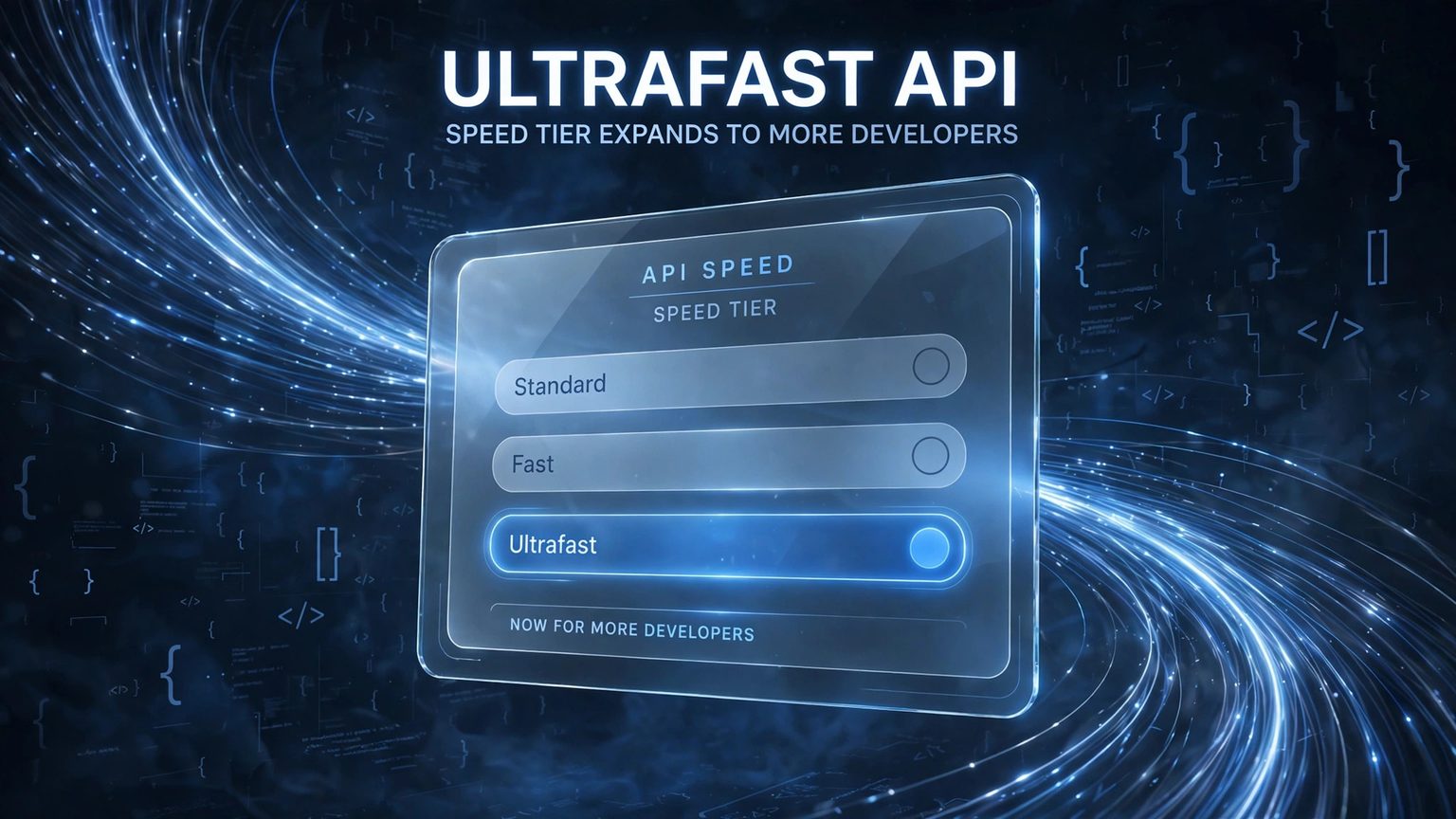
Ultrafast API is the ultra-low-latency inference tier OpenAI launched in August alongside GPT-5.6 Sol, officially rated at up to 750 tokens per second — 14x faster than the Standard tier. On September 26, developers spotted Ultrafast references in the OpenAI Platform and API docs; a screenshot posted by imjustnewatai on X shows "Ultrafast" appearing in the cloud agent API documentation. Separately, TestingCatalog found a hidden speed selector in the works for the Responses API Playground, letting developers switch between Standard, Fast, and Ultrafast — currently hidden from view.
Not a new model — a speed tier
Ultrafast isn't a new model; it's a service tier. The API already offered Standard and Fast (Fast is documented, selectable via service_tier: "fast" in requests); Ultrafast would be the third and fastest tier. It runs on Cerebras infrastructure — OpenAI announced a 750MW capacity partnership with Cerebras earlier this year, to be deployed in phases through 2028. Today Ultrafast is available to only a limited set of customers, with GPT-5.6 Sol the only confirmed supported model.
What it means for developers
The practical shift is that latency becomes something you can buy by the tier. Latency-sensitive workloads — support chat, real-time voice, code completion, trading risk controls — have long forced a tradeoff between smaller models for speed and larger models at the cost of delay. With three tiers, teams can match each workload to the latency it's actually worth, reserving premium inference for paths where it moves revenue or experience. Tiered speed also makes latency a first-class citizen of API economics — application architectures will need latency budgets.
Three open questions
First, OpenAI DevDay is September 29, and an expansion announcement there isn't impossible — but nothing is confirmed. Second, whether the GPT-6 family (Sol, Astra) will support Ultrafast remains unknown. Third, pricing — OpenAI hasn't disclosed the Ultrafast premium.
Docs and a Playground switch appearing together suggests a coordinated warm-up, not an accidental leak. For developers, the real preparation isn't waiting for a toggle to flip — it's starting to budget latency per workload: which paths are worth paying for milliseconds, and which aren't. Answers land on September 29 at DevDay; until then, this remains an unconfirmed report.