
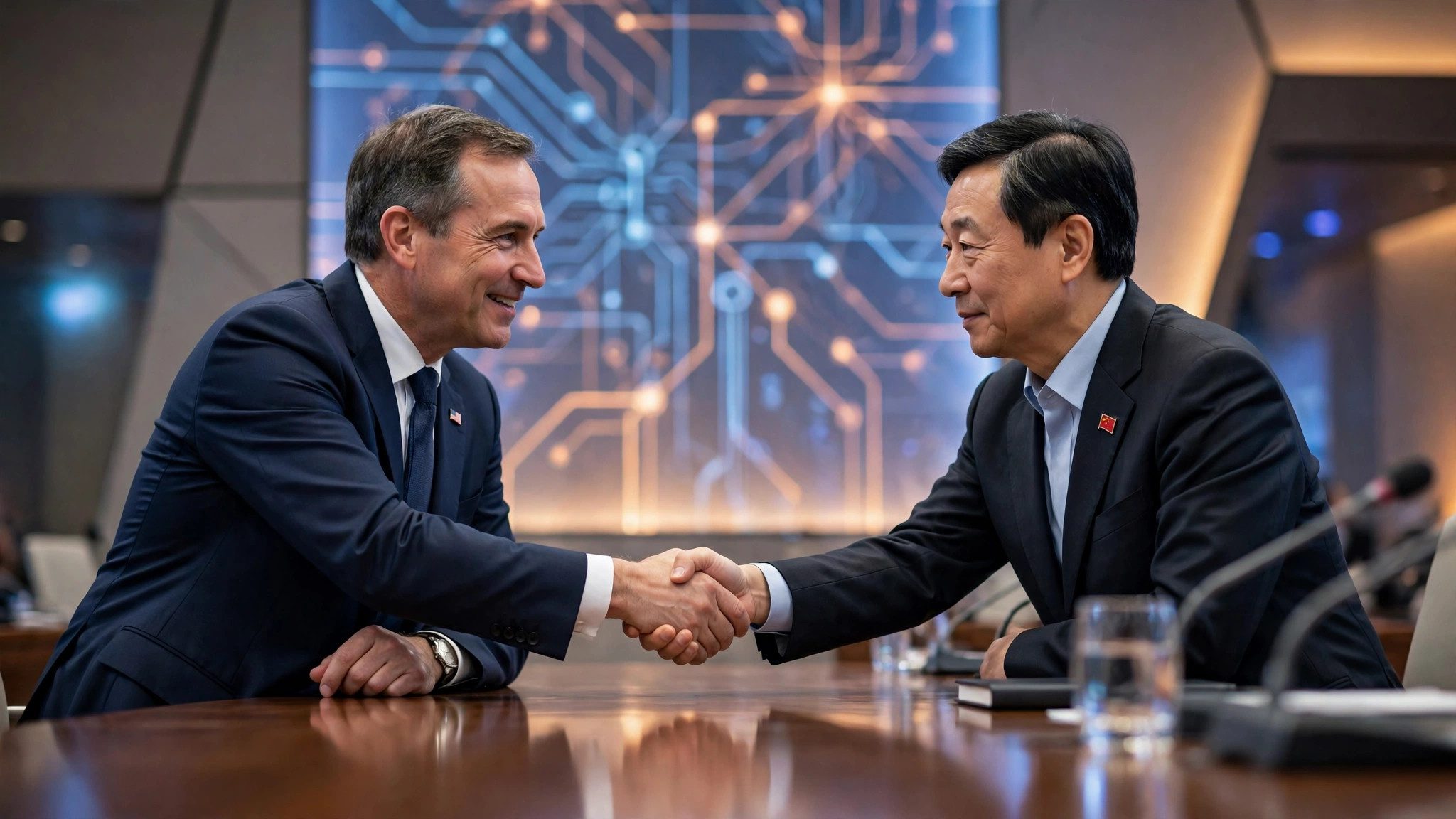
A US-China AI dialogue mechanism has received its first substantive starting signal. On September 26, 2026, the White House announced that US President Donald Trump had spoken by phone with Chinese President Xi Jinping that day, and that the two sides agreed to launch dialogue and cooperation on artificial intelligence. Trump later wrote on social media that the call went "very well" and that the two reached a number of consensuses, adding that he hopes to reach an agreement with China during his planned visit next April.
According to publicly disclosed details, the call lasted about 40 minutes. The two sides exchanged views in depth on issues of common concern and reached an eight-point consensus, with the agreement "to launch dialogue and cooperation on AI" among them. This is the first time the two heads of state have explicitly put an AI dialogue mechanism on their bilateral consensus list.
Why does this statement matter? China and the United States are the two strongest AI powers in the world: the US holds the lead in high-end computing chips and frontier large models, while China has a vast application market, engineering talent and a fast-iterating industrial ecosystem. At the same time, the two countries are locked in fierce competition in AI — the US has imposed export controls on high-end AI chips, while China has placed AI inside its national security and technological self-reliance strategy. The fiercer the competition, the more both sides need a communication channel that can manage risk. That is the practical meaning of a "dialogue mechanism": not to eliminate differences, but to put guardrails around them.
For industry, the immediate impact is on expectations. Over the past few years, compliance teams at AI companies have been scrambling to keep up with changes to export-control lists, and chip supply chains have been constantly reorganizing. Once a US-China AI dialogue mechanism starts operating in substance, rules around compute flows, model safety standards and cross-border data could shift from "unilateral controls" toward "bilateral coordination" — directly affecting compliance costs and market strategies for multinational AI companies, chipmakers and cloud providers.
The second thing to watch is the scope of the agenda. So far the official disclosure is a single sentence about "launching dialogue and cooperation" — no timetable, no lead agencies, no topic list. Whether the dialogue will lean toward AI safety and risk governance or touch on industrial cooperation and mutual recognition of standards remains unclear. Trump's mention of hoping to reach an agreement during his China visit next April suggests Washington wants to package AI issues into a larger bilateral deal, but the shape of any agreement is equally unknown.
One point of caution: a principled consensus at the leaders' level is still a long way from a functioning mechanism. From setting the agenda to agency-level coordination to holding a first round of talks, each step could be disrupted by other variables in the bilateral relationship. It is more accurate to read this as "both sides agreed to sit down and talk" than as "a signal of warming ties."
Three milestones to watch next: whether the White House or Beijing publishes concrete arrangements for the dialogue mechanism; whether any AI-related agreement text emerges around Trump's China visit next April; and whether working-level contacts between the two sides' technology agencies begin to appear. Any one of these would turn this story from a "statement" into a "process."
Readers interested in the broader US-China AI dynamic can follow our US-China AI Competition and Cooperation topic page, where we will keep tracking what comes next.