1. Abstract
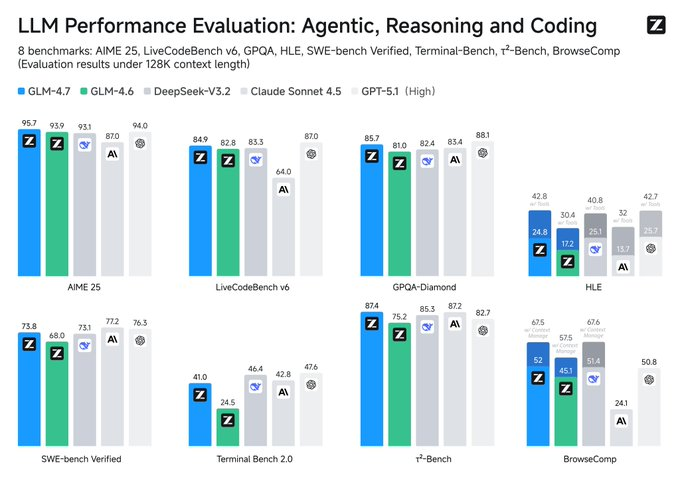
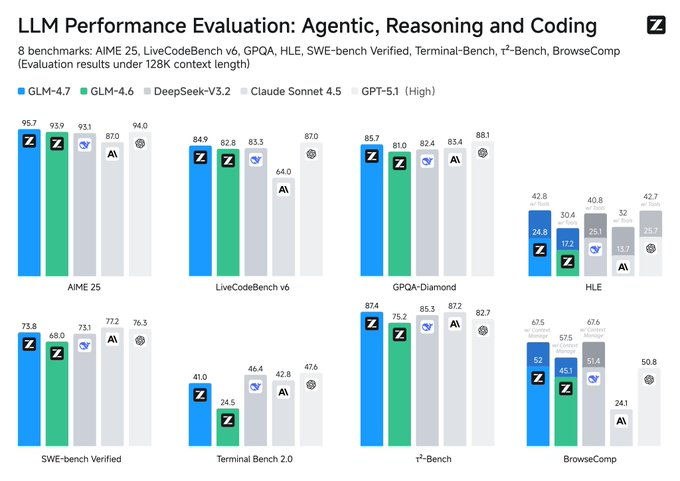
GLM-4.7 is an open-source rights-heavy language model released by zai-org. According to official information, it has greatly improved coding capabilities, complex reasoning, and the use of multi-step tools compared to GLM-4.6, and also enhances the performance of general scenarios such as dialogue, creative writing, and role-playing. The actual effect will be affected by the prompt, toolchain stability, and deployment configuration, so it is recommended to conduct a regression evaluation based on your real tasks.
2. Core features
- Intelligent asana programming capabilities are strengthened: more emphasis is placed on the closed loop of requirements understanding, task disassembly, execution verification and iterative repair.
- Complex reasoning improvement: For multi-step reasoning, long-link tasks and constraints are more robust (subject to the official description).
- More mature tool use: It is more suitable for the workflow of "completing tasks with tools" such as function calls, terminal operations, and retrieval/browsing.
- Thinking Mode is more controllable: Provides a variety of thinking modes to balance stability, latency and output style.
- Optimization of generation quality: Dialogue is more natural, and the consistency between creative writing and role-playing is better (subject to the official description).
3. Installation
- Download weights: Get model weights, configurations, and example descriptions from Hugging Face.
- Choose an inference framework: You can use vLLM, SGLang, or Transformers for local inference and deployment.
- Prepare the operating environment: large models have high requirements for video memory, disk and bandwidth; Strategies such as quantization, parallelism, and caching can be adopted to reduce costs and increase throughput (subject to official and community practices).
4. Typical use cases
- Code generation and repair: generate patches, complete functions, position errors, run tests and iteratively repair.
- Terminal automation: environment troubleshooting, log analysis, dependency conflict handling, and batch execution of scripts.
- Tool Orchestration Agent: String search, database, ticket system, CI/CD and other tools into a multi-step process.
- Front-end and content generation: Quickly produce page structure, component styles, and presentation copy drafts to assist in prototype verification.
5. Ecology and competing products
- Ecosystem: Provide online experience portals, subscription-based coding plans, and weight and technical blogs to facilitate from trial to local deployment.
- Competing products: similar open source and closed source models have their own emphasis on coding, reasoning and tool use; When selecting, it is recommended to rely on your data, real toolchain, and evaluation script, rather than just looking at a single list or a single display result.
6. Limitations and precautions
- Computing power and cost: The model volume is large, and the local deployment needs to evaluate the video memory and throughput. Long contexts and long outputs can further amplify resource consumption.
- Tool security: When executing terminal commands, browsing and external APIs, you need to do a good job in privilege isolation, auditing, timeout, and retry policies.
- Reliability and verification: Key codes and conclusions still need to be tested individually, static checked, and manually reviewed to avoid errors caused by hallucinations or boundary conditions.
7. Project address
http://huggingface.co/zai-org/GLM-4.7
8. Frequently asked questions
Q: Where can I download GLM-4.7 Weights?
A: Download the weights and configuration files from Hugging Face's zai-org/GLM-4.7 page.
Q: How can I experience GLM-4.7 online (chat.z.ai)?
A: Online conversational experience with chat.z.ai.
Q: How do I enable the GLM-4.7 Coding Plan default model (z.ai/subscribe)?
A: Follow the instructions on the subscription page to select a package and complete the configuration.
Q: What on-premises deployment methods (vLLM/SGLang/Transformers) does GLM-4.7 support?
A: It can usually be deployed using vLLM, SGLang, Transformers, and other frameworks, and the specific steps are subject to the model page and official documentation examples.
Q: What is the use of GLM-4.7's Thinking Mode?
A: It is used to improve the planning and stability of multi-step tasks; Different modes have trade-offs in terms of latency and output style, so it is recommended to choose according to the task experiment.