Latest AI News: The World Artificial Intelligence Conference opens, with 29 countries preparing to establish AI cooperation organizations
24-hour AI News Snapshot: Kimi K3 resets the scale of open-source models, intensifying global AI gov
Chat with RTX is a natively running generative AI chat app from NVIDIA that aims to provide users with personalized AI assistants. The app leverages NVIDIA's TensorRT-LLM, NIM microservices, and RTX acceleration technologies to enable users to convert local documents (e.g., .txt, . pdf、. doc/.docx、. xml) or YouTube videos as a data source to build your own chatbot. Through Retrieval Enhanced Generation (RAG) technology, Chat with RTX can quickly provide contextual answers related to user data, improving query efficiency. The app runs entirely locally to ensure data privacy and security, and is suitable for a variety of scenarios such as content creation, office automation, and programming assistance. Currently, Chat with RTX runs on devices with NVIDIA GeForce RTX 30 or 40 Series GPUs (at least 8GB of VRAM) and Windows 11 operating systems, with a package size of around 35GB.
Chat with RTX is better suited for local data Q&A, private knowledge retrieval, and native AI assistant experiences. Its biggest feature is the combination of personal data for local generative Q&A.
According to the site, it requires an NVIDIA GeForce RTX 30 or 40 series graphics card, at least 8GB of video memory, and runs on a Windows 11 device.
Because it runs entirely locally, users' documents and data do not need to be uploaded to an external cloud, which is important for privacy-demanding scenarios.
It supports a variety of local document formats and YouTube videos as data sources for Q&A flows.
While regular online assistants emphasize out-of-the-box, Chat with RTX emphasizes on-premises, private data access, and hardware acceleration.

ChatGPT is a full-scenario artificial intelligence chatbot launched by OpenAI, integrating intelligent question answering, long-form writing, AI programming, code debugging, image recognition and voice synthesis, and supports multilingual real-time interaction. The platform offers advanced features such as plugin marketplaces, browser calls, API interfaces, team collaboration, and enterprise-level deployment, and is powered by the GPT-4o large model to accurately understand context and generate high-quality content. ChatGPT can be widely used in intelligent customer service, marketing copywriting, academic research, software development, knowledge management and other scenarios, supporting simultaneous use on the web, mobile and desktop, and has a privacy protection mode, and the data does not participate in model training, which is safe and reliable, helping individuals and enterprises significantly improve work efficiency and creative capabilities.
Microsoft Copilot is a multimodal AI assistant launched by Microsoft, integrated with Windows, Microsoft 365, Edge browser and other platforms, providing text generation, voice interaction, image creation and other functions. Based on GPT-4 and Microsoft Graph, Copilot can understand users' natural language instructions and assist in tasks such as document writing, data analysis, email processing, and code writing. Users can access Copilot through the web, desktop app, and mobile devices, enhancing productivity and creativity. Copilot also supports plugin extensions, suitable for the diverse needs of individual users and enterprise teams.
Meta AI is a multimodal artificial intelligence assistant developed by Meta (formerly Facebook), built based on the latest Llama 4 large language model, which supports multiple input forms such as text, images, and audio. Users can access the assistant through platforms such as Facebook, Instagram, WhatsApp, Messenger, as well as the standalone Meta AI app and Ray-Ban smart glasses. Meta AI has powerful natural language processing, image generation, voice interaction, and code writing capabilities, and is widely used in scenarios such as content creation, office automation, and programming assistance. Its "Imagine" feature generates high-quality images based on text descriptions, enhancing the user's creative expression. Meta AI is committed to providing personalized and intelligent services that enhance users' experience in socializing, working, and playing.

Gemini is a next-generation multimodal AI assistant developed by Google DeepMind that aims to provide powerful AI services that integrate text, image, audio, video, and code processing capabilities. Since its launch in December 2023, Gemini has become the core AI engine of Google's ecosystem, widely used in Gmail, Docs, Chrome, Photos, and more. Its latest version, Gemini 2.5 Pro, introduces the "Deep Think" mode, which significantly improves the reasoning and planning capabilities of complex tasks. Gemini supports a variety of interaction methods, including voice dialogue, image generation, video creation, etc., to meet the needs of users in office automation, content creation, programming assistance, and other aspects. Through the API interface, developers can integrate Gemini into various applications to create personalized AI solutions. In addition, Gemini offers Pro and Ultra subscription plans that unlock more advanced model access and features for more efficient workflows for businesses and individual users.

Grok is an advanced AI assistant developed by xAI, founded by Elon Musk, that aims to provide an authentic, direct, and humorous conversational experience. Its latest version, Grok 3, released in February 2025, leverages xAI's Colossus supercomputing platform with powerful inference, programming, vision processing, and real-time search capabilities. Grok supports multimodal inputs, including text, images, and audio, and is capable of generating images, analyzing trends, and handling complex tasks through "Think" and "Big Brain" modes. The assistant is integrated into the X platform (formerly Twitter) and is available for iOS, Android, and web access. In addition, Grok has been deployed on the Microsoft Azure cloud platform and supports enterprise-level API access.

Claude is an advanced AI assistant developed by Anthropic to provide AI services that are safe, reliable, and in line with human values. Based on the concept of "Constitutional AI", Claude follows a clear set of ethical principles during the training process to ensure that the content of his output is safe and beneficial. The model performs well in natural language processing, text generation, code writing, data analysis, etc., and is suitable for a variety of scenarios such as office automation, customer support, and content creation. Claude supports multimodal input, is able to process text, audio, and image information, and has strong contextual understanding and reasoning skills. Users can access Claude via a web version, a desktop app, or an API to meet different needs. The latest version of the Claude 4 series, which includes the Opus and Sonnet models, further enhances inference, planning, and long-term memory for complex tasks and enterprise-level applications.
24-hour AI News Snapshot: Kimi K3 resets the scale of open-source models, intensifying global AI gov
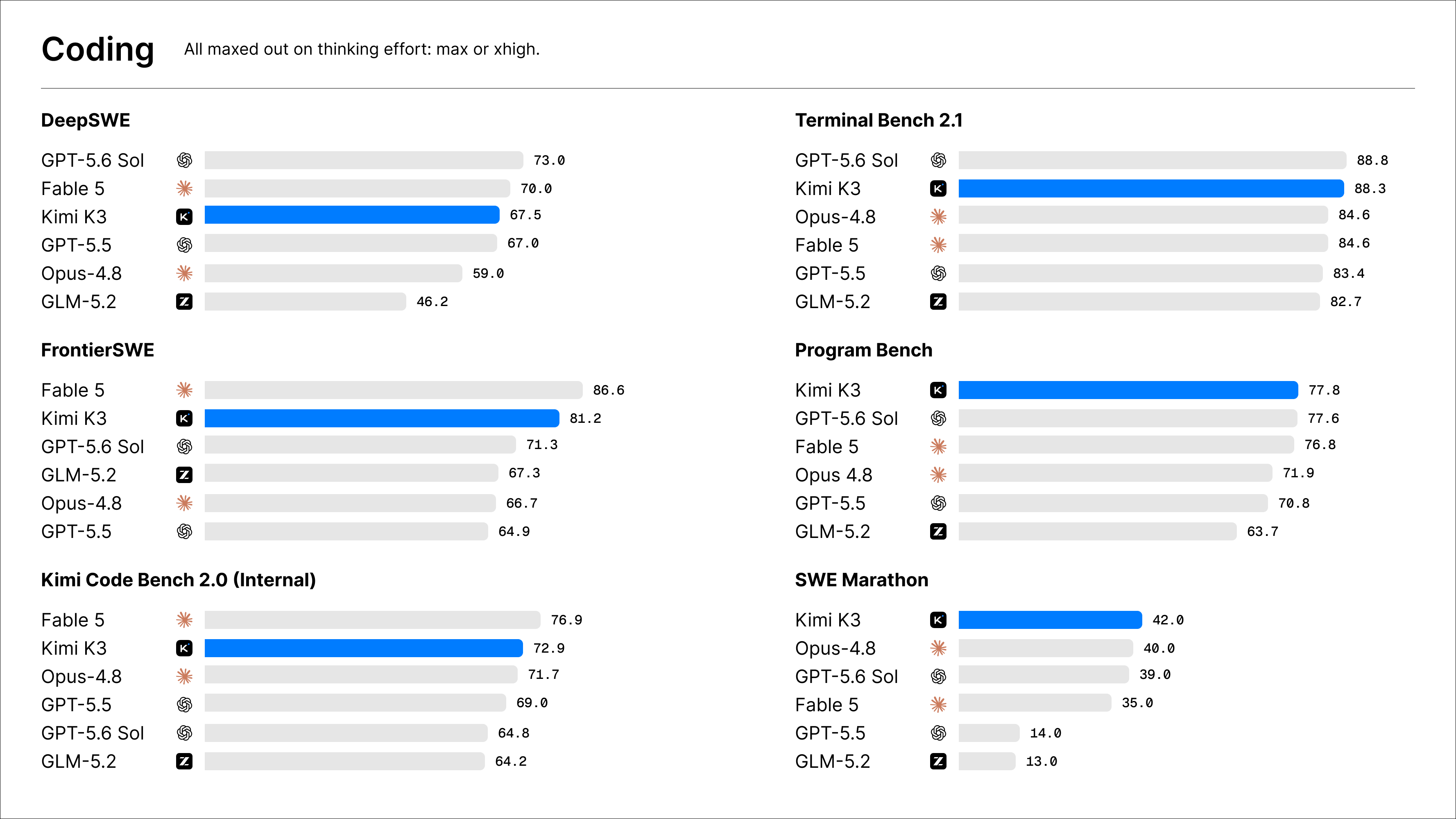
Moonshot AI officially launched the Kimi K3 . This 2.8-trillion-parameter model provides 1 million t
24-hour AI News Summary: Global AI competition continues to heat up, with chips, models, security re

On July 9, 2026, Mistral announced in its official article "Your Prompts and Skills Need a System of

On July 9, 2026, Google Research released the wearable health foundational model SensorFM. It was pr

On July 9, 2026, OpenAI officially announced ChatGPT Work in its announcement "ChatGPT is now a part