Runware is a multi-model generative AI API platform for developers, AI product teams, and enterprises that need unified access to multiple types of generative models when calling images, videos, audio, LLMs, 3D, and more through a single API. It focuses on integrating multi-model capabilities into products in a low-cost, on-demand scaling manner, including support for image, video, audio, LLM, and 3D, providing free test credits, and emphasizing low cost and instant scale. It offers free entry or trial credits, which are suitable for verifying results with small tasks first. Note before use: The output quality, copyright boundaries, and fee structure of different models need to be tested by product scenario. If you plan to adopt it for a long time, it is recommended to test input lead time, output availability, manual review costs, and permission boundaries with real samples before deciding whether to put it into a fixed process.
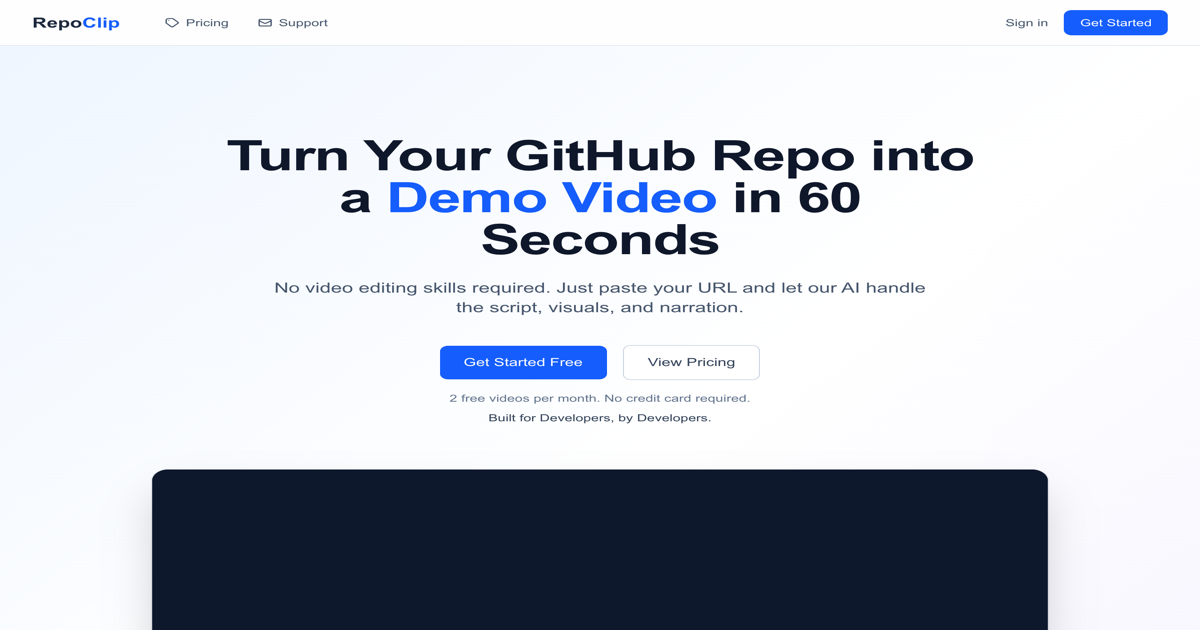
RepoClip is a GitHub repository demo video generator for developers, open-source project maintainers, and technical teams who need to demonstrate product prototypes when turning public GitHub repositories into demo videos with scripts, graphics, narration, and music. Its focus is on quickly forming shareable product explainer materials using repository links, and common capabilities include generating videos by entering public GitHub repositories, including scripts, visuals, narration, and music, and the first video can be generated for free. It offers free entry or trial credits, making it suitable for verifying the effect with small tasks first. Note before use: Private code, customer projects, and unpublished features should not be uploaded or publicly displayed. If the team is preparing for long-term adoption, it is recommended to test input materials, output quality, manual review costs, and permission boundaries with a set of real-world tasks before deciding whether to include a fixed process.
Relay.app is an AI workflow tool for teams that need to create, organize, convert, or review task-specific material before final use. It should be used with clear source material, a defined output goal, and human review for accuracy, rights, privacy, and publishing quality.
RapidNative is an AI workflow tool for teams that need to create, organize, convert, or review task-specific material before final use. It should be used with clear source material, a defined output goal, and human review for accuracy, rights, privacy, and publishing quality.
Novita AI is an AI model API and proxy cloud platform that is mainly used to access multiple models, proxy sandboxes and GPU resources through one API. It is suitable for developers, entrepreneurial teams, AI application teams and platform engineers. It can provide multi-model API access, launch agent sandboxes and GPU instances, and is also suitable for quickly building AI applications and prototypes. Pay attention when using it, and evaluate model costs, current limiting, data security and fault coverage before going online. It is recommended that one or two low-risk tasks be used to test input materials, output quality, manual modifications, and final adoption ratios before deciding whether to put them into a fixed process and document whether they are suitable for long-term use and team review.
MyScale is an AI vector database combined with SQL. It is mainly used to process large-scale multimodal vector data using SQL analysis and vector search. It is suitable for AI application developers, data engineers, search teams and machine learning teams. It can combine vector search with SQL analysis and target large-scale multimodal vector data queries. It can also provide hosting capabilities to facilitate the construction of semantic search and RAG applications. Be aware when using it that it is more suitable for teams with data and engineering foundations; evaluate query performance, index costs, data size, and existing database compatibility before migrating. It is suitable to use one or two low-risk tasks to test input materials, output quality, modification costs and final adoption ratio before deciding whether to put them into a fixed process.
Music AI is an AI audio model platform for the music business. It is mainly used to provide audio separation and music-related model capabilities, and serve music products and business processes. It is suitable for music technology teams, audio product developers, record companies and post-stage teams. It can provide high-quality audio separation capabilities, integrate AI audio models for the music business, and can also be suitable for building audio processing, track separation and music analysis processes. Pay attention when using it, it is more platform capabilities, and ordinary users may need product or technology access; when processing commercial audio, authorization, privacy and output purpose must be confirmed. It is suitable to use one or two low-risk tasks to test input materials, output quality, modification costs and final adoption ratio before deciding whether to put them into a fixed process.
Mixpeek is a multimodal unstructured content search and data warehousing tool used to process text, images, videos, audio and PDFs and build searchable indexes. It is suitable for AI engineering teams, data teams, search product teams, and content platforms. It can process and extract multimodal file characteristics, transform unstructured content into searchable insights, and support pipelines, collections, and API calls. When using it, attention should be paid to planning permissions, index updates, costs and privacy boundaries before data access. The quality of the search depends on sample coverage, providing free storage and API call limits. Before formal adoption, it is recommended to test once with low-risk samples and record the input. Materials, output results, manual modifications and final adoption ratio, and then decide whether to put them into a fixed process.
Mintlify is an AI-native document and knowledge platform mainly used to create product documents and knowledge content for developers and AI. It is suitable for developer tool companies, API teams, technical writing teams, and engineering organizations. It can create beautiful technical document stations, support AI native knowledge management, and be structured for developers and AI agent reading. When using it, you should note that the quality of documents depends on the information architecture, version maintenance and accurate examples. You cannot rely solely on automatic generation to provide trials and team subscriptions. Before formal adoption, it is recommended to use low-risk samples to test once, and record the input materials, output results, and manual modifications. The amount and final adoption ratio are then decided whether to put them into a fixed process.

Luxand.cloud is a cloud-based face recognition API for developers, supporting face search, matching, recognition, detection, and age, gender, and liveness detection. It's suitable for technical teams with mobile apps, access verification, membership systems, photo management, and identity-related features. Before use, focus on evaluating privacy compliance, user consent, data retention, risk of misidentification, and facial recognition regulations in different regions. When it comes to identity verification or security scenarios, manual review and clear grievance mechanisms are also required. Before formal adoption, it is recommended to test with real but low-risk materials to check output quality, authorization boundaries, privacy handling, and manual review costs before deciding whether to put them into a long-term workflow. For individuals and teams, a safer approach is to retain the manual review node first, and then decide whether to expand the scope based on the results of several consecutive times.

Latitude is an observability platform for AI Agents that helps teams monitor, evaluate, and improve agent performance, and provides support around prompting, evaluation runs, and engineering processes. It's suitable for AI engineering teams, product teams, platform teams, and organizations that need to maintain agents for a long time. Before use, it is recommended to conduct a small-scale test with real materials, focusing on observing the output quality, review cost, payment boundaries, data permissions, and whether the team can establish a stable manual review process. Before handling formal business, it should also be judged based on material authorization, privacy requirements, and manual review standards, and avoid using automatic results directly for external release or key decisions. If you are using it for a team, client, or teaching scenario, it is recommended to first confirm the source of the input material, the responsibility for reviewing the results, and the scope of external use.
Kvery.io is an AI-powered SQL editor and database management platform that transforms SQL queries into tables, charts, APIs, dashboards, and management interfaces. It's suitable for developers, data analysts, internal tooling teams, and those who need to quickly build business applications from databases. The platform offers free inquiries and paid plans. Before use, you should confirm database connection permissions, SQL security, query performance, sensitive fields, access control of build APIs, and production environment isolation to avoid exposing experimental queries directly to the outside world. Before use, it is recommended to conduct a small-scale test with real materials, focusing on observing the output quality, review cost, payment boundaries, data permissions, and whether the team can establish a stable manual review process.
Kinovi is an AI video, image, and API platform that supports multimodal reference control, video and image generation, and provides a public REST API. It's ideal for creators, marketing teams, short filmmakers, and developers who need to integrate generative models into their products to create character-consistent visual content, test video creatives, or set up automated generation processes. The platform provides a free starting quota. Before official use, the character authorization, image consistency, prompt controllability, generation cost, and commercial use license should be checked. Before use, it is recommended to conduct a small-scale test with real materials, focusing on observing the output quality, review cost, payment boundaries, data permissions, and whether the team can establish a stable manual review process.
Kie AI is an AI API platform for developers and product teams, providing access capabilities to models such as chat, images, videos, and music, with an emphasis on free API keys, stable performance, scalable calls, and real-time stream output. It's suitable for AI application development, content generation products, multimodal feature integration, and teams that require a unified model entrance. Before accessing, you need to evaluate the response quality, latency, quota, cost, content security policy, generation material authorization, and failure retry mechanism to avoid directly connecting interface capabilities to formal services. Before use, it is recommended to conduct a small-scale test with real materials, focusing on observing the output quality, review cost, payment boundaries, data permissions, and whether the team can establish a stable manual review process.
Kapsul is a data infrastructure platform that provides Storage as a Software with a focus on programmable storage, adaptive privacy, and managing data by context. It is suitable for developers, AI application teams, and products that require fine-grained control over data storage, permissions, and costs to build a more flexible data layer. The platform offers free API requests and per-GB billing plans. Evaluate data types, permission models, encryption requirements, latency, cost, and compliance responsibilities before onboarding. It's more suitable for users with clear goals, input materials, and boundaries, and small-scale testing can help you determine whether the results are worth going into the formal process faster. Before use, you should also use your own data sources, team processes, and review criteria to avoid direct automatic results into official release, submission, or business decisions.
JsRates is a custom shipping tool for Shopify merchants that allows users to write complex shipping rules in JavaScript and connect to third-party APIs. It's suitable for e-commerce teams that need to dynamically calculate shipping rates by region, weight, product mix, customer type, or external data. The platform offers free requests and AI character credits, as well as monthly subscription plans. When using it, you should first verify the code logic, boundary conditions, API errors, and checkout page performance in the test environment to avoid incorrect shipping costs affecting the order. It's more suitable for users with clear goals, input materials, and boundaries, and small-scale testing can help you determine whether the results are worth going into the formal process faster. Before use, you should also use your own data sources, team processes, and review criteria to avoid direct automatic results into official release, submission, or business decisions.
The Jobo API is a job data infrastructure for recruiting, job searching, and career platforms, offering capabilities related to extensive job listings, ATS platform coverage, data synchronization, and automated applications. It is suitable for recruiting technology products, job search tools, career service platforms, and internal talent systems to access job data, sync to business systems, and build job search related functions. The current page is more about API and platform services than individual job seeker tools. Before accessing, data authorization, application automation boundaries, platform terms, and user privacy need to be evaluated. If you want to include it in a long-term process, it is recommended to use a small task to verify the output quality, quota consumption, authorization boundaries, and manual modification costs before deciding whether to expand the scope of use.
Jina AI is an AI infrastructure for search and data understanding, offering capabilities such as embeddings, rerankers, web readers, deepsearch, and small language models, making it suitable for building multilingual, multimodal search, retrieval-augmented generation, and data processing applications. It caters to developers, AI product teams, and businesses that need a search base, offering free tokens and paid credits. Before accessing, evaluate model performance, latency, cost, data permissions, and production monitoring, and do not judge actual business performance based solely on demonstration results. If you want to include it in a long-term process, it is recommended to use a small task to verify the output quality, quota consumption, authorization boundaries, and manual modification costs before deciding whether to expand the scope of use.
ImageKit.io is an image and video API and AI DAM platform with core capabilities including image and video optimization APIs, AI digital asset management, real-time transcoding, and media delivery. It is suitable for development teams, content platforms, e-commerce companies, and digital asset teams, and is commonly used for image CDN, media management, automated tagging, video delivery, and site performance processing. Users can use it to complete pre-collation, generation, or validation, and then put the results into their workflows to continue checking. Attention to Usage: Access costs, privacy permissions, billing, and complex workflows require technical assessments. For those who need to consistently produce output, it is recommended to combine manual review, material licensing, and actual business goals to determine whether the results can be used directly.
HoneyHive is an observability and evaluation platform for AI Agents. It provides event tracking, continuous assessment, observability, and prompt management capabilities to help businesses run AI Agents more reliably in production. It is suitable for AI engineering teams, platform teams, enterprise AI product teams, and agent developers, as well as for verification and organization in agent evaluation, production monitoring, prompt management, event tracking, and quality regression analysis. Data governance, privacy, and permission configuration are important, especially boundaries such as data sources, material authorization, result review, account permissions, or payment limits. It's geared towards production-grade AI engineering and isn't a chat app for average users.
Gumlet is a media hosting and optimization platform for website, application, and content teams, covering video hosting, video streaming, image optimization, CDN distribution, DRM, secure playback, API integration, and AI-assisted video compression. It is suitable for product teams that need to consistently deliver large volumes of images and videos, such as online education, e-commerce, content platforms, and SaaS products. If only a small amount of material is uploaded occasionally, the full media infrastructure may seem too heavy; Evaluate traffic, cost, and migration boundaries before going on. Before official adoption, it is recommended to test the output quality, permission settings, payment rules, data processing methods, and subsequent maintenance costs with real materials or real business processes before deciding whether to access it for a long time.

goPDF is an AI document processing and PDF workflow tool primarily used to handle office tasks around PDFs, web pages, document generation, and automated APIs. Its core capabilities include supporting conversations with PDF documents and extracting information, providing AI Document Generator and workflows, including PDF conversion, screenshot API, and blog automation capabilities, making it suitable for office users, content teams, developers, and those who need to work with document materials for PDF reading, document generation, data summarization, blog writing, and automated interface calls. It combines document generation, PDF processing, web chat, and API capabilities in one suite of products. These tools are better suited for targeted tasks and are not a substitute for human judgment; When the results are to be used in customer communications, study assignments, public content, business decisions, or health records, users still need to proofread facts, confirm permissions, and use them in conjunction with actual processes.

Gooey.AI is a low-code AI orchestration and workflow platform designed to build multi-model, multilingual, and collaborative AI applications and workflows. Its core capabilities include supporting low-code AI workflow orchestration, model-agnostic, connecting different AI capabilities, and targeting agricultural, health, educational, institutional, and cultural scenarios, making it suitable for nonprofit organizations, government agencies, education teams, health projects, and developers in multilingual consulting, public services, learning support, agricultural advice, and AI workflow prototyping. Public product information emphasizes global impact, key industries, and model-agnostic orchestration capabilities. These tools are better suited for targeted tasks and are not a substitute for human judgment; When the results are to be used in customer communications, study assignments, public content, business decisions, or health records, users still need to proofread facts, confirm permissions, and use them in conjunction with actual processes.
Gladia is an AI audio infrastructure platform for voice products and developers, offering real-time speech-to-text, batch transcription, speaker differentiation, timestamping, and conversation data enhancement through APIs. It is suitable for product access such as meeting assistants, voice customer service, media captioning, sales call analytics, and voice agents, rather than simply uploading files to text gadgets. For teams that need to connect calls, meetings, podcasts, or voice interactions to business systems, it provides programmable audio processing capabilities that test the accuracy, latency, and cost of real recordings before official integration. If the product relies on real-time response, the focus should also be on verifying latency, concurrency, language coverage, and stability under abnormal audio.