Back to AI information
OpenAI Codex has launched Agent Skills, which supports $.skill-name calls and automatic selection

OpenAI Codex has launched Agent Skills, which supports $.skill-name calls and automatic selection

AI information Admin 519 views

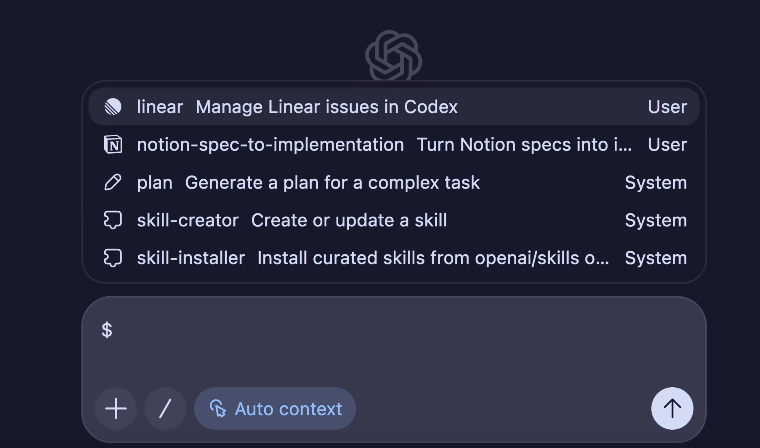
OpenAI developer documentation shows that Codex now supports "Agent Skills", which are used to package task-specific instructions, resources, and optional scripts into reusable capabilities, which can be used in Codex CLI and IDE extensions. Users can either explicitly invoke a skill through $.skill-name or describe the requirement in a prompt, allowing Codex to automatically select the appropriate skill to complete the process.

The skills mechanism emphasizes shareability and combinability: teams can precipitate common specifications, troubleshooting steps, code review points, etc. into a skill base, reducing the cost of repeated communication and improving execution consistency. The official description states that skills are based on the open Agent Skills standard and are easy to disseminate and reuse within teams or communities.

At the same time, the Codex changelog mentions that when explicitly selecting a skill, the corresponding SKILL.md content will be injected into the dialogue round, and it will be loaded on demand in the session, and an alarm will be prompted when the file is unreadable. For users, this means that while gaining stronger process capabilities, they also need to pay attention to the security of skill content, permission boundaries, and risks caused by script execution.

FAQs

Q: What is the function of Codex's Skills?

A: Codex Skills are reusable capability packs that encapsulate instructions, resources, and optional scripts into a stable workflow, allowing Codex to complete specific tasks more reliably.

Q: How do developers call a skill in Codex?

A: Developers can use $.skill-name to call directly by name, or they can let Codex automatically select relevant skills in the requirements description.

Q: What are the best use cases for using Codex Skills?

A: Repetitive tasks that require consistency, such as code review specifications, project scaffolding generation, dependent escalation processes, troubleshooting manuals, and publishing checklists, are best suited.

Q: In which product forms is Codex Skills available?

A: The official documentation states that Skills are available in the Codex CLI and IDE extensions.

Q: What are the risk points when the team implements Skills?

A: It is necessary to focus on preventing abuse of skill scripts or resources, unauthorized access and supply chain risks, and establish governance measures such as auditing, signature and permission control.

Full interpretation of Codex Agent Skills mechanism Codex Agent Skills encapsulates processes into skills The Codex skill library makes team specifications reusable Codex with $. skill-name explicitly calls the skill Codex automatically selects skills to complete complex workflows Codex skills support CLI and IDE extensions Codex skill SKILL.md inject session mechanism Codex skills load on demand to achieve contextual savings Codex Skill Pack Command Resources and Optional Scripts Codex skills allow troubleshooting steps to be reproduced with one click Codex skill precipitation code review checklist Codex skill package checks and rollbacks before they are released Codex skills are used to rely on the standard process for escalation Codex skills are used for scaffolding generation and templating Codex skills are shareable, combinable, and versionable Codex skills are based on open agents Skills Codex skill pool reduces duplication of communication and rework Codex skills improve execution consistency and auditability Codex Skill Content Security and Permissions Boundary Guidelines How Codex skill script execution risk is governed Codex skill unreadable file alarm mechanism interpretation Codex skills are more stable in the IDE Codex skills are quickly triggered in the CLI with $ Codex skills make engineering processes faster Codex skills fit into the internal best practice library Codex skills are used in security auditing and hardening processes Codex skills are used to unify code styles and specifications Codex skills are used for migration refactoring step-by-step execution Codex skills are used for single test generation and coverage improvement Codex skills are used for PR descriptions and change descriptions Codex skills are used for document updates and synchronization checks Codex skills get new members of the team up to speed faster Codex skills turn tacit knowledge into executable packages Codex skills design names and descriptions Codex skill directory structure scripts and assets description Codex Skills References resource organization best practices Codex skill layering injection reduces contextual pollution Codex skills and toolchain MCP linkage ideas How Codex skills prevent supply chain and overreach risks Codex Skills Governance recommends auditing signatures and permissions Codex skills and automated pipeline collaboration methods Codex skills make multi-round missions more controllable and stable Codex skills break down complex requirements into standard steps Codex skills are suitable for customer service troubleshooting and operation and maintenance manuals Codex skills are suitable for data remediation and backfilling processes Codex skills are suitable for compliance checks and log inspections Codex skills are suitable for multi-warehouse bulk change operations Codex skills start with a checklist Codex skill pool construction route and division of labor strategy Codex skills allow team collaboration to go from verbal to standard

Recommended Tools

More