- Abstract
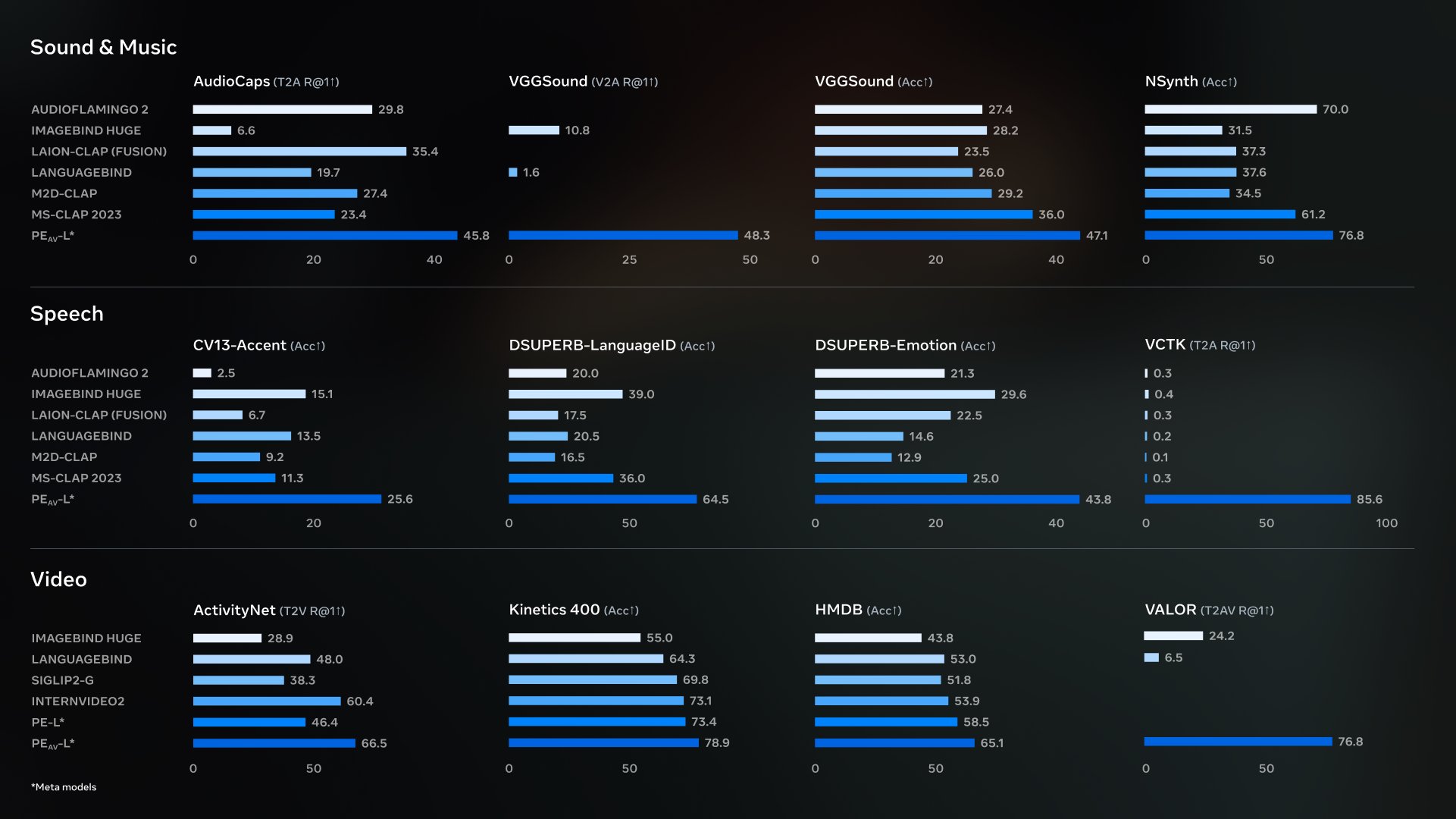
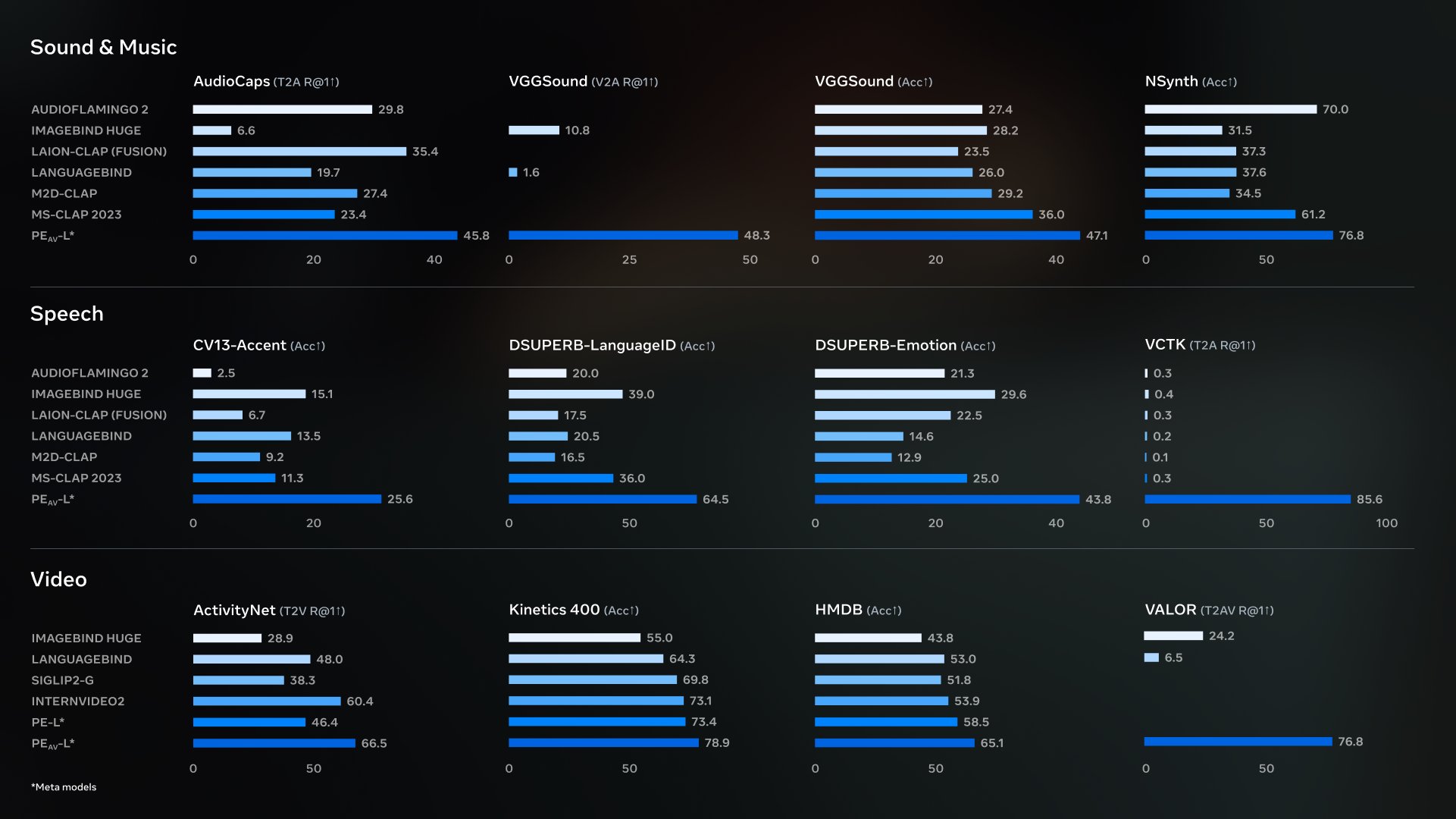
PE-AV (Perception Encoder Audiovisual) is Meta's open-source audio-visual joint encoder family, which adds native audio capabilities on the basis of Perception Encoder to align video, audio, audio and video and text representation with a unified embedding space. It is used to underpin key components of SAM Audio and leads several audio/video retrieval and understanding benchmarks.
- Core features
- Multi-modal unified embedding: It supports feature encoding and similarity calculation of audio, video, audio-video, and text at the same time.
- Audio and video retrieval and alignment: It can do cross-modal search such as "text to find sound/picture" and "screen to find sound".
- Multi-size/multi-version weights: Small/base/large, as well as configurations such as "16-frame" and "all frames", are available to facilitate trade-offs between effects and computing power.
- Engineering reusability: Released in the same warehouse as the perception_models ecosystem, which is convenient for collaboration with PE series and downstream multi-modal applications.
- Installation
- Clone code: git clone https://github.com/facebookresearch/perception_models
- Create an environment and install dependencies: install according to the repository requirements.txt / setup.py instructions (dependencies may vary for different platforms).
- Get weights: When running the example, it will pull the corresponding checkpoint from Hugging Face (such as pe-av-large, etc.).
- Typical use cases
- Audio and video search: Use one sentence to find "dialogue clips with sirens" from the video library.
- Sound cue assisted understanding: Combine the picture to improve sound source recognition and scene description in noisy scenes.
- Upstream perception of audio separation/editing: Provides stronger audio-video alignment representation for interactive separation like SAM Audio.
- Data annotation and quality inspection: use cross-modal similarity to screen samples with "inconsistent picture and sound".
- Ecology and Competing Products
- Ecology: PE-AV is a perception_models of Meta; Model weights are published as collections in Hugging Face for easy reproducibility and integration.
- Competing product ideas: Compared with audio encoders or video encoders only, PE-AV focuses on the unified space of "audio-visual correspondence learning"; Compared with the CLIP method, it is extended to the joint characterization of audio and audio and video, which is closer to the real video task.
- Limitations and precautions
- Computing power and throughput: The configuration of video frame rate will significantly affect the video memory and speed, and you need to choose small/base/large and frame strategy according to the service.
- Data domain shift: In specific languages, specific audio types, or strong noise conditions, cross-modal alignment may decline, so small-scale verification is recommended.
- Copyright and privacy: When processing public video/audio conversations with people, data compliance and authorization requirements must be observed.
- Project address
https://github.com/facebookresearch/perception_models
- FAQ
(PE-AV open source model) What input modalities are supported?
Answers
support audio, video, audio, video, and text, and output embedded representations that can be used for similarity calculations.
Question (PE-AV installation) Where are the weights downloaded from, and do they need to be placed manually?
Answers
are usually automatically pulled by Hugging Face to pull the corresponding checkpoint; For offline environments, you need to manually download and configure the path according to the repository instructions.
Question (PE-AV vs. SAM Audio) What is the relationship between the two?
Answer
:PE-AV is the perception/encoding engine that drives several core components of SAM Audio, providing enhanced audio-visual alignment.
Question (PE-AV checkpoint) Should I choose pe-av-small/base/large or 16-frame?
The larger the answer
, the stronger the effect but more computing power; 16-frames are more resource-saving, and all frames make better use of video information, so it is recommended to conduct comparative experiments based on service speed/cost constraints.