Back to AI information
SEAL adaptive language model sparked heated discussions and was interpreted as "GPT-6 may have life in the sense of computing"

SEAL adaptive language model sparked heated discussions and was interpreted as "GPT-6 may have life in the sense of computing"

AI information Admin 118 views

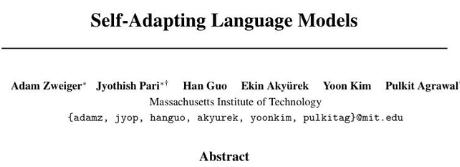
Researchers from MIT and other institutions published a paper "Self-Adapting Language Models" in arXiv, proposing the adaptive language model framework SEAL, which enables large language models to continuously update their weights through a "self-editing" mechanism after deployment. Some social media posts speculate that if similar technology is used in the future GPT-6, such systems may be more "living" in a computational sense, sparking widespread discussion.

In the paper, SEAL allows the model to write a "self-edited" text when exposed to new tasks or knowledge, which contains instructions to synthesize training data, optimize hyperparameters, or call external tools, and then perform a small-scale fine-tuning based on this, and reward or punish these self-edits based on downstream task performance through reinforcement learning, so that the model gradually learns "how to train itself". Experiments show that SEAL has significant performance improvement compared with multiple baseline methods in knowledge injection and low-sample tasks, but it also has limitations such as forgetting old tasks and difficult to fully predict behavior, and still needs to run in a controlled environment.

Currently, there is no public evidence that OpenAI has adopted SEAL itself or its equivalent solution in existing products or unreleased GPT-6, and the research community has not yet reached a consensus on whether "large models are therefore alive or conscious." The industry generally sees SEAL as a technological exploration to improve the continuous learning ability of models, rather than marking the arrival of some kind of "living AI".

FAQ

Q: Where does the phrase "GPT-6 potentially live" come from?

A: Mainly from social media secondary interpretations of SEAL papers, which compare the model to sustainable self-renewal as "life in the computational sense", but it is an exaggerated metaphor.

Q: What is the core idea of the SEAL framework?

A: Let the model generate training instructions and synthetic data by itself, update its own weights in small steps, and use reinforcement learning to screen for effective "self-editing" to continuously adapt to new tasks after deployment.

Q: Does this mean that GPT-6 will truly be "alive" in the future?

A: Existing research only shows more flexible continuous learning capabilities, but does not prove that the model has conscious or subjective experience, and "life" is more of an image in propaganda or discussion.

Q: What are the risks of adaptive large models?

A: Catastrophic forgetting, capability drift, and increased security and alignment difficulties may occur, requiring strict monitoring, rollback mechanisms, and boundary constraints.

Q: Has OpenAI announced the adoption of SEAL or similar technology in GPT-6?

A: As of now, OpenAI has not disclosed the specific technical route of GPT-6, nor has it issued an authoritative explanation on whether to adopt SEAL or similar frameworks.
MIT Adaptive Language Model SEAL Framework Interpretation of the SelfAdaptingLanguageModels paper The SEAL self-editing mechanism allows the model to train itself A new paradigm of continuous learning after the deployment of large models Social media hype GPT6 may be a living statement Whether adaptive language models are more like living organisms SEAL generates self-editing instruction synthesis training data The model automatically selects and optimizes hyperparameters and tool calls Rewards for reinforcement learning Effective self-editing update weights SEAL's performance improvement in knowledge injection tasks In the small sample task, SEAL is better than the traditional fine-tuning method The risk of catastrophic forgetting brought about by adaptive large models SEAL may cause drift issues with old mission capabilities It is difficult to fully predict the challenge of self-editing large model behavior Why is it just an exaggeration to say that GPT6 is alive? Adaptive learning does not mean having consciousness and subjective experience There is still no consensus on the issue of AI life and consciousness in the academic community SEAL needs to be operated discreetly in a controlled environment Continuously update the safety and alignment difficulty of model weights OpenAI has not yet announced the adoption of the SEAL solution in GPT6 Adaptive large models require governance and rollback mechanisms How to set boundary constraints for a self-updaturing model How social platforms misread the conclusions of cutting-edge AI papers The media will continue to learn analogies, calculations, meanings, and life phenomena The prototype of the lifelong learning ability of the large model displayed by SEAL The self-edited text contains the task strategy and training configuration Models learn how to train their own technical imagination space Adaptive language models are different from traditional static models The enlightenment of the SEAL framework for future productization Why is the current product-level large model still biased towards offline training? Continuous learning can lead to security and compliance concerns How self-updating models pass audit and accountability tracking The application prospects of adaptive large models in real business How the academic community evaluates the effectiveness of SEALs on benchmarking tasks From SEAL, the new trend of large model online learning research Discussion on the relationship between adaptive language models and AIAgent capabilities Whether SEAL will be partially borrowed from future commercial models The self-updating large model has an impact on the stability of the evaluation benchmark How to design a mechanism to prevent model self-editing from getting out of control Techno-optimists and prudent parties have different views on SEALs New challenges for alignment research by adaptive large models OpenAI has not disclosed the current status of GPT6's technical route The importance of distinguishing between scientific research exploration and product function hype Does the SEAL framework change the way we understand large models? Does adaptive learning accelerate the iteration of model capabilities? Fine-tune frequently executed computing power and cost considerations online Potential applications of SEAL in knowledge injection scenarios Adaptive large models may give rise to new offensive and defensive games Whether AI can be considered a philosophical and technical debate about life How the public rationally views GPT6 may be living speech What kind of regulatory framework is needed to continuously learn about large models SEAL research reflects the current evolution direction of large models

Recommended Tools

More