1. Product positioning and appearance design
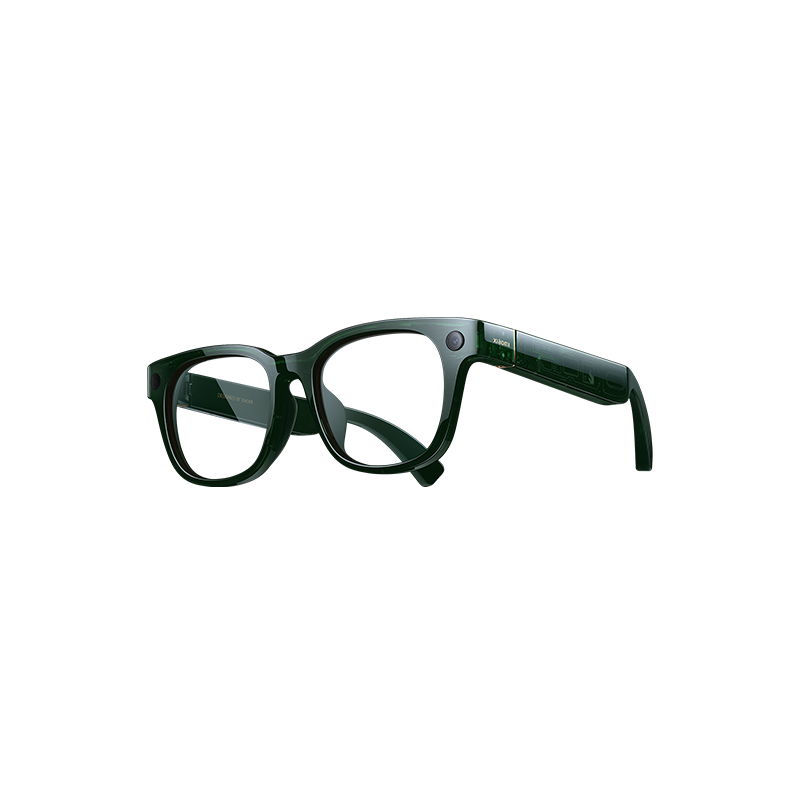
Xiaomi AI glasses are positioned as AI shooting glasses that can be worn on a daily basis, focusing on first-view recording and portable voice assistants, rather than AR glasses with screens. Using classic D-shaped frames, optimized for Asian face shapes, the whole machine is about 40 grams, available in black, tortoiseshell brown, parrot green in a variety of colors, with a choice of ordinary lenses and electrochromic lenses, and it looks more like a pair of fashionable glasses when going out on the street every day.
2. Core hardware and battery life performance
The hardware uses a dual-core architecture of Qualcomm Snapdragon AR1 plus Hengxuan chip, supplemented by four plus 32 million gigabit storage, providing computing power for multi-modal AI and local shooting. The front 12-megapixel Sony sensor supports 4,000-level resolution photos and 2K 30-frame video, with electronic image stabilization, which is more suitable for hands-free scenes such as cycling, walking babies, and cooking. The battery capacity is about 260 mAh, the official typical battery life is about 8.6 hours, continuous recording can last for tens of minutes, and a full charge is about the time of a class or meal.
3. Audio system and AI capabilities
Thefuselage has built-in symmetrical open speakers and a five-microphone array, one of which is a bone conduction microphone, which is used to reduce wind noise and ambient noise and ensure clear calls and recordings. Equipped with Super Xiaoai, it can complete voice Q&A, simultaneous interpretation in ten languages, text translation of pictures and street signs, object recognition and calorie estimation, transcription of meeting recordings, itinerary reminders, and QR code scanning payment, etc., and move many commonly used operations on mobile phones to voice and first-view screens.
Fourth, the interaction method without a screen and the applicable group
Xiaomi officials clearly chose to abandon the lens display, and all feedback is played through voice, with the advantage of lighter weight and smaller wearing burden, and the disadvantage is that the information density is limited, and translation and navigation must be "listened to with the ears". Overall, it is more suitable for people who often shoot first-person videos, listen to podcasts and Q&A on their commute, need to communicate across languages, or control Xiaomi smart homes. If you only take photos occasionally, and the main needs are to watch dramas and office screens, the significance of such AI glasses without display is limited.
Q&A
Q1: What is the difference between Xiaomi AI glasses and Mijia glasses cameras and wireless AR glasses
A: Mijia glasses cameras and wireless AR glasses are more head-mounted cameras or AR display devices, with heavier bodies, near-eye screens and more complex interfaces. Xiaomi AI glasses are lightweight AI shooting glasses, which do not provide lens display, only focus on shooting, listening and speaking, and are more suitable for wearing on the face all day long.
Q2: Will the actual battery life and heat affect a day of use
A: There is no problem with typical mixed use for more than eight hours, but if you record continuously for a long time or frequently call AI capabilities, the battery will drop significantly faster, and the temples will also have a certain warmth. A more reasonable rhythm is to use it in segments by commuting and activity segments, using fragmented time to charge, rather than when the all-weather action camera is always on.
Q3: Who are the most suitable and least suitable for Xiaomi AI glasses
?A: The most suitable for heavy Xiaomi ecological users, content creators, frequent business travelers or people who need translation, can use shooting, Q&A, translation and QR code payment at the same time. The least suitable is users who are particularly sensitive to privacy, rarely take photos and videos, or expect "large-screen AR effects", this product has neither a screen display, nor is it difficult to completely replace mobile phones and professional cameras.
Q4: What details do you need to pay attention to for privacy and usage etiquette
A: Although there is a recording indicator, others may not be able to understand it, and it is best to turn off the shooting function or remove the glasses directly when entering the office, classroom, hospital and other scenes. It is safer to use it when taking photos or recording in public, and to clean up unnecessary cloud backups and call records in a timely manner.