Anthropic announced the launch of Claude Opus 4.5, a new generation of large language model, as the flagship version of the Claude 4.5 series, focusing on high-intensity work scenarios such as code generation, agent orchestration, and general computer use. Officials describe it as one of the most powerful Claude models available, emphasizing significant performance improvements over the previous generation Opus 4.1 in complex office tasks, long text processing, and professional applications.
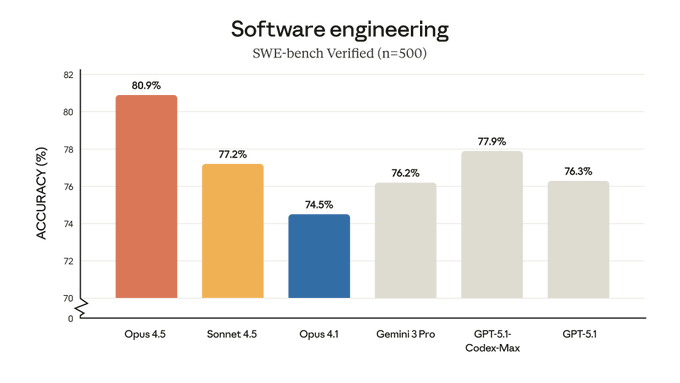
In terms of technical features, Claude Opus 4.5 improves the depth of reasoning and long-range memory capabilities, optimizes for professional tasks such as software engineering, table modeling, and financial analysis, and adds adjustable "effort" parameters to facilitate the balance between response detail and computing power cost. Publicly available benchmark data shows that the model achieves high results in coding and agent evaluations such as SWE-bench Verified, outperforming its predecessors Opus 4.1 and Sonnet 4.5 in terms of terminal operations, tool calls, and computer environment tasks, while further lowering the threshold for using flagship-level capabilities in terms of price.
At present, Claude Opus 4.5 has been opened to users through Anthropic's own applications and APIs, and has been connected to mainstream clouds and development platforms such as Microsoft Foundry (including GitHub Copilot paid version and Copilot Studio), Amazon Bedrock, Databricks, etc., covering various scenarios such as enterprise development, office automation, and agent deployment. At the same time, the industry is also concerned about its performance in terms of security and abuse prevention, and some people believe that the model's ability to reject malicious coding requests has been enhanced, but there is still room for bypass in malware generation and improper computer operations, and relevant protection mechanisms are still being improved.
FAQs
Q: What is the Claude Opus 4.5?
A: Claude Opus 4.5 is the latest generation of flagship large models released by Anthropic, belonging to the Claude 4.5 series, focusing on complex code generation, agent construction, computer use automation and professional office scenarios, and is officially positioned as one of its most powerful general-purpose models.
Q: What are the major upgrades in Claude Opus 4.5 in terms of coding and agents?
A: This model strengthens cross-file code understanding and long-range reasoning capabilities, can complete refactoring, test generation, and multi-step development tasks in large codebases, and achieves leading results in multiple coding and agent benchmarks, making it more suitable for building production-grade agents that run for a long time and can call multiple tools and applications.
Q: What channels is Claude Opus 4.5 available through now?
A: Users can use Claude Opus 4.5 through Anthropic's official apps and APIs, and enterprises and developers can also call it on platforms such as Microsoft Foundry, GitHub Copilot, Copilot Studio, Amazon Bedrock, Databricks, etc., and some services may be open in stages or in the form of limited trials.
Q: Has there been a consensus on the "world's strongest coding, agent and computer use model" mentioned in the publicity?
A: This statement mainly comes from the positioning of officials and partners, highlighting the advantages of Claude Opus 4.5 in coding, agent, and computer use tasks. At present, there are multiple public benchmarks and developer evaluations to support its leading performance in related tasks, but there are differences in different test scenarios and indicators, and a unified authoritative ranking has not yet been formed in the industry.
Q: What are the risks to be aware of when using Claude Opus 4.5?
A: Although Claude Opus 4.5 performs better at rejecting some malicious code requests and potential attacks, there may still be a risk of abuse in areas such as malware generation, improper terminal operations, etc. When deploying Claude Opus 4.5 to handle critical systems, enterprises should cooperate with permission control, operation logs, and manual review mechanisms, and should not completely hand over core resources to the independent control of automated agents.