1. Basic Information
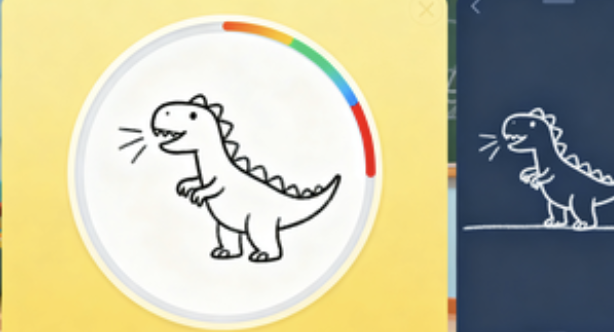
Animated Drawings is an online demonstration and open-source project launched by Meta FAIR. It uses AI recognition, skeletal rigging, and an action library to quickly generate animations like walking, waving, and jumping from static hand-drawn characters. Users upload a hand-drawn drawing of a single humanoid character on a webpage. The system then segments it, locates key points, matches the skeleton, and transfers the motions, producing an animated result that can be previewed and downloaded. The project also provides research code and datasets for educational and R&D purposes.
2. Product Overview
Animated Drawings is aimed at non-professional animation professionals, aiming to animate "children's doodles" or similar hand-drawn characters with minimal manual effort. The product understands the anatomy of the character and adapts its shape to the human form. It automatically or semi-automatically checks the connectivity of the torso and limbs and performs skinning, then matches a standardized skeleton with a built-in motion library. The system emphasizes robustness against non-realistic, exaggerated, and irregularly drawn shapes, making it suitable for classroom presentations, creative workshops, and family projects.
3. Core Functions
1. Main functions
- Hand-drawn upload and pre-processing: Supports uploading a single character's humanoid hand-drawn image. It is recommended that the limbs and body do not overlap significantly to facilitate automatic segmentation and recognition by the system.
- Keypoint and Skeleton Automation: Automatically detect keypoints of the head, torso, upper limbs, and lower limbs, generate a standard skeleton, and complete image skinning and binding.
- Action library driven: built-in common actions such as waving, walking, jumping, dancing, etc., which can be applied with one click and previewed in real time.
- Interactive Correction: Allows for minor adjustments to joint points and outlines to improve animation stability and occlusion handling.
- Export and share: The generated results can be played online and exported as common video or animated image formats for classroom presentation and social sharing.
2. Technical characteristics
- Non-realistic robust recognition: Targeting the structural diversity of children's hand-drawn and amateur line drawings, we combine detection, pose estimation, and image segmentation to improve recognition rates.
- Lightweight rigging pipeline: Automates the process from outline to skeleton to skinning on the browser side, reducing dependence on professional animation software.
- Standard skeleton mapping: Through unified skeleton specifications, diverse shapes are mapped to a reusable action library to achieve "one-time recognition, multiple action reuse".
- Open source and data support: Provides research code and large-scale hand-drawn datasets to support secondary development, teaching experiments, and algorithm reproduction.
4. Pricing and Versions
Animated Drawings is provided free of charge to the public as a research demonstration and open source project. The available functionality and action library in the online demo may be adjusted over time; the open source repository contains the core algorithms and example resources. Due to service policies that may vary by region and time of day, please refer to the official website and project description for details.
5. Applicable Scenarios and Target Audience
- Educational scenario: Demonstrate the interdisciplinary process of "from hand-drawing to animation" in art and information technology courses to stimulate students' creative interest.
- Family and parent-child creation: Quickly transform children's drawings into shareable dynamic works to enhance interaction and sense of accomplishment.
- Makers and Workshops: Used for rapid verification of creative prototypes and interactive devices, and for achieving character actions with a low threshold.
- Research and Development: Serves as data and baseline code for teaching and research in computer vision, graphics, and human-computer interaction.
6. Frequently Asked Questions
Q: What are the basic requirements for uploading works to Animated Drawings?
A: We recommend using a hand-drawn image of a single humanoid character with a basic structure such as a head, torso, arms, and legs. The limbs should be kept as separate from the body as possible to facilitate automatic segmentation and recognition.
Q: What actions and formats can Animated Drawings export?
A: The online demonstration provides a variety of common actions (such as waving, walking, jumping, etc.). The generated results can be previewed online and exported as animated images or video formats for easy sharing. Specific options are subject to the current page.
Q: Is this project open source? Can it be used for teaching and research?
A: The project provides open source code and datasets, which are suitable for course teaching, experimental reproduction and secondary development. Specific licensing, data use and attribution requirements are subject to the project description.
Q: How to deal with unstable recognition or severe occlusion?
A: You can fine-tune the joint points and outlines in the interactive interface to ensure that the limbs are clearly outlined and do not overlap with large parts of the body. This can significantly improve the binding and movement effects.
Q: Does it support non-humanoid characters or multiple characters?
A: The system is primarily designed for single characters with a humanoid structure. The effectiveness of non-humanoid or multi-character scenes is uncertain and will depend on the actual recognition results.