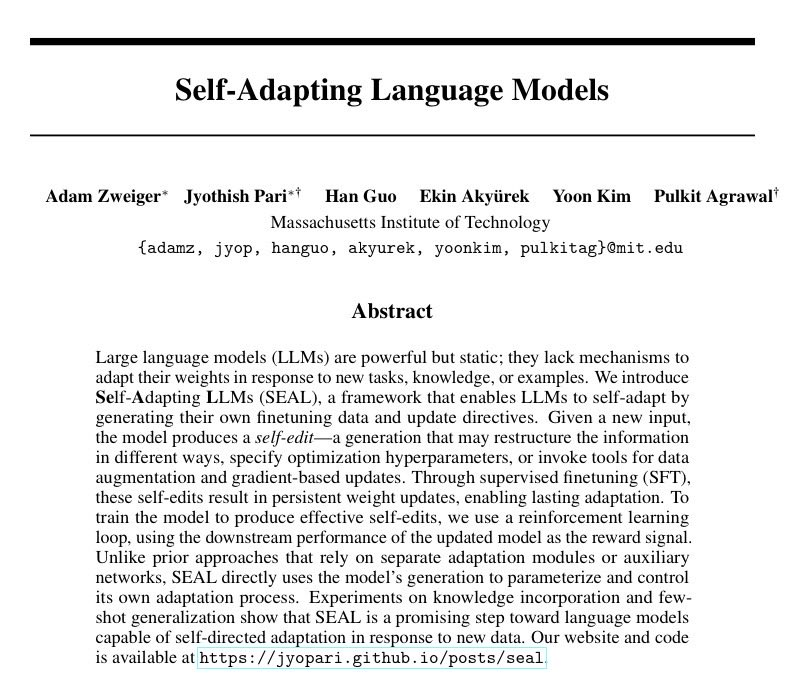
A recent paper published on arXiv, "Self-Adapting Language Models (SEAL)," proposes a novel approach for enabling language models to continuously learn after deployment. Research shows that SEAL can generate self-update instructions ("self-edit") during inference, automatically selecting data and parameters to adjust its own weights, thereby enabling knowledge updates and long-term memory without retraining. This mechanism is believed to have the potential to overcome the limitations of traditional models' "frozen weights," enabling AI to continuously evolve as the external world changes.
Several researchers working on the SEAL project have joined OpenAI, sparking speculation that the company may be testing a similar architecture in GPT-6. However, this has not yet been officially confirmed. Existing papers have only demonstrated the feasibility of SEAL on medium-sized models, and it still faces challenges such as catastrophic forgetting, update drift, and security controls. Even if GPT-6 adopts such mechanisms in the future, they are more likely to employ layered adaptation and review rather than fully autonomous learning. However, the development of SEAL is considered a significant milestone in the advancement of self-learning AI.
Frequently Asked Questions
Q: What is the biggest difference between SEAL and traditional language models?
A: SEAL can generate self-update instructions after deployment and adjust some parameters on its own to achieve continuous learning. Traditional models have fixed weights and require retraining to update knowledge.
Q: Does GPT-6 use SEAL technology?
A: There is no official confirmation so far. Only some researchers have cross-posted between OpenAI and SEAL projects, and the relevant speculation is still unconfirmed information.
Q: Does SEAL’s continuous learning mean that AI has “consciousness”?
A: No. SEAL can optimize its own performance, but it has no self-awareness or subjective intent. Its "evolution" is merely an algorithmic parameter update.
Q: What risks does SEAL face?
A: These mainly include catastrophic forgetting, bias amplification, difficulty in security review, and high computing costs. Currently, manual supervision and constraints are still required.
Q: What is the significance of SEAL to the future development of AI?
A: It marks the transition of AI from static models to dynamic learning systems, which is expected to improve adaptability and knowledge timeliness, and lay the foundation for the next generation of general models.