I. Summary
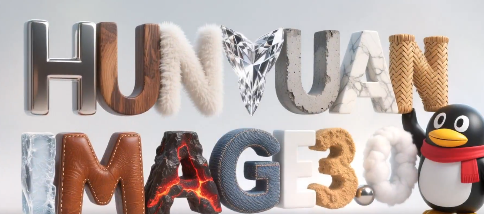
HunyuanImage 3.0 is Tencent Hunyuan's open-source, native multimodal text-to-image model. It utilizes a MoE architecture and transfusion approach to unify training for text and images. According to official information, the model boasts over 80 bytes of parameters, with approximately 13 bytes activated per token for inference. It supports understanding thousands of word prompts, accurately generates text from images, and emphasizes "reasoning with world knowledge." The current version focuses on text-to-image, and will expand to image-to-image, editing, and multi-round interaction.
- Core Features
1. MoE×Native Multimodality : Unified autoregressive framework, deeply coupled LLM and diffusion generation.
2. Large-scale training : 5B image-text pairs and multi-source data, combined with 6TB of text corpus (according to official standards).
3. Long prompt alignment : Complex, thousand-word prompts have stronger semantic alignment.
4. Text readability : The generation of "text in pictures" in posters/GUIs/forms is more stable.
5. Inference optimization : compatible with FlashAttention, FlashInfer, and supports multiple GPUs.
- Installation
- Environment: Linux, Python 3.12, PyTorch 2.7.1 (CUDA 12.8).
- Weight: Download from Hugging Face to a local directory (avoid including "." in the directory name).
3. Dependency: pip install -r requirements.txt, optional installation of FlashAttention/FlashInfer.
4. Example: Run run_image_gen.py --model-id ./HunyuanImage-3 --prompt "…" to generate.
Typical Use Cases
- Brand posters/e-commerce banners: require clear and readable text and complex layout.
- Comics and illustrations: Consistency control from long descriptions to multi-element images.
- Educational content and emoticon packages: unified style and standardized output of text in pictures and images.
- Product/UI concept map: controllable generation of interface elements and layout text.
- Ecosystem and Competitive Products
- Ecosystem: Provides GitHub inference code, Hugging Face weights, and a local Gradio Demo; plans to support VLLM, launch Instruct/Distillation, and graph generation.
- Competitors: Open-source applications like SDXL, SD3, and FLUX are mostly DiT-based. HunyuanImage 3.0 differentiates itself with MoE and native multimodality, focusing on long prompts and text rendering. Specific performance is subject to public benchmarks and field testing.
VI. Limitations and Precautions
- High resource requirements: ≥3×80GB video memory is recommended; enabling the acceleration library for the first time may require additional compilation time.
- License compliance: Hugging Face displays the license as "tencent-hunyuan-community". Please read the repository LICENSE carefully before use.
- Functional scope: Currently only text-to-image; image-to-image, editing, and multi-round interaction are in the roadmap.
- Prompt Engineering: Pre-trained weights do not override prompts by default, but Instruct weights support self-overriding and "thinking" chains.
- Project Address
https://github.com/Tencent-Hunyuan/HunyuanImage-3.0
- Frequently Asked Questions
Q: What are the hardware requirements for HunyuanImage 3.0?
A: The official recommendation is a disk size of about 170GB, video memory ≥ 3×80GB, CUDA 12.8 and PyTorch 2.7.1.
Q: How to improve inference speed?
A: Install FlashAttention and FlashInfer, and use multiple GPUs with the appropriate attention/MoE implementation.
Q: What is the difference between Instruct and pre-trained weights?
A: Pre-training focuses on basic generation; Instruct additionally supports prompts for self-rewriting and the "thinking" process, with stronger control over long prompts.
Q: Does it support image generation and editing?
A: Support is planned in the official roadmap, and the current version focuses on Wenshengtu.
Q: Can the license be used commercially?
A: According to the specific terms of "tencent-hunyuan-community", please read the licensing instructions of the warehouse and model card before evaluating.