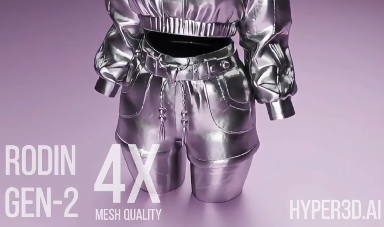
The Rodin team announced the release of Gen-2 , featuring several updates to the 3D generation and asset pipeline. The release officially includes 4x mesh quality , recursive part generation , and support for baking high-poly models to low-poly models with normal maps . HD Textures (Beta) have also been added to the texturing platform. 3D ControlNets, Quads (part-level), T/A Pose, and PBR capabilities are also included for topology refinement and pose control. The team also announced a " 50% off for the first month " promotion in the release post.
As seen in the public demo and user case pages, Gen-2 excels at quad mesh and sub-component editing for characters and props, making it suitable for rapid prototyping and asset production from text/images to 3D. However, the exact quality and compatibility still depend on the input material and downstream DCC pipelines. Pricing and features can be found on the official website and subscription page. Some features are in beta or are in a phase of gradual release, so please refer to the official website for details.
Frequently Asked Questions
Q: What are the core updates for Gen-2?
A: The official said that the mesh quality is improved by 4×, recursive part generation, high poly → low poly + normal baking, HD texture (Beta), and ControlNets, Quads, T/A Pose, and PBR are retained.
Q: Is it officially open?
A: The team calls it "NOW LIVE"; users can experience it on the official website and product page, and the functions will be gradually released.
Q: Are there any discounts?
A: The post mentioned a 50% discount promotion for the first month . The specific validity period and scope of application are subject to the subscription page.
Q: What scenarios is it suitable for?
A: Rapid modeling from images/text to 3D, component editing, low-poly baking and texture generation, making it easy to enter the game and real-time rendering pipeline.
Q: What are the things to pay attention to?
A: HD textures are in Beta; the quality and topology of the finished product are still affected by the input and downstream toolchain, so it is recommended to verify them on a project-by-project basis.