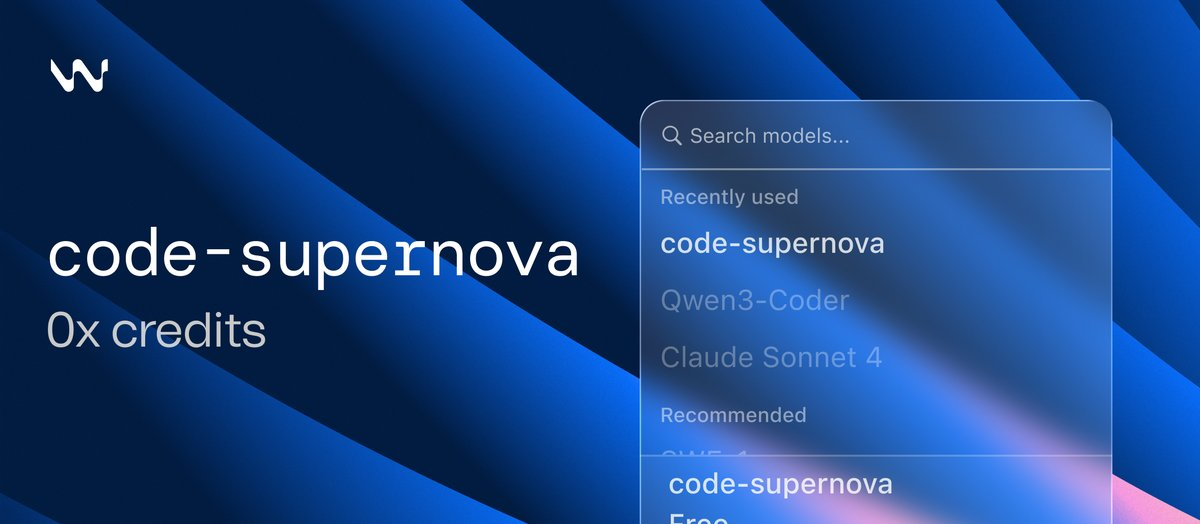
Recently, Code-Supernova, a new Stealth coding model, was launched. It features agentic coding capabilities and can automate tasks during the coding process, including tool invocation, file operations, and command execution. Its most notable feature is its support for image input, allowing it to directly interpret visual materials such as screenshots, design drafts, and flowcharts, and then combine them with text for code generation and problem solving. According to the official description, Code-Supernova boasts a context window of 200,000 tokens, enabling it to simultaneously process multiple files, large amounts of logs, and long-running tasks, making it particularly suitable for complex engineering development environments. The model is currently available on the Cline and Kilo Code platforms, and individual users can use it free of charge during the beta phase, with no call limits or throttling restrictions. As it is still in the alpha/stealth testing phase, future pricing and availability policies have not yet been announced. Frequently Asked Questions Q: What are the main features of Code-Supernova?
A: It supports image input, 200K token context, and features agentic coding, enabling multi-step coding and debugging tasks.
Q: How can Code-Supernova be used now?
A: It can be called from the Cline or Kilo Code platforms, and individual users can use it free of charge at this stage.
Q: What does the 200K context window mean?
A: The model can handle massive inputs and long outputs in a single session, supporting continuous analysis across files, long logs, and complex code bases.
Q: Is there a time limit for free use?
A: Yes, it is currently marked as free for a limited time, but fees may be charged or the calling policy may be adjusted in the future.
Q: Are there any indications that it is related to other known large models?
A: Some developers speculate that its capabilities are similar to Claude 4.5 Sonnet, but the specific underlying model has not yet been officially confirmed.