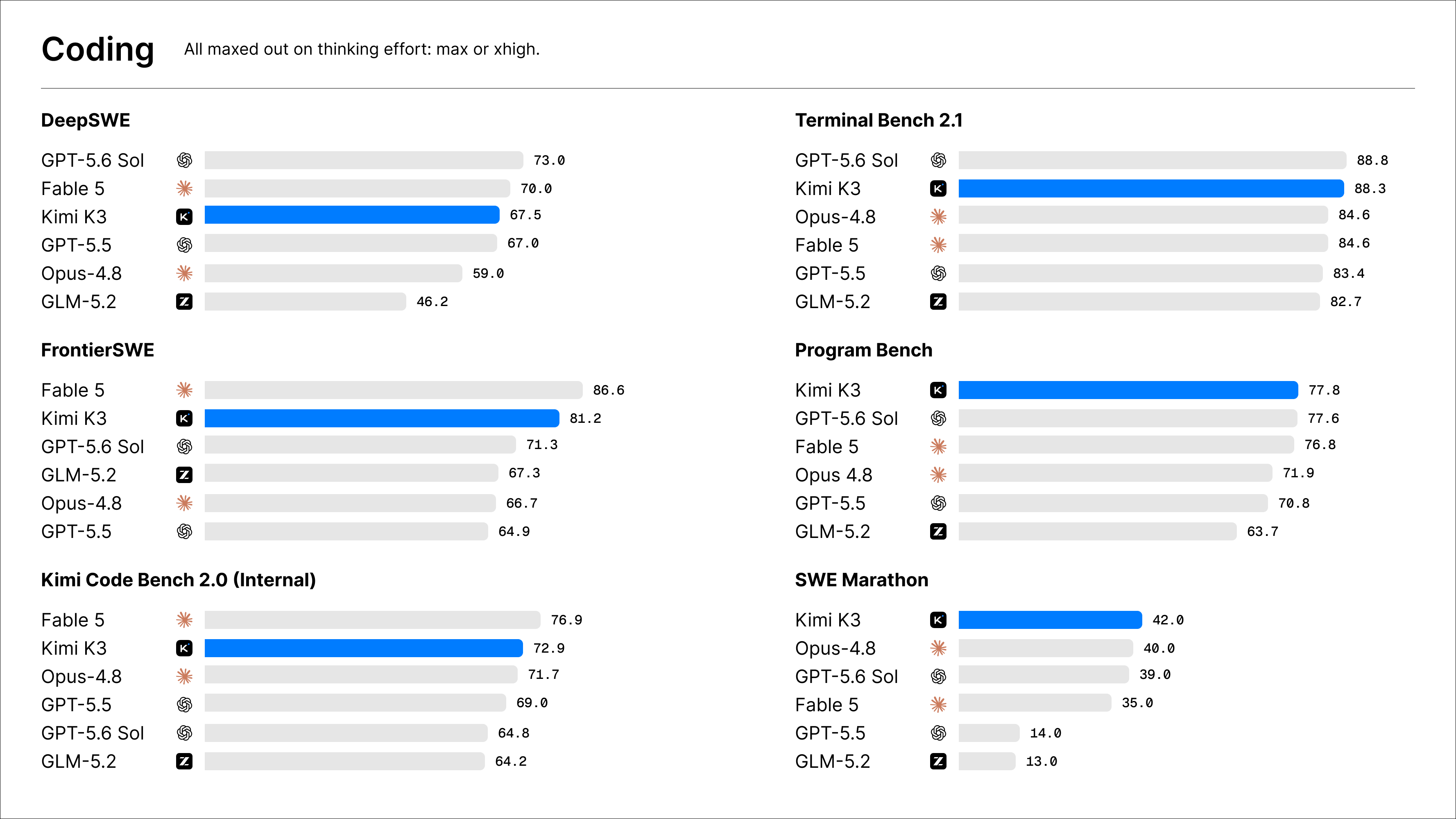
Moonshot AI officially launched the Kimi K3. This 2.8-trillion-parameter model provides 1 million token context and native multimodal capabilities, and is now available on Kimi.com, Kimi Work, Kimi Code, and Kimi API. The real news hook is not just about scale: it tries to place ultra-long context, reasoning efficiency, and long-term proxy tasks onto the same open weight route.
Millions of contexts first solve the speed
The bottleneck for ultra-long contexts is often not "whether it can fit," but decoding delays and cache costs. Kimi Delta Attention (KDA) uses hybrid linear attention, and the official statement states it can decode up to 6.3 times faster in million-token scenarios.
This brings the Kimi K3's 1 million context closer to continuous use, rather than just for spec display. Faced with large codebases, continuous research, and cross-document analysis, speed determines whether an Agent can truly complete its tasks.
Deep information flow lowers training costs
Another core design feature is Attention Residuals (AttnRes). It no longer simply accumulates layers of representation but selectively retrieves information of different depths; Official data states that the additional cost is less than 2%, and training efficiency is improved by about 25%.
Combined with Stable LatentMoE, Kimi K3 activates 16 out of 896 experts per token. Moon's Dark Side claims its overall scaling efficiency is about 2.5 times that of K2, with a focus on converting computing resources more efficiently into model capabilities.
Long-term agency has become the main battleground
Kimi K3 is designed for long-term proxy coding, knowledge work, and inference, capable of handling large codebases and calling terminal tools with minimal human intervention, while advancing front-end, game development, and CAD tasks through visual feedback.
This positioning also explains multi-platform synchronous deployment: models no longer just answer questions, but must continuously plan, execute, check, and correct within hours of workflow, supporting recursive self-improvement.
The weighting is scheduled to be released before July 27, 2026. Whether Kimi K3 can change the open model landscape depends not on the 2.8 trillion parameters itself, but on whether developers can turn millions of contexts and long-term agents into stable productivity at an acceptable cost.