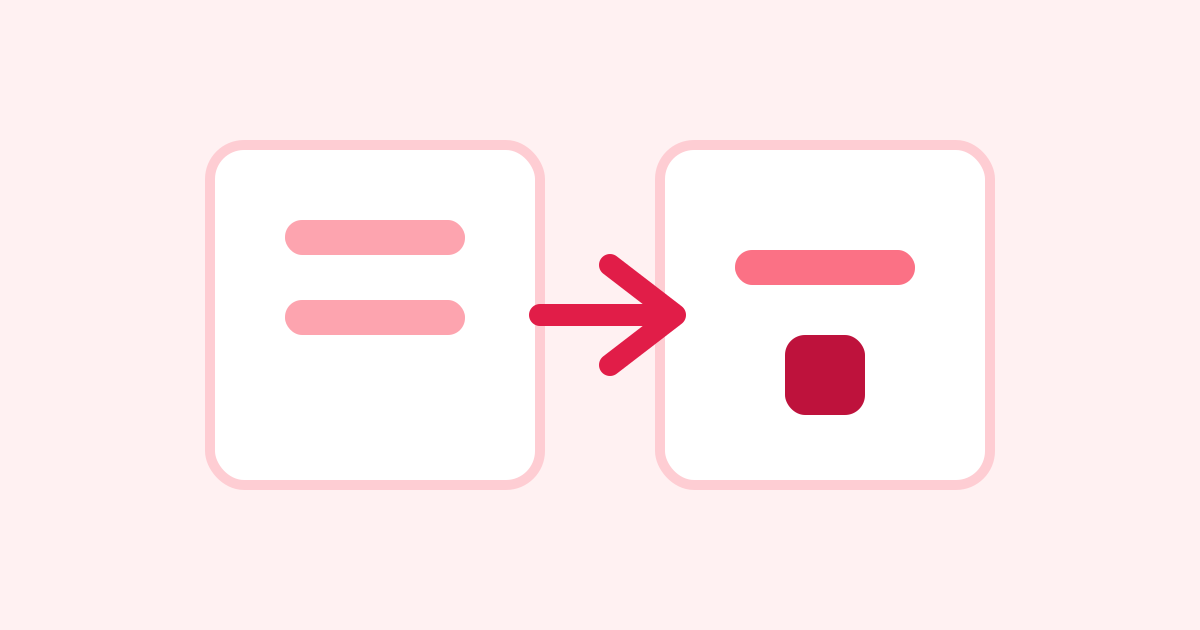
AI Native generally refers to a system designed around AI capabilities from the underlying logic, interaction methods, and workflow structure of the product, rather than "adding a chat box" or "adding a generate button" to the original software. This term has been mentioned more and more frequently recently because people have slowly discovered that the reason why many AI functions are not easy to use is not that the model is not strong enough, but that the product skeleton is still the skeleton of the old era.
To give the most intuitive example, stuffing AI into old software is to add a sidebar that allows users to copy the content themselves, ask a question, and copy it back. Of course, this can also be considered "using AI", but it is more like a plug-in. AI Native products think the other way around: If the system assumes that AI can understand the context and can draft, organize, track, and execute for you, should the entire workflow be reconstructed? Recently, many AI native writing, customer service, voice assistants, and research tools have been doing this.
Therefore, the key to AI Native is not whether there is a model or not, but whether AI becomes part of the main product process. It typically manifests itself in several characteristics: contextual auto-access rather than manual user copying; AI is not just about a single generation but about multi-step collaboration; Interfaces and interactions are designed around "getting things done together" rather than treating AI as a temporary plugin.
Why is this concept popular? Because users are no longer satisfied with "there is also a generate button here". In the past, everyone would pay for freshness, but now they are more concerned about whether the efficiency has really become higher. If a product with AI on the surface still requires users to move data, disassemble tasks, and spell results by themselves, the experience will soon return to the old process. What really makes people stay is often those products that deeply embed AI into the main link of the task.
However, AI Native is not a one-size-fits-all marketing word. Many products use it as a package, but in essence, it is just a deeper connection to the model API, and it does not refactor the way it works. To determine whether a product is AI Native, you can ask three questions: whether the AI truly grasps the context of the task; whether the AI participates in the main process rather than corner functions; After leaving AI, this product is almost untenable. If none of the three are true, then there is a high probability that it is only "AI-enabled", not "AI-native".
Another very realistic meaning of AI Native is organizational rework. It's not just a product plus a feature, it often means teams rewriting permissions, data flows, assessments, and collaboration processes. Because once AI participates in the core link, the original software boundaries and job boundaries will be rewritten.
So it's not surprising that the word will get hotter and hotter. It represents not a single technology, but a product paradigm shift: not to equip old systems with AI, but to acknowledge that many systems are worth redesigning from scratch.