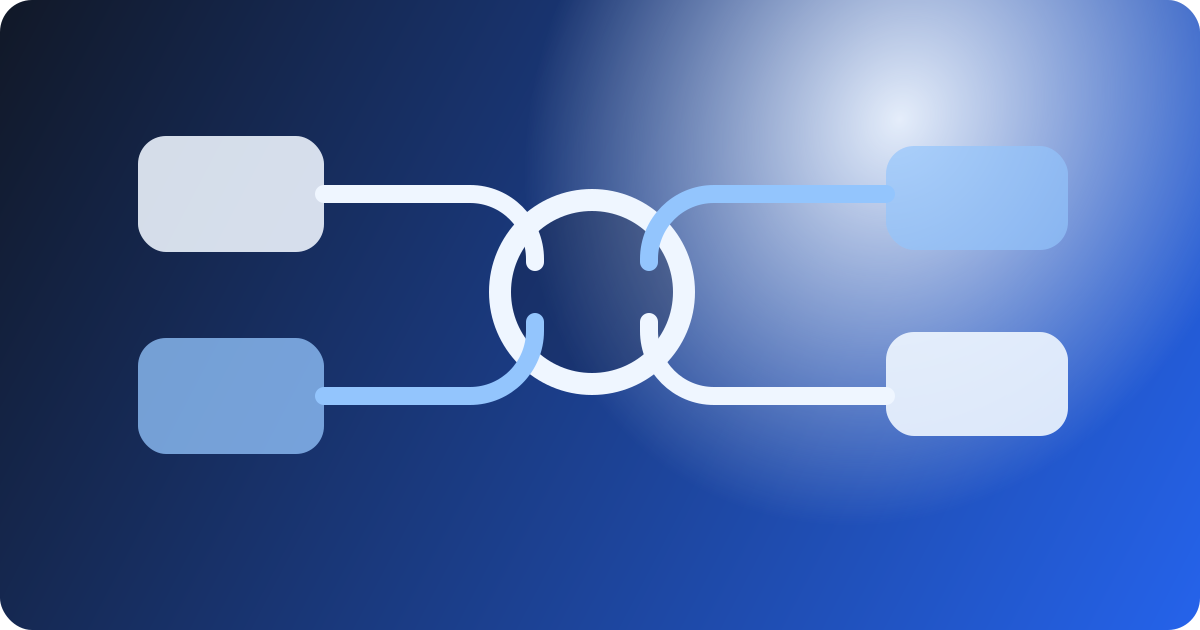
Model Router can be understood as a scheduling layer that "helps you decide which model to use first". It does not answer questions directly, but distributes requests to more suitable models or providers based on the type of task, budget, speed requirements, context length, tool requirements, etc. after the request enters the system. Recently, this concept has become more and more popular because multi-model has changed from a multiple-choice question to an operational question, and many products cannot rely on only one model to dominate the world.
In the early days, many teams were very straightforward: choose the strongest model and use it in all scenarios. The problem was quickly exposed. Simple tasks with the most expensive model, waste; Long context tasks give short window models and will crash; Real-time scenes that require low latency are slow models and have a poor experience. As a result, more and more teams began to add a router to the front of the model, allowing the system to triage first, and then decide who would answer.
A good Model Router usually combines several types of signals. For example, the question is whether it is code, whether it is math, whether it is a long document, whether it is a voice real-time task, which provider is currently cheaper or more stable, whether a model has triggered a current limit, and whether the context has exceeded the threshold. It is actually a real-time trade-off: finding a better solution between quality, cost, and latency.
This is also one of the differences between it and the model gateway. The gateway is an infrastructure entrance that is responsible for unified authentication, logging, billing, and compatible interfaces. The router is more decision-making and is responsible for "who will go this time". Of course, the two often appear together in the real system, so everyone will discuss them together.
Why is it now more and more like standard? Because the model ecology is too fast. New models are constantly coming out, prices are constantly changing, and the boundaries of capabilities are also changing. If the product still writes a dead order model, the iteration speed will be dragged down; Once the routing layer is independent, the team can more flexibly change models, do A/B, control costs, and do the bottom line. For enterprise applications, this is more realistic than simply chasing the strongest model.
But the router doesn't just add it. It requires evaluation criteria, fallback logic, monitoring, and historical data support. Routing rules that are written too deadly will make the system more and more complicated; Leaving it to another model for routing can add additional costs and latency. What's even more troublesome is that once the route is wrong, users usually only think "how did this product get stupid today", and rarely realize that there is a problem with the triage strategy.
Therefore, the popularity of Model Router shows that the industry's focus has shifted from "whether there are models available" to "how to organize multi-model capabilities". In the future, many AI products look like an assistant, but behind it is actually more like a scheduling system. Users only see the answer, and it is often the routing layer that really makes the decision first.