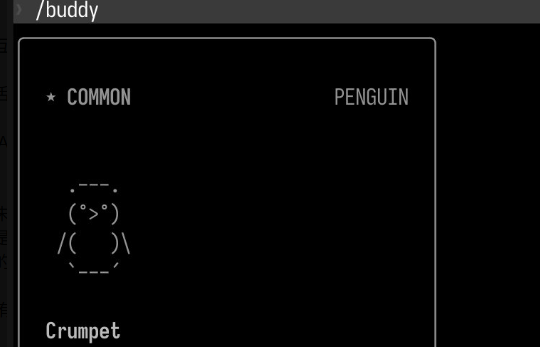
Claude Code has added theAI petfunction in version 2.1.89. After the user enters the/buddycommand, the system will generate an exclusive pet based on historical conversations. It looks like an April Fool's Day egg, but it's taken seriously: Developer tools are starting to integrate long-term memory, personality feedback and companionship into the main process.
The most intuitive part of the new feature is the little pet spelled out by ASCII characters. It is not exquisite or even a little rough, but precisely because it is light enough, it is more suitable for stuffing into command-line scenes. For developer-oriented products like Claude Code, complex vision is not the focus, but low-interference and sustainable interaction are the focus.
What is more interesting is the generation logic. Pets are not dropped randomly, but are customized based on historical conversations, which means that Claude Code is commercializing the matter of "who you are and how you work with AI." What the user gets is not just an ornament, but a figurative portrait of the person. There are five publicly visible attributes at this stage: Wisdom, Debugging, Chaos, Patience, and Snark. Judging by the interaction style, these values will likely change in real time with subsequent dialogues, but there is no more public information on the specific rules. This design is very similar to the nurturing system in a game, and also like a compressed version of the user portrait panel. The problem is not that "pets are not cute", but that Claude Code uses it to test a more convenient feedback mechanism. In the past, AI remembered user preferences often implicitly; now, memories and styles have been made into interface elements that can be seen, discussed, and ridiculed. For high-frequency users, this will significantly increase stickiness because every conversation is no longer isolated. Once this mechanism is introduced in developer tools, the competitive dimension will also change. In the past, the competition was about model capabilities, code quality, and response speed. In the next step, it was about "who understands users better" and "who can form relational inertia." When tools begin to have a continuous personality, replacement costs go beyond migrating commands and configurations. The most easily underestimated feature of this kind is that it has natural social communication attributes. A penguin named Crumpet and a set of variable attribute values are itself screenshots, showoffs, and comparable content. For product teams, this is easier to get out of circles than traditional update logs and bring the otherwise closed command-line experience to social media. Taking a step further, the real commercial space of AI pets is not necessarily as simple as "selling skin". As long as long-term memories continue to be strengthened, pets may evolve into users 'AI clones, carrying preferences, habits, collaboration styles, and even team identities. At that time, the imagination of forming teams, collaborating, leasing, and collecting will begin to have a realistic foundation. It is too early to talk about the trading market, but the outline of "personality capitalization" has emerged. A more realistic judgment is that AI pets may not explode in consumer-level applications first, but may run through high-frequency productivity tools first. Because developers are talking to AI for a long time every day, the relationship density is high enough, and the sense of cultivation is easier to establish. Pets are just entrances. What is really valuable behind them is the high retention and high reuse brought by continuous memory. Of course, an ASCII penguin cannot support Web 4.0, nor will it immediately bring about the revival of NFT, but it reminds the industry of one thing: the next round of AI product competition is not just about answering questions, but about who can turn "relationships" into interfaces and "memories" into assets. Public information is still relatively limited, and subsequent evolution is worth paying close attention to.