1. Abstract
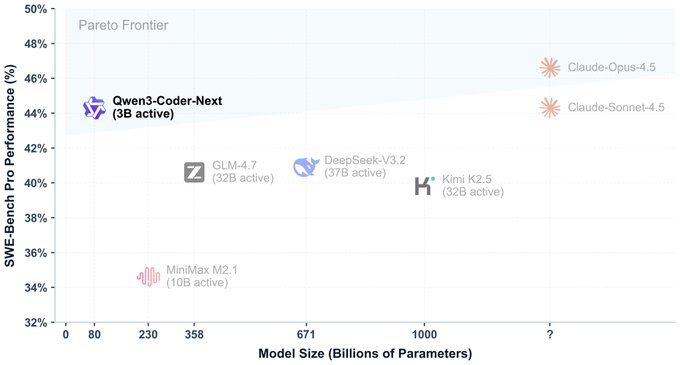
Qwen3-Coder-Next is an open-source weighted code model released by Qwen Team, which is suitable for coding agents and local development scenarios. Its core idea is "ultra-sparse MoE + agent training": the total number of parameters is about 80B, but only about 3B parameters are activated per token, supporting long-term, multi-round tool usage and code modification workflows with lower inference costs, and achieving strong performance in proxy coding evaluations such as SWE-Bench Pro.
2. Core features
- Ultra-sparse efficiency-performance trade-off: 80B total parameters and 3B activation, suitable for cost control for long sessions and multi-tool calls.
- Agent-based capability enhancement: Special training formulas have been made around long-link reasoning, the use of complex tools, and recovery after execution failure.
- Long context: Native 256K context, which can be expanded to 1M in combination with Yarn, for repository-level retrieval, cross-file changes, and dependency tracking.
- IDE/CLI scaffolding adaptation: Emphasizes compatibility with common Coding Agent scaffolding prompt and function call formats, covering terminal and IDE scenarios.
- Multiple deployment forms: In addition to BF16 weights, there are also distribution forms such as FP8 and GGUF that are closer to local operation and quantification (subject to built-in instructions and community implementation).
3. Installation
- Transformer inference: It is recommended to use the newer transformers version and load the tokenizer and causal LM according to the model card example for generation.
- vLLM local service: Install vLLM (the model card indicates that vllm is required>=0.15.0), you can launch OpenAI-compatible APIs, and enable tool selection and corresponding tool-call parser.
- SGLang service: You can use sglang to start the local endpoint and configure the tool call parser that matches the Qwen3-Coder series.
- Quantization/local lightweight: If using the GGUF/llama.cpp route, you need to prepare enough unified memory or video memory according to the quantization accuracy, and follow the running recommendations of the specific release page.
4. Typical use cases
- Repository-level refactoring: Include the entire codebase in a long context or "retrieval + long context" to complete cross-module renaming, interface migration, and dependency sorting.
- Automatic bug repair (including executable verification): Combined with the runnable environment, execute tests/scripts after generating patches, and self-repair iterations if they fail.
- Full-stack web development: From scaffolding creation, component development to building and deploying scripts, with browser/terminal tools to complete the closed loop.
- Multi-tool coding agent: Call the file system, shell, test framework and browser in the proxy framework such as Cline to achieve "reading code-modifying code-running test-commit changes".
5. Ecology and competing products
- Ecology: Officially provide collection pages and multiple weights in Hugging Face and ModelScope; The inference side covers common routes such as Transformers, vLLM, and SGLang. The proxy side emphasizes docking with scaffolding such as Claude Code, Qwen Code, and Cline.
- Competing products: Similar targets (Coding Agent/local development) also include other open source code models and sparse MoE route models. It is recommended to choose based on the type of task you want to run (bug fix, refactoring, web, test drive), context length, tool call stability, and local resource budget.
6. Limitations and precautions
- Long context cost: Even if 3B is activated, 256K/1M level context will still bring memory and throughput pressure; When a service fails to start, you can first reduce the maximum context (for example, to 32K).
- Tool call security: When performing shell/browser automation locally, it is recommended to use sandboxing, least privilege and network isolation to avoid accidental file deletion or credential leakage.
- Evaluate migrability: The performance of SWE-Bench Pro is not the same as the success rate of your private repository, so it is recommended to use the real project playback set for A/B verification.
- Quantization differences: Different quantization formats (FP8, 4-bit, GGUF, etc.) have a significant impact on accuracy and tool call stability, and need to be tested according to the scenario.
7. Project address
https://github.com/QwenLM/Qwen3-Coder
8. Frequently asked questions
Q: Is Qwen3-Coder-Next suitable for local Coding Agent to run for a long time?
A: The design goal is to reduce the inference cost of long sessions and multiple rounds of interaction, but it is still necessary to prepare enough memory/video memory based on context length and quantization accuracy.
Q: How is Qwen3-Coder-Next's 256K context used for "warehouse-level understanding"?
A: A common practice is to "retrieve (index/grep/embedding) + long context stitching key files", gradually converging the scope of changes in one or more rounds.
Q: How does Qwen3-Coder-Next integrate with vLLM's OpenAI-compatible interface?
A: Use vLLM to launch the local OpenAI-compatible service, enable automatic tool selection and specify the corresponding tool-call parser, and then call the endpoint by the proxy framework.
Q: Why does Qwen3-Coder-Next emphasize 800K verifiable tasks versus executable environments?
A: The core is to turn "write code" into a closed-loop training signal of "write code + run verification", so that the model is better at handling execution failures, missing dependencies, and multi-step repairs.