Back to AI information
Google DeepMind has released TranslateGemma: a family of open-source translation models that support 55 languages

Google DeepMind has released TranslateGemma: a family of open-source translation models that support 55 languages

AI information Admin 125 views

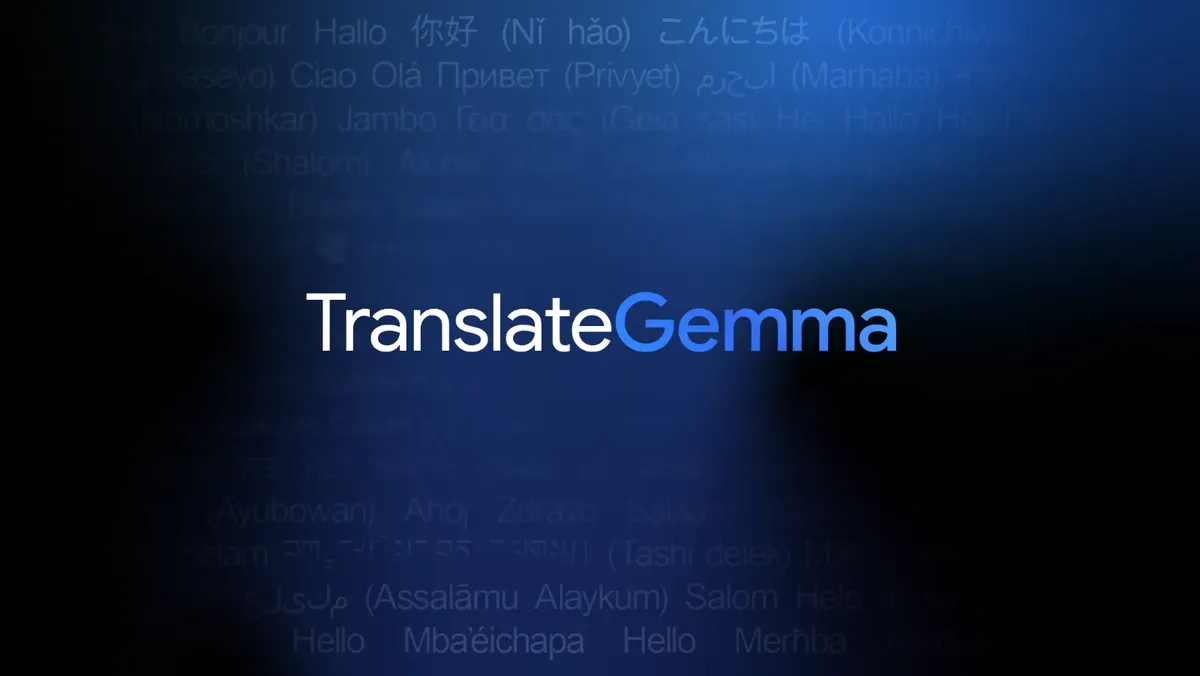
Google DeepMind announced the launch of TranslateGemma, a set of open-source models for machine translation that supports 55 languages and offers three parameter scales: 4B, 12B, and 27B. According to the official introduction, these models are based on the Gemma 3 architecture, focusing on improving the performance of translation tasks while taking into account deployment efficiency in different computing environments such as mobile phones, laptops and clouds.

According to the technical report, TranslateGemma uses a two-stage training process, including supervised fine-tuning and reinforcement learning optimization, and improves compared to the basic Gemma 3 model in benchmark evaluations covering 55 languages. Model weights and descriptions are available on platforms like Hugging Face, and related entries are also available in Google Cloud's Vertex AI Model Garden. Due to the large differences between languages and fields, actual use still needs to be verified and tested in combination with specific languages, terminology consistency, and data compliance requirements.

FAQs

Q: What company is TranslateGemma published?

A: TranslateGemma is released by Google DeepMind and is available as an open-source model.

Q: What language ranges does TranslateGemma support?

A: According to public information, TranslateGemma covers translation tasks in 55 languages.

Q: What model sizes are available for TranslateGemma?

A: TranslateGemma offers three parameter scales: 4B, 12B, and 27B, catering to different deployment needs.

Q: What use cases is TranslateGemma suitable for?

A: TranslateGemma is suitable for multilingual content localization, cross-language search, and customer service translation, but it still needs to be evaluated for terminology accuracy in specialized fields.

Q: Is TranslateGemma a direct replacement for commercial translation services?

A: TranslateGemma is more of a self-deployable open-source model solution, and the effect and cost depend on the language, hardware, and subsequent fine-tuning configuration.
Google DeepMind's open-source TranslateGemma: 55-language translation model is here TranslateGemma Released: A dedicated model for machine translation based on Gemma 3 Google DeepMind launches TranslateGemma with three gears 4B12B27B to cover deployment requirements TranslateGemma focuses on mobile to cloud-to-deployable open-source translation models, which attract attention TranslateGemma technical report discloses two-stage training SFT+RL enhancement translation TranslateGemma compared to the base Gemma 3 translation benchmark improvement, but it still needs to be measured Google DeepMind bets on the open source machine translation ecosystem with TranslateGemma TranslateGemma supports 55 languages and verifies how to implement multilingual translation capabilities TranslateGemma open-source authority is online, and Hugging Face developers can deploy it themselves TranslateGemma is synchronized into the Vertex AI Model Garden cloud call is more convenient How to choose the three parameter scales of TranslateGemma, 4B12B27B, each has its own trade-offs TranslateGemma is geared towards localization and customer service translation, but terminology consistency is key Whether TranslateGemma can replace commercial translation services depends on the language and fine-tuning cost Google DeepMind's open-source TranslateGemma releases a new signal of translation model competition TranslateGemma enhances translation performance while emphasizing efficiency and multi-end deployment as a selling point TranslateGemma covers 55 languages, but the low resource language effect is still to be disclosed What are the costs and benefits behind TranslateGemma's reinforcement learning optimization translation quality? TranslateGemma's open source brings controllable compliance benefits, but data governance is still a threshold TranslateGemma adapts to mobile phones, notebooks, and cloud computing power differences emphasize engineering TranslateGemma is based on Gemma 3. The architecture is designed for translation optimization and general model division TranslateGemma weights and explanation: Can the open source translation model be reproduced? TranslateGemma improves in multilingual benchmarking but warns of domain migration risks TranslateGemma is used for cross-language search, and task-level verification is still required Google DeepMind uses TranslateGemma to complete the puzzle of the open-source translation model The TranslateGemma 4B model focuses on whether the end-side translation is sufficient TranslateGemma 27B large model sprint translation quality, how to calculate the cloud cost The TranslateGemma 12B balancing scheme is the main force depends on the actual throughput How companies do terminology consistency and quality evaluation after the release of TranslateGemma TranslateGemma's open-source model means reducing costs or increasing the burden for localization teams TranslateGemma vs Gemma 3. Compared with the translation improvement point, SFT or RL TranslateGemma's two-stage training route is trained as standard after exposing the open-source translation model How to pass the privacy and compliance of TranslateGemma's landing customer service translation scenario Whether TranslateGemma multilingual content localization can reduce outsourcing dependencies leads to discussion TranslateGemma is available on Hugging Face, but the licensing and commercial boundaries need to be clear TranslateGemma on Vertex AI Model How will the Garden cloud ecosystem spread? TranslateGemma emphasizes deployment efficiency, but real latency and cost still need to be tested TranslateGemma is suitable for cross-border e-commerce multilingual operations, but the professional field still needs to be fine-tuned The rise of TranslateGemma's open-source translation model has increased the pressure on commercial translation services TranslateGemma supports 55 languages, but whether it includes dialects is a concern Can TranslateGemma's optimization for machine translation surpass general large models? How developers evaluate the difference between BLEU and real readability after TranslateGemma is open-sourced TranslateGemma is used for cross-language customer service to prevent hallucinations and mistranslation risk management TranslateGemma's terminology consistency problem still requires self-built thesaurus and constraint decoding TranslateGemma release ignites the imagination of end-side translation, but hardware adaptation is a key variable TranslateGemma has open source weight in place, enterprises can be privatized and deployed, but data compliance comes first TranslateGemma vs. Business API Core is controllable rather than one-click The training data coverage behind the improvement of TranslateGemma translation evaluation is still the deciding factor TranslateGemma's open-source translation model is suitable for developers or enterprise localization teams Google DeepMind TranslateGemma is launched: open-source machine translation enters the multi-terminal era The biggest suspense after the release of TranslateGemma: 55 language consistency and long-term maintenance

Recommended Tools

More