1. Open Source and Access
MiMo has opened weights and supporting data. Priority is given to obtaining models (including MiMo-V2-Flash/Base, etc.) on the XiaomiMiMo organization page of Hugging Face, and technical reports and some code are available on GitHub; Online Studio and API platform portals are also available.
2. Technical Architecture and Data
MiMo-V2-Flash uses MoE:309B general parameters and about 15B activation parameters, focusing on efficient inference and agent workflow. Hybrid slides/global attention are used on the architecture to reduce KV caching and introduce lightweight multi-token prediction (MTP). The official disclosure of the pre-training scale is 27T tokens, but a more detailed list of data sources has not been disclosed. Post-training emphasizes multi-teacher distillation and Agentic RL, which will generate a large amount of task trajectory data.
3. Speed efficiency and deployment
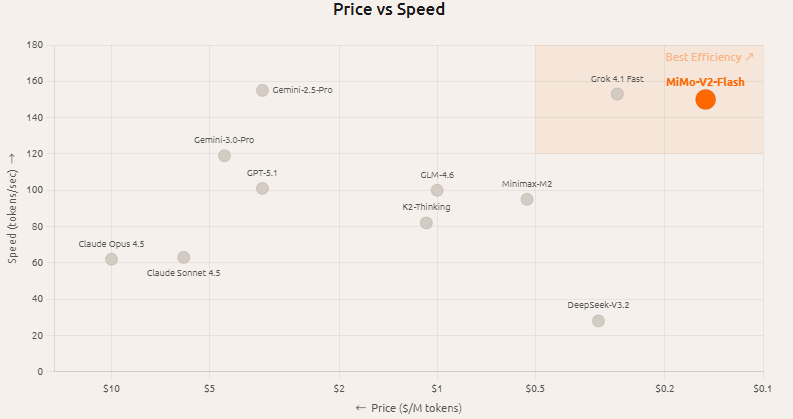
Hybrid attention can significantly reduce KV occupancy, MTP is used to increase output speed, and the overall is more "low-cost and high-throughput". Deployment can use SGLang and other solutions, and local operation can be combined with parallel and quantization to lower the threshold.
4. Comparison and ecological implementation
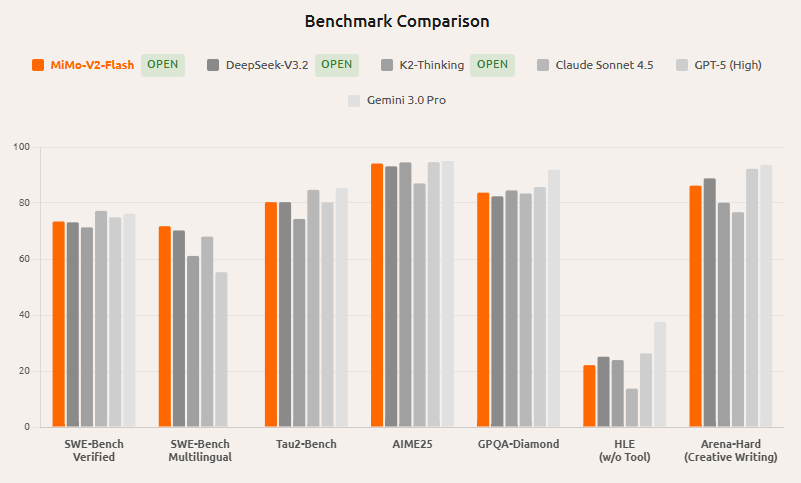
Compared with closed-source models such as GPT, MiMo's advantages lie in open weight, privatized deployment, and controllable costs. In the official comparison benchmark, the reasoning/code performance is outstanding, but whether the writing class and general ability are on par still need to be measured under the same conditions. The landing is more in line with the entrance of Xiaomi's "people, cars, and homes" system: home device linkage, in-car voice and navigation Q&A, cross-device task orchestration, developer agent toolchain, etc.
5. Q&A Frequently Asked Questions
Q: Can MiMo be commercially available?
A: The license marked on the model page and repository shall prevail; For example, some weights are labeled as MIT, which is generally allowed for commercial use, but still subject to terms and compliance requirements.
Q: How will MiMo be used in smart homes and cars?
A: It is more like a HyperOS/system-level AI base, which connects "Q&A + control + automation" to home appliances and car scenarios through unified protocols and agent orchestration.
Q: How can I verify if it is a better fit than GPT?
A: Using your real task set to do offline A/B, comparing tool success rate, hallucination rate, latency and unit cost is more reliable than a single benchmark.