Back to AI information
MiMo-V2-Flash released: 256K long context and multi-token prediction to improve inference throughput

MiMo-V2-Flash released: 256K long context and multi-token prediction to improve inference throughput

AI information Admin 128 views

Xiaomi MiMo and the Xiaomi large model Core team have released and opened MiMo-V2-Flash-related resources, positioning it as a basic language model for high-speed reasoning and agent workflows, and the model weight and inference deployment data are provided to developers and researchers simultaneously.

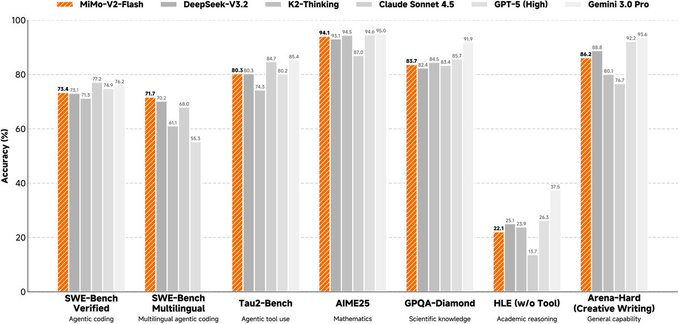
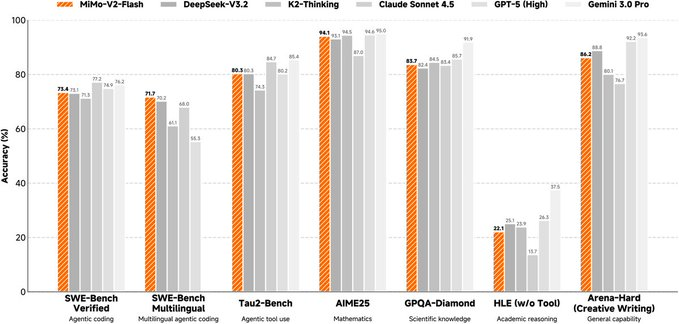
The model is a Mixture-of-Experts (MoE) architecture with a total parameter of about 309B, activation of about 15B during inference, and supports a maximum context length of about 256K. Its mixed attention design intertwines sliding window attention with global attention in proportion, and uses a smaller window to compress KV cache overhead. At the same time, a lightweight multi-token prediction (MTP) module is introduced to improve the decoding output speed, and the official also provides additional multi-layer MTP weights for community research. The model page and repository provide training and post-training points (including FP8 mixed precision and agent-oriented reinforcement learning/distillation routes), and list multiple evaluation results for comparison.

It should be noted that such ultra-large-scale MoE models have high requirements for computing power and inference frameworks, and the evaluation results and actual business effects may be affected by prompts, tool chains, and parallel quantification and inference strategies. Before commercial use and redistribution, you should also check the specific license terms and scope of the model page and code repository.

FAQ

Q: What type of model is MiMo-V2-Flash?

A: MiMo-V2-Flash is a MoE basic language model released by the Xiaomi MiMo team, which is aimed at high-speed inference and agent task scenarios.

Q: What is the parameter size and context length of MiMo-V2-Flash?

A: Public information shows that its total parameters are about 309B, activation is about 15B, and it supports a maximum context length of about 256K.

Q: What problems does the MiMo-V2-Flash mainly solve with "mixed attention" and MTP?

A: Mixed attention focuses on reducing the KV caching cost of long context inference, while MTP focuses on improving output throughput and speed in the decoding stage.

Q: Where can I get the model weights and technical reports for MiMo-V2-Flash?

A: Model weights are available on Hugging Face, code and technical reports are available in the GitHub repository, and the official website blog and LMSYS articles are also organized.

Q: What is the most common pit for MiMo-V2-Flash to step on when deploying?

A: Common issues include insufficient memory/bandwidth, incomplete inference framework support for MoE and MTP, and improper quantization and parallel configuration leading to speed or quality fluctuations.

Xiaomi released a full analysis of MiMo-V2-Flash open source resources Xiaomi MiMo-V2-Flash focuses on high-speed inference agents MiMo-V2-Flash opens up weight and inference deployment data The Xiaomi Core team has revealed the key points of MiMo-V2-Flash technology MiMo-V2-Flash adopts MoE architecture parameters and scale MiMo-V2-Flash total 309B activation 15B instructions MiMo-V2-Flash supports 256K contextual long-text inference MiMo-V2-Flash Hybrid Attention Reduces KV caching costs How the MiMo-V2-Flash sliding window is intertwined with global attention MiMo-V2-Flash How to save attention in small windows MiMo-V2-Flash Lightweight MTP for improved decoding throughput MiMo-V2-Flash multilayer MTP weight open study MiMo-V2-Flash post-training training route with FP8 essentials MiMo-V2-Flash Reinforcement Learning Distillation is agent-oriented MiMo-V2-Flash Review Results Comparison and Interpretation Guide MiMo-V2-Flash deployment computing power threshold and framework requirements Key points to check the pre-commercial license terms of MiMo-V2-Flash Analysis of the impact effect of MiMo-V2-Flash inference parallel strategy MiMo-V2-Flash quantifies the causes of fluctuations The impact of MiMo-V2-Flash prompts on business performance is explained MiMo-V2-Flash toolchain selection and implementation suggestions MiMo-V2-Flash Solution to Insufficient Memory Bandwidth MiMo-V2-Flash Inference Framework MoE Support Checklist The MiMo-V2-Flash inference framework MTP supports verification methods MiMo-V2-Flash Long Context KV Cache Optimization Practice MiMo-V2-Flash agent workflow base model positioning Analysis of the difference between MiMo-V2-Flash and traditional dense model What key information is included in the MiMo-V2-Flash open source repository? MiMo-V2-Flash Technical Report Access and Reading Methods How to obtain MiMo-V2-Flash weights and download suggestions MiMo-V2-Flash is organized by Hugging Face resources A quick tour of the contents of the MiMo-V2-Flash GitHub repository MiMo-V2-Flash official blog and LMSYS entrance summary MiMo-V2-Flash FAQs are answered clearly What type of model and application scenarios is MiMo-V2-Flash? MiMo-V2-Flash parameter scale, context length, and full combing How the MiMo-V2-Flash hybrid attention mechanism works The logic of the MiMo-V2-Flash MTP module to increase speed Reasons for the difference between MiMo-V2-Flash and online results MiMo-V2-Flash service is the easiest to take stock of Configuration recommendations for MiMo-V2-Flash multi-machine parallel deployment MiMo-V2-Flash Throughput and Latency Optimization Roadmap What MiMo-V2-Flash Open Source Means for Developers The MTP research value of MiMo-V2-Flash for researchers MiMo-V2-Flash Agent-oriented post-training strategy MiMo-V2-Flash Licensing and Redistribution Compliance Considerations MiMo-V2-Flash inference deployment data synchronization release highlights MiMo-V2-Flash high-speed inference and long-context analysis Key takeaways from training to deployment of MiMo-V2-Flash

Recommended Tools

More