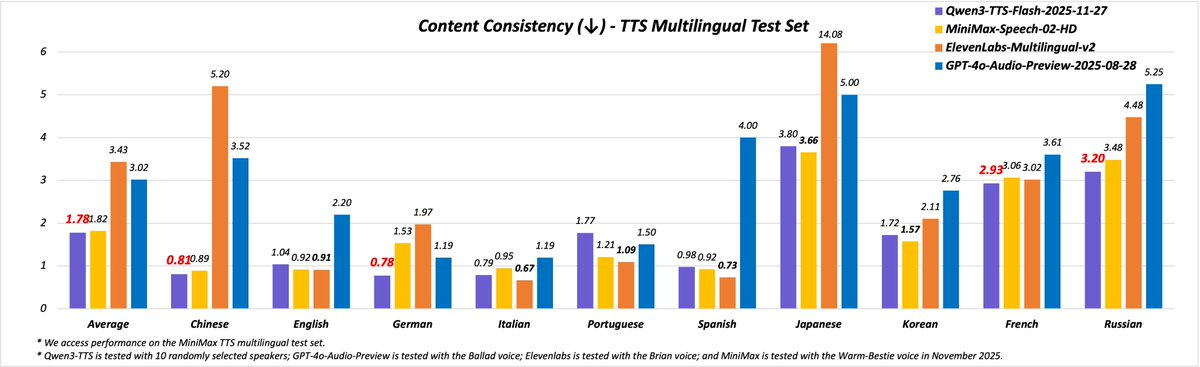
Alibaba's Tongyi team released a new version of the speech synthesis model Qwen3-TTS (2025-11-27), focusing on comprehensive upgrades around timbre richness, multilingualism and naturalness. Officially, this version provides more than 49 high-quality tones, from lively and cute to stable and serious, covering a variety of application scenarios, and users can choose the sound that is more in line with the brand and content temperament according to their needs.
In terms of language and dialect support, the new version of Qwen3-TTS has covered ten languages: Chinese, English, German, Italian, Portuguese, Spanish, Japanese, Korean, French and Russian, and added Hokkien, Wu, Cantonese, and Sichuan, Beijing, Nanjing, Tianjin, Shaanxi and other local accents. The model's control of speech speed, pauses, and tone is further refined, emphasizing the ability to automatically adjust the rhythm according to the text and context, enhancing the "sense of reality".
Qwen3-TTS is now directly experienced through Qwen Chat's "Read and Reply" function, and simultaneously opens real-time APIs and offline APIs, making it easy for developers to embed voice capabilities into various applications. The official also launched an online demo on the Hugging Face and Magic Partnership community, making it convenient for users to quickly try out different timbres and language effects.
Frequently Asked Questions
Q: What is the version number of this Qwen3-TTS update?
A: This is the 2025-11-27 version, which has made important upgrades in terms of timbre quantity, multilingualism, and naturalness.
Q: What languages and dialects are currently supported?
A: It supports 10 languages, including Chinese, English, German, Italian, Portuguese, Japanese, Korean, French, and Russian, and covers Hokkien, Wu, Cantonese, and Chinese accents in many places.
Q: How do regular users experience the new model?
A: You can listen directly to Qwen Chat through the "Read and Reply" function, or you can visit the official online demo page.
Q: What is the difference between the Realtime API and the Offline API?
A: Realtime API is suitable for latency-sensitive online interaction scenarios, while Offline API is more suitable for batch generation or offline processing, making it easy to integrate into your own services.
Q: How can developers integrate Qwen3-TTS into their applications?
A: You can access the real-time or offline API provided by Alibaba Cloud ModelStudio and configure the model parameters and authentication information according to the document.